
The total value of companies in the private credit market has increased over the last year but the quality of much of the debt they have issued has declined, according to an analysis by Lincoln International, an investment bank advisory service that monitors that market. The new data sheds some light on a $3 trillion market that has recently been unnerved by Blue Owl Capital’s decision to ban retail investors from cashing out of one of its private debt funds, in favor of returning their money through episodic payments as it liquidates assets. Shares in Blue Owl fell 6% on that news. Lincoln looked at 7,000 company valuations, using data from over 225 asset managers globally, within its Private Market Index. It found:
- The enterprise value of the companies in the $250 billion index increased by 1.9%.
- Growth in earnings before interest, taxes, depreciation and amortization (Ebitda) among companies that have issued private debt is in decline, largely because the number of high-growth companies is in decline, lowering the average level of profitability across the index.
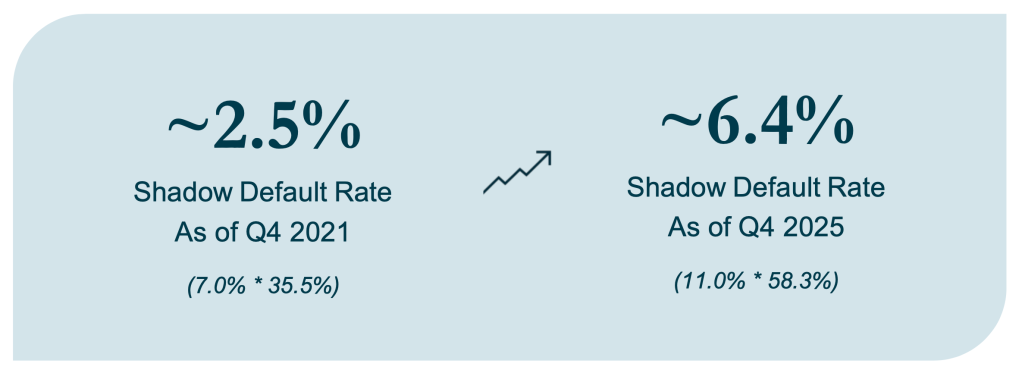
- The “shadow default” rate — meaning the percentage of companies that took on unexpected extra lending conditions midway through the terms of their deals — increased from 2.5% of all deals to 6.4% over the last year.
- Company leverage (the amount borrowed against the Ebitda of the company) should have declined over time as borrowers work off their loans but in fact it has gone up recently, eating into returns for lenders.
- A decline in interest rates offered by the Fed plus excessive demand for private credit investments has reduced yields for investors.
Ebitda growth in Q4 2025 was 4.7%, down from the record high of 6.5% in Q2 2025. That occurred because of a decline in the number of high-growth companies, according to Brian Garfield, Lincoln’s managing director and head of U.S. portfolio valuations. 57.5% of companies had earnings growth of 15% or more back in 2021. Today, only 48.2% of companies are that profitable — implying that nearly 10 percentage points-worth of high-growth companies have slipped into a lower-growth mode, Garfield said.
“There’s essentially a slowing of growth that’s occurring, and that’s just a takeaway of what might come,” Garfield said. It’s not clear why profit growth is slowing, Garfield said, but tariffs could be one factor.
Good PIK, bad PIK
The portion of companies utilizing “PIK” — a term describing riskier debt — rose to 11%, up from 10.5% the year before and up from 7% in 2021. “PIK” stands for “payments in kind.” A PIK provision means a company has agreed to make extra payments if it cannot pay the interest on the debts initially agreed to.
Of the companies with PIK, 58.3% had “Bad PIK,” indicating the PIK provision was inserted unexpectedly into the deal midway through the course of the agreement — generally a negative sign.
The “shadow default rate” in Lincoln’s index — meaning the percentage of companies carrying bad PIK — more than doubled from Q4 2021 when it was 2.5% of all deals to 6.4% in Q4 2025.
The rise in shadow defaults isn’t inherently alarming, Garfield says. Private credit is a risky market and lenders know in advance that a percentage of all their bets will end in some kind of default.
Yields in decline
Rather, the decline in yield for investors will be more of a concern, he says.
Interest rates on private credit are based on the Fed’s Secured Overnight Financing Rate (SOFR) plus an additional “spread” to reward investors for taking the risk.
At the peak of the market, SOFR was around 5.4% and investors were demanding a further 6% on top of that, for yields totalling 11% or more. Today, SOFR is priced at 3.73% and a typical all-in yield is only 8.5%, Garfield said.
The spread above SOFR has declined because more investors have entered the market chasing private credit deals, allowing companies to insist on more favorable terms.
“The real input that’s going to be impacting your returns is going to be the pricing, not a 6% default,” Garfield said.
“There’s a lot of capital in the market, all chasing high-quality deals, so the competition is causing the compression [of yields] to occur.”
The post In the $3 trillion private credit market, the ‘shadow default’ rate is increasing as more money chases lower-quality deals appeared first on Fortune.