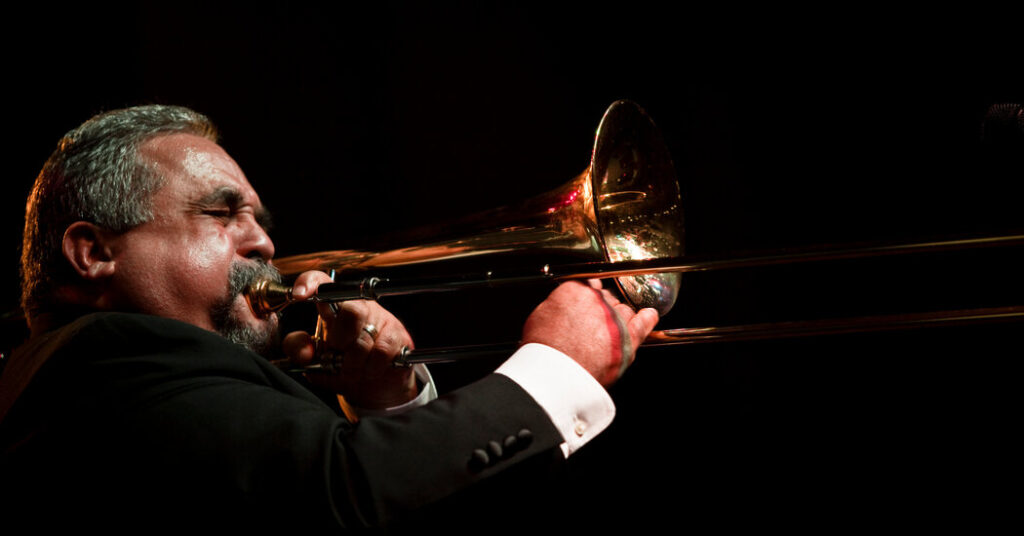
The music that the world now knows as salsa would probably not exist if not for the vision of Willie Colón. While Eddie Palmieri’s La Perfecta had been plying the two-trombone sound for years, Colón made the instrument central to his band, and the instrument’s ornery, sarcastic, yet often uplifting sound defined not only salsa’s break from the Cuban tradition, but the Nuyorican generation’s countercultural moment.
Colón, who died on Saturday at 75, began his career leading a “kiddie band” playing bugaloo at clubs all over the South Bronx, but everything changed when the Fania Records co-founder Johnny Pacheco suggested he take on Héctor Lavoe, a recent migrant from Puerto Rico, as his lead singer. The two bonded over their shared street roots, creating a gangster image for their album covers that predated hip-hop. But their musical impact derived from fusing Colón’s R&B and jazz-influenced style with Lavoe’s traditional jíbaro and bolero roots. Lavoe’s inability to sing well in English prompted Colón to abandon bugaloo, allowing his band to become an indispensable part of Fania’s 1970s salsa explosion.
Lavoe’s erratic lifestyle eventually resulted in a pseudo-breakup between the two, with Colón leaving his own band and producing their albums, and Lavoe remaining as lead singer. Colón’s production took center stage in his work with the Cuban vocalist Celia Cruz, and finally, his collaboration with Rubén Blades. “Siembra,” the culmination of his Lennon-McCartney-like partnership with Blades and perhaps his own career, became salsa’s biggest selling and most critically appraised album.
Colón went on to a successful solo career, scoring a few significant hit singles, and playing internationally to throngs of devoted loyalists until his death.
Here are 14 essential examples of Colón’s work as a bandleader, vocalist and producer. (Listen on Spotify or Apple Music.)
‘El Malo’ (1967)
Colón’s first album, “El Malo,” signaled his transition to the rapidly coalescing Fania salsa sound. The title track is an anthem, claiming ownership of the barrio by defining the courage to fight as having “heart,” and dissing pretenders who can’t dance. Bugaloo excursions like “Willie Baby” and “Skinny Papa” share space with Afro-Cuban guaracha and guaguancó on “Borinquen” and “Chonqui.” Colón’s trombone incessantly provokes and distorts as if blown through a bank of Marshall amplifiers.
 Listen on Spotify, Apple Music or YouTube
‘Asalto Navideño’ (1970)
Always looking for new directions, Colón decided to take a break from salsa’s rapid evolution to make this collection of aguinaldos, traditional Christmas songs, for the 1970 holiday season. “Asalto Navideño” allowed Lavoe to dig deep in his reserve of nasal jíbaro vocalizing while also introducing Yomo Toro, who became known as the Jimi Hendrix of cuatro, a rustic stringed instrument. The album is still a holiday fixture in households in San Juan and the Puerto Rican diaspora.
Listen on Spotify, Apple Music or YouTube
‘Barrunto’ (1970)
Written by Tite Curet Alonso, one of salsa’s master songwriters, “Barrunto,” from the album “La Gran Fuga,” is a brooding, prophetic track that makes a lost-love song a metaphor for Puerto Rico’s continually precarious state. With Colón and Torres’s piano narrating in counterpoint, you can feel Lavoe’s anguish, melancholy and disillusionment. “If yesterday was happiness, today is sadness,” he sings, echoing “A Felicidade” from the film “Black Orpheus,” knowing a storm is coming from the smell of rain in the wind.
Listen on Spotify, Apple Music or YouTube
‘Che Che Colé’ (1969), ‘La Murga’ (1970) and ‘Ah-Ah/O-No’ (1972)
One of Colón’s lesser-noted contributions to salsa was his experimentation with non-Cuban rhythms on songs that became some of his biggest hits. “Ah-Ah/O-No,” from “El Juicio” features a whole new melodic feel for Lavoe’s vocals while floating on Puerto Rican bomba sicá rhythms. “La Murga,” a song Colón heard on his first trip to Panama City, sneaks into the “Asalto Navideño” album and “Che Che Colé” is based on a Ghanaian children’s song.
Listen on Spotify, Apple Music or YouTube Listen on Spotify, Apple Music or YouTube Listen on Spotify, Apple Music or YouTube
‘Lo Mato’ (1973)
The album’s cover, a parody of a National Lampoon issue, conveys the wacky instability of Colón and Lavoe on the road, where they often got into fights with clubgoers. Their sound was coming together in explosive fashion, with Colón writing unforgettable trombone melodies, playing off Professor Joe Torres’s edgy piano figures and Milton Cardona’s santería-inflected conga. “Calle Luna, Calle Sol” is a vehicle for Lavoe’s ascension into bad boy heaven. Don’t miss an underrated track: the samba-ish “La María,” with its haunting melody lamenting a shared love affair.
Listen on Spotify, Apple Music or YouTube
‘Pena de Amor’ (1975)
In 1975, Colón tracked down one of his early influences, the plena/pachanga bandleader Mon Rivera, in Puerto Rico and made the album “There Goes the Neighborhood.” (Rivera’s collaboration with the trombonist Barry Rogers in the early 1960s convinced Colón to switch from trumpet to trombone.) “Pena de Amor” is its most memorable track, a celebratory bomba tune about love’s inevitable straying into pain.
Listen on Spotify, Apple Music or YouTube
‘Usted Abusó’ (1977)
When Colón decided to leave his band to Lavoe in 1974, he sought out new vocalists, including the Cuban diva Celia Cruz, with whom he collaborated on “Only They Could Have Made This Album” in 1977. While the whole LP is peak Fania-era salsa, “Usted Abusó” is transcendent both in its seamless production and as a feminist anthem. Ironically, the song was originally written by two Brazilian composers from a male perspective.
Listen on Spotify, Apple Music or YouTube
‘El Baquiné de los Angelitos Negros’ (1977)
An all-instrumental 1977 soundtrack to a ballet performed on “Realidades,” a television series broadcast on PBS, “El Baquiné de los Angelitos Negros” allows Colón to explore orchestral arrangements of a wide variety of Afro-Caribbean rhythms. Based on the Afro-Caribbean ritual funeral wake for a child who dies at a young age, it is an avant-garde take on sacred tradition.
Listen on Spotify, Apple Music or YouTube
‘Siembra’ (1978)
A concept album in the tradition of classic rock, “Siembra” was the arrival of “conscious salsa,” with cinematically crafted songs, co-written by Blades and Colón, that raised street stories to social justice commentary. Featuring “Pedro Navaja,” a song with roots in Kurt Weill’s “The Threepenny Opera,” and “Plástico,” an anthem attempting to unite Latinos around anti-consumerist enlightenment, the album succeeded wildly beyond expectations. The roll call of Latin American nations at the end of “Plástico” was a precursor to Bad Bunny’s flag-waving Super Bowl finale.
Listen on Spotify, Apple Music or YouTube
‘Canciones del Solar de los Aburridos’ (1981)
Colón and Blades ended their partnership as Blades entered into disputes with Fania over royalties, and this album was put together to satisfy the Panamanian singer’s remaining obligations to the label. Far from a throwaway compilation, it’s packed with some of their best work, like “Tiburón,” a protest against United States intervention in Central America, “Te Están Buscando,” a sarcastic barrio revenge story, and “Ligia Elena,” about anti-Black racism in a middle-class Latin American family.
Listen on Spotify, Apple Music or YouTube
‘Oh Qué Será?’ (1981)
After the breakup with Blades, Colón set out to prove he could record albums as a lead singer, engaging in direct competition with his former collaborator. Holding his own despite some criticism, Colón scored a hit with this cover of a Chico Buarque proto bossa nova song, featured on the album “Fantasmas,” layering it with a phalanx of heavy strings and a dreamy version of salsa beats.
Listen on Spotify, Apple Music or YouTube
‘El Gran Varón’ (1989)
Written by the Panamanian composer Omar Alfanno, “El Gran Varón” represented a bold move by Colón to shed a light on the L.G.B.T.Q. community during a period of intolerance because of the AIDS epidemic. It’s a straightforward narrative about a trans person whose father visits in the hospital and struggles to recognize them. The character’s tragic death, which is not explicitly attributed to AIDS, generated compassion in a salsa world thoroughly dominated by ultra-masculinity.
Listen on Spotify, Apple Music or YouTube
The post Willie Colón: 14 Essential Songs and Albums appeared first on New York Times.