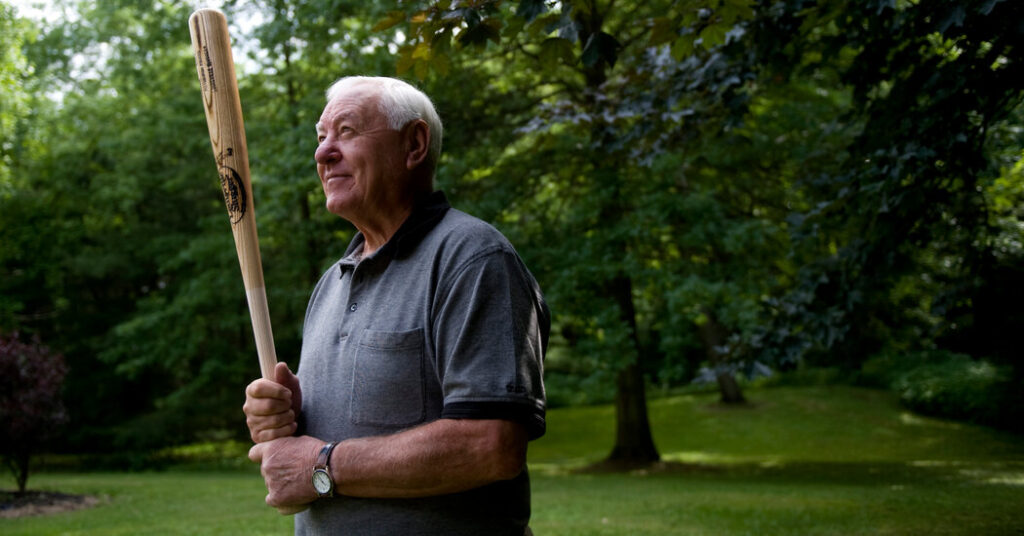
Bill Mazeroski, who hit the most famous — and surely the most decisive — home run in World Series history, a blast in the bottom of the ninth inning of the seventh game in 1960 that gave the upstart, overmatched Pittsburgh Pirates a thrilling victory over the New York Yankees, died on Friday in Lansdale, Pa. He was 89.
The Pirates announced the death but did not provide further details.
Almost as memorable as Mazeroski’s historic home run — on Oct. 13 at the Pirates’ Forbes Field — was the home run trot that followed.
When Mazeroski hit the ball, he wasn’t sure it would clear the ivy-covered left field fence 406 feet away-, so he galloped toward first base. Only when he was halfway to second did he see the umpire, with a circular wave of a hand, signaling that it had.
By the time he reached the bag, the Pirates second baseman began waving his cap wildly. Between second and third, Mazeroski jumped for joy, spreading out both arms as if doing the breast stroke. As he rounded third, he saw delirious Pittsburgh fans, whose team had not won a championship in 35 years, jump onto the field to greet him, forcing Mazeroski to thread his way to home plate.
Mazeroski’s hit, off the Yankees’ Ralph Terry, still marks the only time a seven-game Series has been decided by a home run on the final pitch — a “walk-off” in current parlance. ESPN proclaimed it the greatest home run ever.
What ended a seesaw contest that afternoon became one of baseball’s most re-enacted moments, though Carmen Berra, whose husband was the Yankees left fielder that afternoon, always refused to relive it.
“I still can’t watch that replay,” she later told the sportswriter Bill Madden for his 2003 book “Pride of October: What It Was to Be Young and a Yankee.” “The saddest moment I ever had in baseball was sitting in the stands, seeing Yogi standing there in left field, helpless to do anything but watch that ball go over the fence.”
Once they got over their shock, the Yankees, and their fans, felt robbed. The New Yorkers had won their three games by ridiculously lopsided scores — 16-3, 10-0 and 12-0 — while the Pirates had squeaked by in theirs by a grand total of seven runs.
“What happened to us, for cryin’ out loud?” Roger Maris, the Yankees slugger, asked Berra afterward.
Berra replied, “We just got beat, Roger, by the damnedest baseball team that me or you or anybody else ever played against.”
And Mazeroski was the damnedest sort of hero. Though hitting for more power than many second basemen, what had distinguished his career, and gotten him elected to the Hall of Fame in 2001, was his defense.
During a 17-year career — spent entirely with the Pirates — he won eight Gold Gloves and appeared in 10 All-Star games. He still holds the record for most career double plays turned by a second baseman (1,706); most seasons leading the league in double plays (eight); and most double plays turned by a second baseman in a single season: 161, in 1966.
A career .260 hitter, Mazeroski hit 138 home runs. But in 1960 he had hit only two at Forbes Field since July, though the second of them had won the opening game of the Series and remained the Pirates’ only home run until the finale.
The Pirates led that contest, 9-7, after a five-run rally in the bottom of the eighth, highlighted — at least to Yankees fans — by a sure double play ball that took a freak bounce and hit the Yankee shortstop, Tony Kubek, in the throat.
After the Yankees tied the score in the top of the ninth, Mazeroski led off the bottom of the inning. The first pitch from Terry, New York’s fifth pitcher that afternoon, was high. But the next pitch was just what Mazeroski had wanted: a fastball, or so it seemed, down the middle.
“If the guy threw me a change-up or a curve, I’d have missed the thing by a mile and turned myself around — I swung so hard,” he said. Terry, who had warmed up so often that day that he had little left, later insisted that the fateful pitch was a slider, but he didn’t press the point.
“I don’t know what the pitch was,” he said in the dressing room. “All I know is it was the wrong one.”
“With the crack of Mazeroski’s bat, the problems of the world were forgotten,” the reporter Vince Johnson wrote the next day in The Pittsburgh Post-Gazette. “Khrushchev became a noisy, little bore. Ballistic missiles didn’t have the power of a baseball bat. And the recession took a recess.”
An estimated 300,000 people soon converged in Pittsburgh’s Golden Triangle. More would have come had the police chief not closed off the major roads leading into the city.
William Stanley Mazeroski was born on Sept. 5, 1936, in Wheeling, W.Va., and spent his early years in Tiltonsville, Ohio. His father, an alcoholic, was a miner and a well-known sandlot shortstop in eastern Ohio whose own budding professional baseball career ended after he lost part of his right foot in a mining accident.
“When I was old enough to walk, Dad took me in the backyard and taught me baseball,” Mazeroski recalled. “He wanted to make his dream come true through me. He showed me how to charge a ball. I remember he always taught me how to have ‘soft hands’ when going after a ball instead of fighting it.”
After starring in baseball and basketball in high school, Mazeroski signed with the Pirates in 1954. He, too, was a shortstop until Branch Rickey, then the Pirates general manager, decreed that his arm was better suited for second. He joined the Pirates in 1956, and made his first All Star team the next year.
The secret to the double play, Mazeroski once explained, was actually not catching the ball — which took precious time — but letting it hit his glove, then grabbing and releasing as it ricocheted out. “There never was any such thing as a bad hop to Bill Mazeroski,” Dick Groat, his collaborator at shortstop on innumerable double plays, later said.
Mazeroski retired in 1972, and 15 years later the team retired his number, 9. Bothered by his comparatively minor offensive output, baseball writers passed him over for the Hall of Fame 15 times. Only in 2001, and only after six more tries, did a veterans’ committee — headed by Mazeroski’s former general manager — elect him. The decision left some stars, Ted Williams of the Boston Red Sox among them, grumbling.
Breaking down barely two minutes into his prepared remarks at his induction ceremony, Mazeroski set another major-league record: for the shortest speech ever at Cooperstown. “Defense belongs in the Hall of Fame — as much as pitching and hitting,” he said.
His wife of 64 years, Milene (Nicholson) Mazeroski, died in 2024. Survivors include two sons, Darren and David.
As oft-reported, a 14-year-old schoolboy named Andy Jerpe, who had left the game early to help his mother prepare dinner but had lingered outside the fence, retrieved Mazeroski’s home run ball. When he presented it to Mazeroski in the dressing room, the Pirates second baseman signed it, then gave it back.
“You keep it, son,” he told him. “The memory is good enough for me.”
One sunny day the following spring, the boy lost the ball in the weeds during a pickup game. Estimates are it would have fetched up to $1 million today.
The post Bill Mazeroski, 89, Whose 9th-Inning Blast Made Pirates Champs, Is Dead appeared first on New York Times.