President Trump’s stinging defeat before the Supreme Court on Friday came because the court’s six conservative justices splintered over the legality of Mr. Trump’s tariffs.
That divide underscored differing visions of presidential power and the role of Congress, and has implications for how the court may deal with future cases involving Mr. Trump’s agenda.
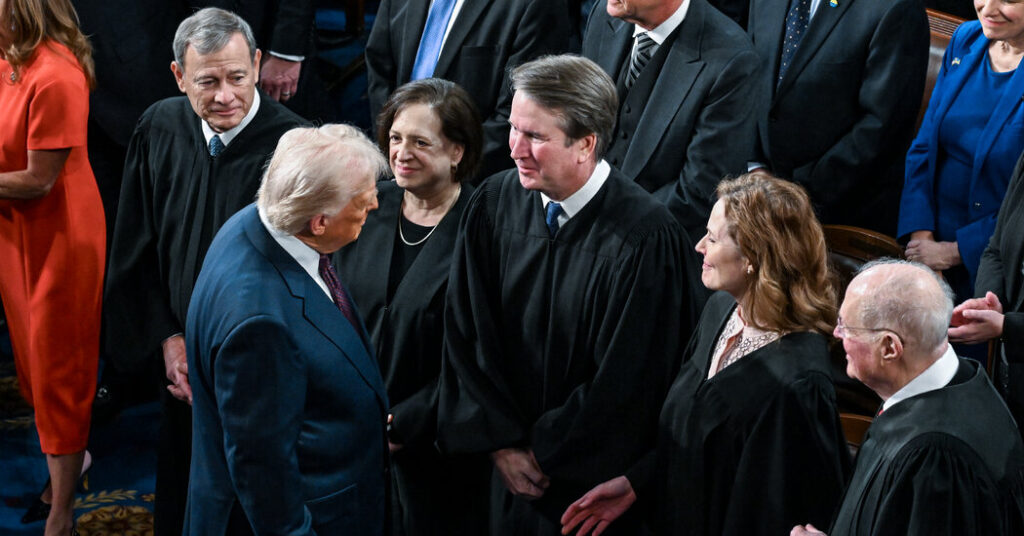
Chief Justice John G. Roberts Jr. wrote the court’s 6-3 majority opinion, which concluded that the president had exceeded his authority by using an emergency statute to impose sprawling tariffs on nearly every U.S. trading partner without congressional approval. The chief justice was joined by the court’s three liberals and two of Mr. Trump’s own nominees — Justices Neil M. Gorsuch and Amy Coney Barrett.
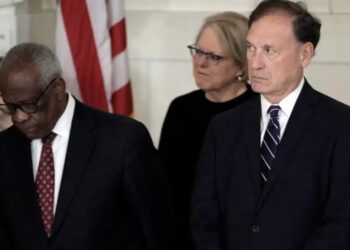
Justice Brett M. Kavanaugh, the president’s third nominee, dissented, along with Justices Clarence Thomas and Samuel A. Alito Jr., both staunch conservatives.
The division appears in part to come down to how much deference the justices think a president is due after declaring an emergency, and to their views of how much leeway Congress intended to give a president to conduct foreign affairs.
Jonathan Adler, a law professor at William & Mary, said that while it was “tempting to see a court with a conservative super majority as a monolith,” its ruling in the tariffs decision highlighted a number of meaningful differences among the justices.
The fractured decision, including the dueling written opinions from the conservative justices, “reinforces that there are important and subtle differences in the way the conservatives understand the contours of executive power and its relationship to Congress,” Professor Adler added.
The divisions suggest that in cases related to presidential power, the Trump administration and those who have challenged its policies in court cannot assume that the justices nominated by Republican presidents will see things the same way. The split also creates ways for the court’s liberals to potentially forge coalitions — particularly with the chief justice and Justice Barrett — that could make action at the court unpredictable in coming years.
The separation has been less clear in the court’s other recent interactions with Mr. Trump.
In the months before the president returned to office, the court divided along ideological lines when it granted Mr. Trump substantial immunity from prosecution. Since then, the court’s conservative majority has signed off on most of his emergency requests, temporarily allowing him to fire independent agency leaders without cause, remove transgender troops from the military and remove deportation protections for hundreds of thousands of migrants.
Those orders were unsigned, but members of the conservative bloc rarely noted that they disagreed with giving Mr. Trump his way.
But those rulings were placeholders. The tariffs decision was the first time the court issued a final judgment about the legality of a piece of Mr. Trump’s agenda.
It will not be the last. The court is still weighing the president’s authority to remove a member of the powerful Federal Reserve Board, and whether he can fire independent regulators at will despite tenure protections signed into law. And on April 1, the court will hear arguments over whether Mr. Trump can end birthright citizenship.
“With so many other momentous cases pending before the court on issues on executive power, it is far too early to declare winners and losers this term when it comes to the president,” said Gregory G. Garre, who served as the solicitor general in the George W. Bush administration.
In a defiant news conference after the court’s decision was announced on Friday, Mr. Trump appeared to divide the conservative justices into two camps.
He attacked the justices who ruled against him. “I’m ashamed of certain members of the court, absolutely ashamed for not having the courage to do what’s right for our country,” he said.
He also said that Justices Gorsuch and Barrett joining the majority was “an embarrassment to their families.”
“I don’t want to say whether I regret nominating them,” he added, concluding, “I think their decision was terrible.”
The president thanked the dissenting justices by name. In a social media post, he wrote that they had “Strength, Wisdom, and Love of our Country, which is right now very proud of you.”
Until 2020, justices named to the bench by Republican presidents held a slim 5-4 majority. That solidified when Mr. Trump nominated Justice Barrett to the court following the death of the liberal justice Ruth Bader Ginsburg.
The decision Friday to reject Mr. Trump’s signature economic initiative, however, cut across ideological lines.
But even in the majority coalition of conservatives and liberal, there were sharp disagreements.
The justices stated their reasoning in four separate concurring opinions — potentially an indication of why it took the court more than three months after the case was argued in early November to issue its ruling.
Friday’s opinion “gives the lie to the notion that the court is in the bag for the president, and also makes its approach to issues of presidential power in Trump 2.0 both clearer and more nuanced,” Jack Goldsmith, a Harvard law professor and a former top Justice Department lawyer under George W. Bush, wrote in a blog post.
The biggest disagreement among all of the justices was over whether, and how, to apply the so-called major questions doctrine, which requires Congress to use clear language to authorize executive action with vast economic and political consequences.
Chief Justice Roberts said that the president could not “‘point to clear congressional authorization’ to justify his extraordinary assertion of the power to impose tariffs.” He invoked the same principle in 2023 to invalidate President Joseph R. Biden Jr.’s student loan forgiveness program.
Chief Justice Roberts and Justice Kavanaugh, who have similar backgrounds, often vote together, and are both strong proponents of executive power. Both worked as lawyers in the administrations of Republican presidents: Chief Justice Roberts for George H.W. Bush and Justice Kavanaugh for George W. Bush.
But they parted ways on Friday over the major questions doctrine.
Justice Kavanaugh has joined decisions applying the doctrine in the past, but has said it does not apply when it comes to foreign affairs and the president’s power to declare a national emergency, as Mr. Trump did in imposing tariffs.
“In the foreign affairs realm, courts recognize that Congress often deliberately grants flexibility and discretion to the president to pursue America’s interests,” Justice Kavanaugh wrote, joined by Justices Thomas and Alito.
That echoed Justice Kavanaugh’s views as a judge on the U.S. Court of Appeals for the D.C. Circuit and in his opinion last year in a case involving the Federal Communications Commission, in which he said the major questions doctrine “has not been applied by this court in the national security or foreign policy contexts,” because it “does not reflect ordinary congressional intent in those areas.”
The issue split even the ideologically diverse majority in the Friday decision. Justice Elena Kagan, joined by the two other liberals, said there was no need to apply the doctrine, because the language in the International Emergency Economic Powers Act of 1977 that Mr. Trump used to impose tariffs, known as IEEPA, simply did not permit the president to do so.
Another member of the majority, Justice Gorsuch, wrote separately to reinforce his views on preserving legislative powers and checking the unbounded delegation of core congressional powers, like taxation, to the president.
“In all, the legislative process helps ensure each of us has a stake in the laws that govern us and in the nation’s future,” he wrote in a 46-page concurrence.
He added: “For some today, the weight of those virtues is apparent. For others, it may not seem so obvious. But if history is any guide, the tables will turn and the day will come when those disappointed by today’s result will appreciate the legislative process for the bulwark of liberty it is.”
Although they reached the same outcome, Justices Barrett and Kagan pushed back on Justice Gorsuch’s take on their separate writings.
Mr. Garre said in an email that even with the varying opinions among the justices, “it’s hard not to see the decision, however, as an extension — and perhaps most important step in — the court’s unwillingness to infer broad grants of executive authority hidden in routine statutory language.”
Ann E. Marimow covers the Supreme Court for The Times from Washington.
The post Divide Among Supreme Court’s Conservatives Could Test Trump’s Agenda appeared first on New York Times.