A few months ago, the musician Patrick Cosmos shared a “new unified theory of American reality” that he called “everyone is twelve now”—an attempt to explain an executive branch that endorses AI-generated videos of the president dropping poop on protesters from a shiny jet, and that replies to official press queries with the words your mom. Everyone is 12 is a strikingly effective summary of contemporary politics, but it also helps us understand why a good amount of popular culture feels as brain-numbingly dense as it currently does. Why is Nicki Minaj throwing insults at one of Cardi B’s children and generating images of her as the purple dinosaur Barney? Everyone is 12. Why is Kim Kardashian the star of a fur-swaddled drama about Bentley-driving divorce lawyers with seven-figure clothing budgets? Everyone is 12. Why has Emerald Fennell adapted one of the more chasmic and ambitious tragedies in English literature into a poppy, gooey, thuddingly literal work of sexy fan fiction? Everyone is … you get it.
In some ways, that Fennell’s Wuthering Heights is this vacuous and one-dimensional feels like progress. Male directors get to make big, unserious epics all the time. (“How many times have you watched Top Gun: Maverick?” I asked my husband last night. “This month?” he replied.) Fennell, whose film made $83 million at the global box office during opening weekend, is at least proving, with sticky aplomb, how starved we as a culture are for romance. Margot Robbie, the movie’s co-star and one of its producers, has shrugged off mixed reviews; she told Vogue Australia, “I believe you should make movies for the people who are going to buy tickets to see the movies. It’s as simple as that. I love working with Emerald because she always prioritizes an emotional experience over a heady idea.” In other words, Wuthering Heights is simply giving the people what they want. And the people are 12.
[Read: An erotically untamed take on Wuthering Heights]
Truly, though, at times the movie gave off an even more immature vibe—a lot of it felt like watching a toddler smear lunch on the wall and grin at how naughty they’re being. Emily Brontë’s Gothic tale about the mutual obsession between Cathy, a self-centered and irascible teenager, and Heathcliff, the foundling her father has brought into the family, is a notoriously ambiguous study of how noxious social systems ruin people. None of that subtlety or analysis is present in Fennell’s version, which begins with an opening scene of grotesque commoners cheering the public spectacle of a hanging and the deceased man’s postmortem erection, then copulating grubbily in the town square. Immediately, this Wuthering Heights makes clear that what it’s shooting for is one-ply provocation.
Cathy and Heathcliff grow up surprisingly naive for two teenagers surrounded by farm animals. Cathy seemingly learns about sex while witnessing Joseph—a sinister religious fanatic in the book, now reimagined as a friendly dom—and Zillah, a servant, get into some light BDSM horseplay. The teens (both played by actors well past that decade) have a bond, the movie emphasizes via multiple scenes of them running on soggy moors—not since “November Rain” has pathetic fallacy been so abused—and staring at each other. (At one point, Cathy leaves raw eggs in Heathcliff’s bed, which he sits on, then runs his fingers through with pensive emphasis.)
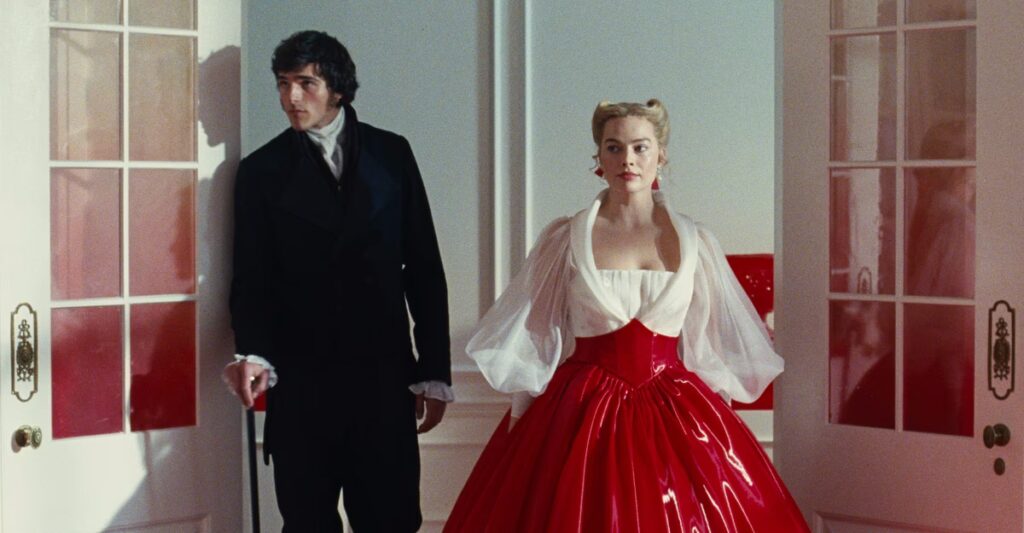
But Cathy, dismayed by her family’s poverty, becomes fixated on the wealthy new neighbor, Edgar Linton, whose money allows him to inhabit a totally different aesthetic universe. (If Cathy and Heathcliff live in coal-blackened serf grime, the home that Edgar shares with his ward, Isabella, is Homes and Gardens meets Madonna video, all sunshine and flowers and maximalist patisserie.) Cathy loves Heathcliff but despises his poverty; she marries Edgar, then punishes herself by making her corsets too tight and wafting gloomily around her new acid-trip mansion.
Much of the drama is undermined by the odd choice to have the characters explain exactly what is happening (presumably for the slowpokes in the back). “Here, look, the freckle from your cheek,” Edgar says to Cathy, pointing at the silk-and-latex wallpaper in her new bedroom, neutralizing any of the tension that might have ratcheted up from his offering of a room modeled after human skin. All the subtext is made too explicit, the text too flatly literal. “My, you are handsome, you brute,” Cathy tells Heathcliff when he returns, with a gentlemanly makeover, from the vaguest of travels. “And rich.” (This, in case the audience has missed Fennell’s insistent association of poverty with monstrous ugliness, and wealth with fetishized beauty.)
Did we notice that Cathy’s father is drinking himself to death? Behold his corpse presented in front of two enormous piles of bottles, as green and resplendent as Christmas trees. Did we forget that Cathy is now extravagantly humping Heathcliff while pregnant with another man’s child? Allow Cathy’s companion, Nelly, to spell it out for anyone who might later stream the movie with one eye on their phone. Speaking of which, by the time the two protagonists do finally consummate their relationship after apparent years of unbridled yearning, the montage of sexy, sexy sex—in a rose garden, in a carriage, in a gazebo next to a grave—should feel like ecstatic release. But the film’s inability to really communicate why Cathy and Heathcliff are drawn to each other, beyond both being played by smoking-hot Australians, leaves us nothing to connect with but visuals.
[Read: The director tackling the dark side of Millennial desire]
Fennell is an extraordinary stylist, and combining beauty with darkness—what could be called her “poisoned candy” aesthetic—seems to be in her blood. Her father, a jeweler, is known for his irreverent and often macabre designs. An exhibition of his work at the Royal Academy in 2007 included the faces of Lenin, Mao, and Mussolini carved into gold rings, and displayed a pair of ruby-and-diamond earrings on a model of the guillotined head of Marie Antoinette. Some of the shots in Wuthering Heights are breathtakingly audacious: Cathy’s pearlescent plastic nightgown on her wedding night, the crimson sky behind Heathcliff as though he’s on the cover of a Harlequin-romance paperback, or backlit in a Kate Bush video. But without a coherent narrative to hold them together, they don’t have anything to do—beyond being screenshotted and reposted on TikTok.
It’s audacious, too (as many others have written), to take a book so deliberately and boldly written about the toxic dynamics of class and racism—a book that exposed the brutality of domestic violence—and remove all of those elements to focus on mucilaginous erotica. Fennell has presented her movie as “Wuthering Heights”—quotes included—as though it’s really just a riff on the characters with some viscous, eggy imagery to get extra attention. She casts a white actor as Heathcliff, a character who, in the novel, is ambiguously described as “dark,” whose brutality seems to stem from being cruelly treated as an outsider and from his subsequent desire for revenge.
Fennell also trollishly reimagines Isabella—a character who, in the book, impulsively marries Heathcliff, then is tortured by him to the point that she flees without any concern for the consequences—as an adult baby who consents and even delights in her own abuse. It’s easy, really—excising all the multivalent complexity of the book so as not to confuse us. As the film critic Richard Brody wrote this week, “Rushing to defend a literary source against a supposed cinematic mauling is often little more than an attempt to signal culturedness and education.” Why would we expect a movie to cater to either? We’re 12!
The thing is, I’m not so sure making a big, silly epic is quite what Fennell was trying to do. You don’t name-check auteur filmmakers such as Catherine Breillat and David Cronenberg as inspiration if all you’re hoping to create is, as one critic described it, a “smooth-brained” Wuthering Heights. The insistent sliminess of her imagery—a snail trailing wetly down glass, hands sinking into sticky dough, pigs’ blood on petticoats—suggests a desire to provoke more than please, to needle into the space between sex and romantic iconography. But Fennell has also expounded on her obsession, as a tween, with Baz Luhrmann’s Romeo + Juliet and James Cameron’s Titanic—both movies that also drew mixed reviews but made astonishing amounts of money. In attempting to bridge the gap between art-house extremity and mass-marketed blockbuster, Fennell has made something that just ends up feeling juvenile.
Still, the Warner Bros. marketing machine rolls on: Wuthering Heights has branded partnerships with lingerie companies and body-oil brands; you can purchase a “Haunt Me” Heathcliff-themed acai bowl, a “Be With Me Always” leather bag charm, a “Crème Undone” tin of tea, and a “Burning Desire” chocolate-lava cookie, many of which are emblazoned with the movie’s logo. Because this is what stoking 12-year-old desire is actually about—the real yearning is for what’s contained in our wallets.
The post Why the Wuthering Heights Movie Is Infantilizing appeared first on The Atlantic.