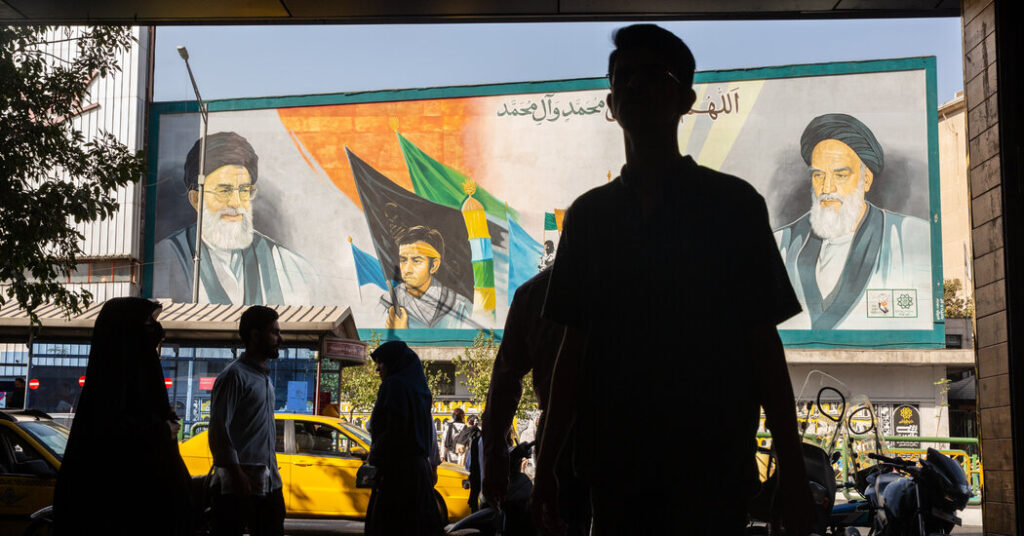
The recent uprising in Iran was the first time the theocracy faced nationwide protests after losing a war. But by massacring thousands of Iranians in January, the ruling elite has shown that military defeat has not led to acquiescence. With a large American force gathering in the region, the stark reality is that the regime appears as strong today — and just as defiant — as it was before the recent convulsions.
In the aftermath of the 12-day war with the United States and Israel in June, which devastated Iran’s nuclear facilities and left scores of top military officials and scientists dead, the Islamic Republic’s ruling elite was thrown into disarray. Thus when the uprising began in late December over the collapse of the currency, the regime initially adopted a conciliatory approach.
But Iran’s theocratic rulers seemed to have forgotten the dynamics of the 1979 revolution that brought them to power, when demonstrations grew once the masses realized that Shah Mohammed Reza Pahlavi was unwilling to slaughter his own people. For those demonstrators, it was both safe and validating to join the opposition. And so the protests in January, too, intensified and engulfed much of the country.
The regime eventually rallied around the contempt for the protests held by the supreme leader, Ali Khamenei. On Jan. 5, the cleric Gholam-Hossein Mohseni-Ejei, the hard-line head of the judiciary, led the charge: “There can be no tolerance toward rioters,” he said. “This time there will be no leniency.” The elite groups that control Iran’s military and economy held together, and the security forces attacked. According to the Human Rights Activists News Agency, 7,008 people had been killed and 53,344 arrested as of Feb. 13. These numbers are likely to grow as more dead are counted, more of the missing show up in prisons, and the security services track down those who demonstrated.
Even now the regime is expanding its target list, arresting hitherto tolerated members of the Reformist Front political faction, including its head, Azar Mansouri, although she has since been released. The judiciary accused them of “organizing and leading extensive activities aimed at disrupting the political and social situation.” Wobbliness among public figures now won’t be tolerated.
The Trump administration most likely assumed that its success in the 12-day war, coupled with the scale of the recent uprising in Iran, would give it leverage in the negotiations with Tehran that are now underway. Always inclined toward displays of power, the White House has deployed a formidable armada to the region and said it would consider military action if negotiations fail.
Two recent rounds of talks, one in Oman and one in Geneva, belie the idea that Tehran will be intimidated. The second round ended on Tuesday, with both sides citing undefined progress. Iran reportedly said it would provide more detailed proposals in the next two weeks.
Secretary of State Marco Rubio initially had insisted that for the talks to be meaningful they had to encompass Iran’s nuclear program, ballistic missiles, support for militant organizations in the region and “the treatment of their own people.” None of this seemed to have happened. In “proximity talks,” in which Iran-friendly Omanis pass messages between the two sides, Tehran limited the discussions to the nuclear issue and refused to budge from its position that it has a right to enrich uranium at home. For good measure, Iran said it had conducted naval exercises on Tuesday in the Strait of Hormuz, an important waterway, briefly closing it.
The clerical regime surely has no desire for another altercation with President Trump. Like most other international actors, the clerics are still trying to figure him out. The cagey Ali Larijani, the secretary of the Supreme National Security Council, has tried to entice Mr. Trump by suggesting that if talks on the nuclear issue are successful, “they can be expanded to other areas in the next stages.” Tehran is trying to keep its red lines in place while providing Mr. Trump a pathway to avoid war. This might still work.
But what seems clear is that the clerical regime no longer views being bombed by America or Israel as an existential threat. This isn’t likely to change even if Mr. Khamenei dies. The Islamic Republic isn’t a personalized dictatorship but an ideological system with a multilayered elite that benefits from it. The Americans who came to the talks may have seen the Iranians as supplicants; Mr. Khamenei and his men think of themselves as survivors.
That mind-set could prove to be their downfall in the long run. The theocracy may have regained command of Iran’s streets, but the underlying causes of popular discontent remain. The regime has revealed no plans for addressing the nation’s economic decline, widespread corruption, class cleavages or the ecological problems that create persistent water shortages. At some point, there will be another uprising. Millions of Iranians cannot be suppressed forever.
But for now, it must be conceded that however long the life span of the Islamic Republic may turn out to be, it has been extended by its recent killing spree. The regime has reanimated the haybat, or terrifying awe, on which this tyranny depends.
Reuel Marc Gerecht is a resident scholar at the Foundation for Defense of Democracies. Ray Takeyh is a senior fellow at the Council on Foreign Relations.
The Times is committed to publishing a diversity of letters to the editor. We’d like to hear what you think about this or any of our articles. Here are some tips. And here’s our email: [email protected].
Follow the New York Times Opinion section on Facebook, Instagram, TikTok, Bluesky, WhatsApp and Threads.
The post What if the Iranian Regime Is Stronger Than Trump Thinks? appeared first on New York Times.