What’s it like to have millions of fans but struggle to make friends?
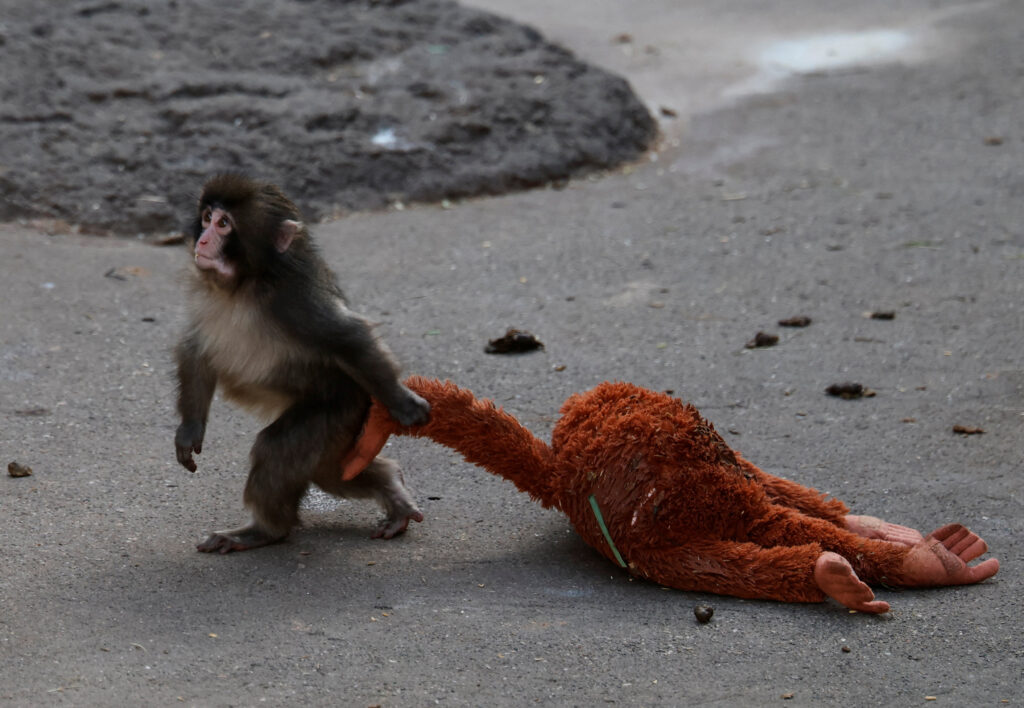
For Punch, a 7-month-old macaque, fame and loneliness have collided, leaving the world watching as he clings to a stuffed orangutan toy from IKEA.
Punch was abandoned shortly after birth and raised by the staff at the Ichikawa City Zoo outside Tokyo. Baby monkeys often clutch their mothers for comfort and security, so the staff gave Punch a surrogate. He carries the toy around with him and runs back to it for comfort when scolded or rejected by other monkeys, according to a statement on X from the zoo.
The zoo and botanical garden has been posting regularly about Punch’s progress as he tries to integrate with the other macaques after moving in with them last month at the zoo’s “Monkey Mountain.” The baby monkey now has masses of dedicated human fans around the world cheering him on — though he’s still learning how to socialize with his own species.
Videos have gone viral showing Punch looking lonesome and snuggling with his soft toy, or approaching other monkeys in the enclosure with varying degrees of success. Some videos show Punch being outright rejected by the group of primates, or even seemingly bullied.
In a statement posted Friday on X, the zoo confirmed that videos of Punch being dragged by other monkeys seemed to be authentic and explained that this is part of his journey as he learns how to be a monkey without his mother to show him the ropes.
“Punch has been scolded by other monkeys many times in the past and has learned how to socialize with them,” the statement said.
The zoo staff also noted that after moments of conflict with other monkeys, Punch runs back to his comfort object — his stuffed toy orangutan. When he feels safe again, he will leave his toy and return to his peers.
Punch has also been observed clinging to zookeepers’ legs when they enter the enclosure.
The small zoo has been overwhelmed by visitors and long lines since its posts about Punch started dominating social media feeds. Larger crowds still are expected this weekend and Monday, which is a holiday in Japan. A red banner has appeared at the top of the zoo’s website with a message from Punch’s keeper encouraging visitors to take public transportation rather than a car.
Punch has also become an accidental influencer of sorts. IKEA told The Washington Post that there has been a marked increase in sales of the DJUNGELSKOG orangutan toy, and asked for patience from customers who visit stores in Japan, the United States and South Korea, where the toy has sold out.
“We are making sure that the toy is back in stock as soon as possible,” Javier Quiñones, a commercial manager for IKEA’s Ingka Group, said in a statement. “The toy has long been one of our most sought-after across markets, and the story from Japan is now giving it a little extra love.”
“Seeing our orangutan soft toy provide hugs, snuggles, and a sense of calm for Punch has deeply touched us,” said Karin Blindh Pedersen, development leader at Children’s IKEA.
IKEA has also jumped on the marketing opportunity, with ads for the toy promoting it as “Punch’s comfort orangutan.”
For biologists and psychologists watching from afar, this has been a reminder of a famous experiment that changed the thinking about caregiving in primates, including humans.
“The first thing I thought was, we’ve done this experiment!” said Joan Silk, a professor of evolution at Arizona State University.
In the 1950s and ’60s, American psychologist Harry Harlow conducted experiments with rhesus monkeys that demonstrated that comfort and affection are almost as essential as food for infants. He separated infant monkeys from their mothers — “we wouldn’t do that now,” Silk said — and gave them everything they needed to survive except their mothers. The baby monkeys struggled socially, often failing to mate. If they did have offspring, they didn’t know how to care for them.
In one experiment, infants could get food from a wire “mother” but also were given a soft cloth surrogate mother for comfort. The infant monkeys spent all of their time with the cloth mothers, going to the wire mother only to feed. When distressed or scared, the cloth mother provided comfort and security, demonstrating that caregivers weren’t only important for basic needs — but also emotional ones.
“That really shook people up,” Silk said.
Developmental psychologists had previously discouraged parents from spoiling children with too much affection — but Harlow’s experiments changed ideas about how human infants should be raised, especially orphans in institutions.
Silk explained that without his mother to help him navigate the social world, Punch has an uphill climb.
Silk, who studies baboons, said the strength of social ties actually determines how long they live.
“The reasons are not that different than the reasons that social bonds are so important for humans,” Silk said. “They help us cope with stress. They help us process all the sort of various kinds of uncertainties that we face in life that cause anxiety.”
As for Punch, Silk thinks he has a good shot at overcoming his lonely early life. But it depends on the social group allowing him in — someone being willing to groom him, let him sit close to them, let him sleep near them.
Silk has noticed people on social media saying they want to adopt Punch and rescue him from his isolation and social discomfort.
“I know the sort of human impulse is to intervene,” Silk said, but she advises that’s not the solution.
“He’s got to live a monkey life,” she said.
Or, as the zoo said in its statement: “While Punch is scolded, he shows resilience and mental strength. … We would like you to support Punch’s effort rather than feel sorry for him.”
The post After lonely baby monkey goes viral, his IKEA comfort toy sells out appeared first on Washington Post.