A few years after a “Western Civilization” course led me to change my plans from law school to a Ph.D., my professor—a University of Chicago legend named Karl Weintraub whose teaching inspired generations of us to stand in line overnight hoping for a place in his class—wrote to me about what he wanted students to learn. I reread his 1986 letter recently and found some resonance with current debates about our national past. Mr. Weintraub’s words about teaching history clarified why all Americans have a stake in what happens at our National Historic Sites.
[time-brightcove not-tgx=”true”]
In the classroom, Mr. Weintraub wrote that he poured himself into telling human stories of yearning and fear and achievement: “All the different teaching, undergraduate and graduate, seems to confront me all too often with moments when I feel like screaming suddenly: ‘Oh my god, my dear student, why cannot you see that this matter is a real, real matter, often a matter of the very being, for the person, for the historical men and women, you are looking at—or supposed to be looking at!’”
Mr. Weintraub was reminding me, an aspiring professor, that it’s not enough to analyze the dead. Even as you respect the chasm between their time and now, you need to see through their eyes.
Historic sites can offer this experience to every American, but these places are now at risk. In National Parks across the country, government officials are removing, often without explanation, exhibits that enable us to see through the eyes of people who lived in a world different from our own. In Philadelphia, local officials and organizations are fighting back. All Americans have a stake in the outcome.
Read more: We’ve Never Agreed About George Washington and Slavery
National Historic Sites are America’s open classrooms—places where people from every zip code stand on ground that holds stories of our dead. At them, we learn how to imagine ourselves into radically different, multi-faceted lives: a Massachusetts farmer fighting at the Battle of Lexington. A California fisherman incarcerated at the Manzanar War Relocation Center. The nonagenarian daughter of a doctor born into slavery, celebrating the opening of the National Museum of African American History and Culture.
Few college classrooms can compare. Visit the National Mall in Washington and you will walk where, for over a century, Americans holding starkly opposed and sometimes abhorrent views have exercised our First Amendment rights. At the Tenement Museum on the Lower East Side, you can stand in apartments from which generations of immigrants helped to build New York’s economy, neighborhoods, and culture.
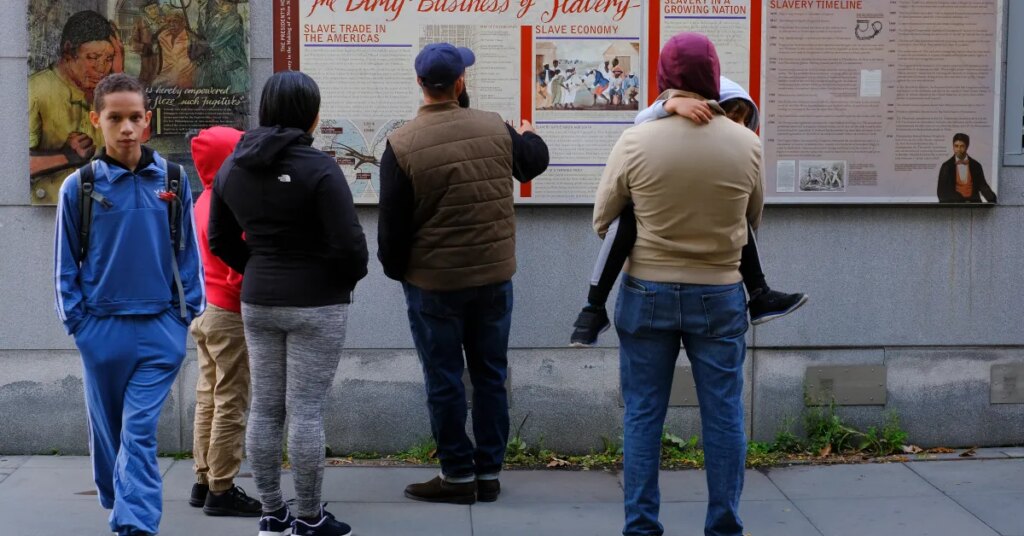
Go to Independence National Historical Park in Philadelphia and you will cross the living quarters of persons enslaved in George Washington’s household just before you see the Liberty Bell, so named by abolitionists in the 1830s, eighty years after it had been inscribed with words from Leviticus: “Proclaim Liberty thro’ all the Land to all the Inhabitants thereof.”
Dwight Pitcaithley, a former Chief Historian at the National Park Service, described this experience: “The contradiction in the founding of the country between freedom and slavery becomes palpable when one actually crosses through a slave quarters site when entering a shrine to a major symbol of the abolition movement…. How better to establish the proper historical context for understanding the Liberty Bell than by talking about the institution of slavery?”
Equipped with background information, a visitor could in a single day imagine the world through the eyes of an abolitionist newspaper editor, a Revolutionary War general who became our first president, and an enslaved Virginian who seized her freedom from that president.
Everyone deserves the kind of experience Pitcaithley described. No one can have it when government officials selectively erase stories that historic places hold.
No one is served when ongoing research is thwarted or challenging exhibits are removed. Visitors to the sites at Independence Park were cheated when they were cut off from facts that enable us to imagine ourselves in the lives of those who lived and worked there. Removing these exhibits, as U.S. District Judge Cynthia M. Rufe noted in her recent opinion ordering the National Park Service to restore them, is tantamount to “dismantling objective historical truths.” The exhibit on the history of slavery at the President’s House in Philadelphia was restored this week.
Seeing the world through the eyes of the dead takes humility and courage. Humility, because no matter how much we know, there’s always more to learn. And courage, because we’ll discover unsettling realities, both about the past and about ourselves.
I learned so much in Mr. Weintraub’s class on Western civilization. He spoke with memorable urgency when he wanted us to grasp hard realities. Athenians enjoyed democracy at home while sanctioning brutal conquest abroad. Fighting for a perfectly egalitarian France could lead one to commit acts of undeniable cruelty. Holding fast to pacificism could contribute to a massacre. An inspiring ideal of universal human freedom could emerge on the backs of enslaved human beings. Two at-odds facts can both be true, and all of us are susceptible to arrogance and self-serving rationalization.
From Mr. Weintraub’s perspective, our best defense, our best hope, was to learn where we had come from.
Human beings, Toni Morrison wrote in her essay collection The Source of Self-Regard, “are the moral inhabitants of the globe. To deny this, regardless of our feeble attempts to live up to it, is to lie in prison.” If I read Morrison right, our status as moral comes from a capability—one we rarely exercise—“to project, to become the other, to imagine her or him.”
National Historic Sites nurture this capability at a scale few institutions can match. They give us the opportunity, over and over, to imagine ourselves in the lives of others.
It’s on us, the American people, to make sure that these meaningful places are free to do that, both now and into the future.
The post Historic Sites Are Where Americans Learn Who We Are appeared first on TIME.