After the botched federal response to Hurricane Katrina contributed to hundreds of deaths in 2005, Congress sought to prevent those deadly mistakes from repeating.
It passed a law that gave more authority to the person running the Federal Emergency Management Agency and placed restrictions on the homeland security secretary, whose department oversees FEMA.
The statute reflected concerns that FEMA’s mission suffered under leadership more focused on fighting terrorism and securing borders, and that the FEMA administrator needed to be able to make funding and personnel decisions.
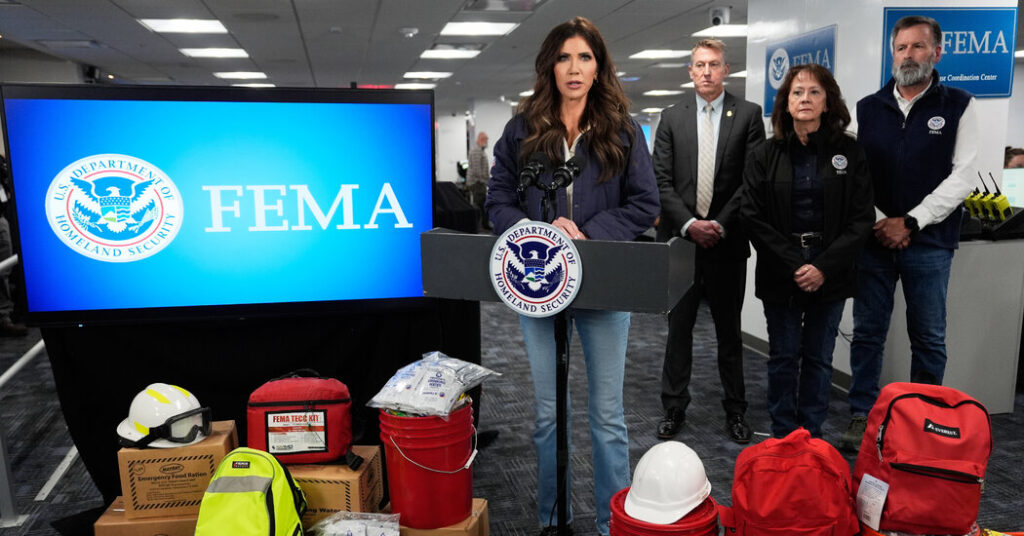
Two decades later, the law known as the Post-Katrina Emergency Management Reform Act has not prevented Homeland Security Secretary Kristi Noem from micromanaging FEMA’s staffing, programs and spending.
Some FEMA staff and emergency managers worry that Ms. Noem may be violating the spirit, if not the letter, of the post-Katrina reform law, with changes that whistle-blowers have warned leave FEMA less prepared for disasters.
FEMA “is operating lawfully and in full compliance” with the post-Katrina reform law, Victoria Barton, a senior FEMA spokeswoman, said in a statement.
“The secretary of homeland security has clear statutory and delegated authority to manage the Department, including decisions related to staffing, grants and program oversight,” Ms. Barton said.
States, unions and advocacy groups have won court challenges to some of the changes Ms. Noem has made. But lawyers said that the 2006 statute is difficult to enforce.
Internal FEMA documents reviewed by The New York Times and interviews with FEMA employees show Ms. Noem has been closely involved in changes to the agency’s staffing levels and capabilities.
For example, before the agency ended the contracts of hundreds of disaster workers last month, supervisors were directed to request contract extensions through a new approval process that bypassed FEMA leadership and instead went through Ms. Noem’s office.
In a lawsuit against FEMA over the dismissals, government worker unions filed a motion this month demanding that a judge block the firings, arguing that they violate “plain language” in the post-Katrina law that bars Ms. Noem from stripping the agency of its own authority.
In a response filed on Friday, the government said the law has not been violated because “FEMA’s functions continue unaltered, regardless of the number of employees they have performing them.”
This week, Ms. Noem raised fresh alarm among FEMA staff by restricting their travel to and from disaster-struck areas. Any travel now requires written approval from homeland security officials, according to documents obtained by The Times. The agency cited the affects of a partial government shutdown on the Homeland Security Department, though FEMA’s disaster work is not funded by government appropriations, but rather through a special and separate fund.
After Ms. Noem last year required that her office approve any FEMA expenditures of $100,000 or more, a database of disaster aid projects shared with The New York Times showed billions of dollars in delayed spending awaiting her approval. When asked about the bottleneck in a House oversight hearing on Wednesday, Gregg Phillips, leader of FEMA’s disaster response and recovery efforts, said the agency “can’t go any faster” to eliminate the backlog.
“I’m extremely concerned about how this law is being violated right now by Secretary Noem and others,” said Abby McIlraith, an emergency management specialist at the agency who was placed on administrative leave after signing a public letter in August warning that FEMA risks repeating the mistakes of Katrina.
Three former FEMA lawyers who spoke with The New York Times said that while it may be true that the agency’s capabilities have been diminished under Ms. Noem’s leadership, it doesn’t mean that she has violated the law, or that such a thing could easily be proven. Two of those lawyers spoke on the condition of anonymity, because they were not authorized to speak to the media in their current roles.
They said states could, in theory, sue FEMA over alleged violations of the law if they could prove that the agency failed to fulfill its duties in an emergency. Congress could also hold oversight hearings to probe possible violations of the law.
But while the law forbids the homeland security secretary from compromising FEMA’s “authorities, responsibilities or functions,” it leaves broad latitude for the specific staffing levels or agency reorganizations that are deemed necessary by an administration. For example, it doesn’t specify whether “a one-person office or a 1,000-person office” is needed to meet certain functions, said Adrian Sevier, who served as FEMA’s chief counsel for a decade before resigning in February 2025.
“It’s unfortunate, it’s bad government — you can make all those arguments,” Mr. Sevier added. “There’s really nothing unlawful about it, in my opinion.”
The post-Katrina law also requires that the FEMA administrator have extensive experience in emergency management, a criterion that none of the three officials who have filled the role on an acting basis over the past year have met. Ms. Barton said that that was “consistent with federal law.”
The role of FEMA administrator is subject to Senate confirmation, and a year into his second term, President Trump has yet to nominate a candidate.
Federal laws including the post-Katrina reforms also require FEMA to invest in the capacity of states to manage disasters within their borders. But even after a federal judge ruled in favor of states that had sued FEMA over access to key emergency preparedness grants, some states are still waiting for money FEMA is legally obligated to provide.
Pete Gaynor, who served as FEMA administrator during President Trump’s first term, said homeland security secretaries have broad powers over grant programs. He recalled that when he was serving as an emergency manager in Providence, R.I., the Obama administration informed him that the city no longer qualified for funding through FEMA’s Urban Areas Security Initiative program.
“There’s really nothing you can do about it,” Mr. Gaynor said. Ms. Noem “has a pretty high ability to manage those grants the way she sees fit,” he said.
When the 2006 law was written, there was debate about whether FEMA should be an independent agency, as it had been before the Homeland Security Department’s creation in 2003.
Instead, lawmakers passed the law “elevating it within D.H.S. and providing the administrator direct access to the president in emergencies,” its sponsors, Senators Susan Collins, Republican of Maine, and Joseph Lieberman, Democrat of Connecticut, wrote in a 2008 letter to the editor in The New York Times.
Senator Collins did not respond to a request for comment about the law or the state of FEMA under Ms. Noem’s leadership. Mr. Lieberman died in 2024.
As written, the law left significant power over FEMA with the Homeland Security Department, Mr. Sevier said. “Congress was unwilling to remove FEMA from the department,” he said. As a result, he added, the post-Katrina law “doesn’t really do a whole lot.”
Scott Dance is a Times reporter who covers how climate change and extreme weather are transforming society.
The post A Post-Katrina Law Guards FEMA Resources. Why Hasn’t It Stopped Noem? appeared first on New York Times.