Colombian soldiers defending a state-owned oil pumping station near the border with Venezuela were under attack. Two powerful insurgent groups that have been fighting the Colombian state for decades had been regularly stealing fuel from it.
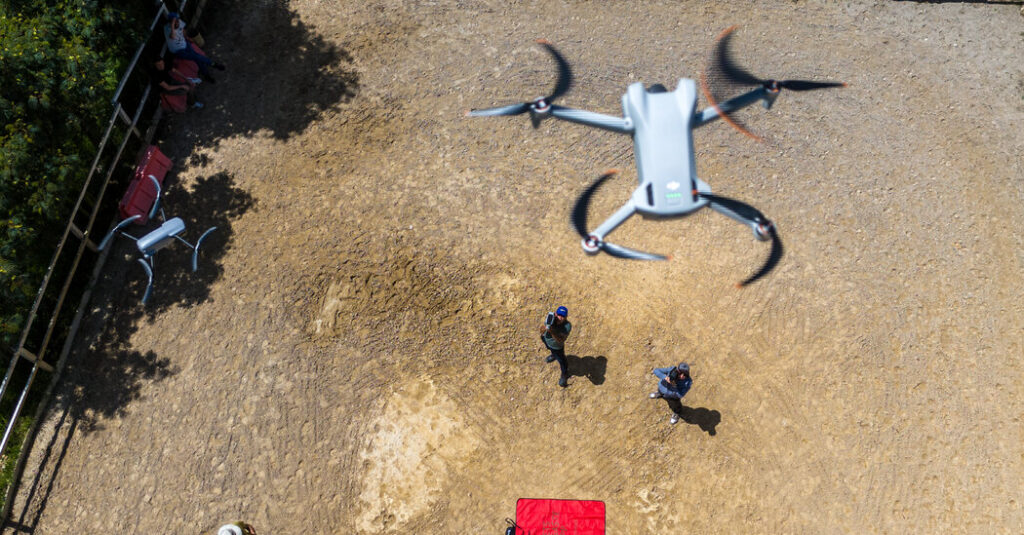
The soldiers were used to snipers and ambushes, but now they had to contend with a new weapon their adversaries have by the thousands: swarms of small drones, the kind hobbyists can buy on Amazon, fitted with clawlike hooks carrying grenades.
Over 15 days, the soldiers shot down 50 of them, according to four government security officials familiar with the operation. On the 16th day, a much larger drone, commonly used for spraying pesticides, appeared carrying four grenades. The battalion did not detect it in time. The grenades exploded, killing one soldier, the officials said.
The four government security officials working in active combat zones across Colombia shared similar stories with The New York Times, reflecting what they said was a worrying trend: cheap access to easily modifiable drones is upending the country’s decades-long war against insurgent groups and putting the government on its heels. Each spoke on the condition of anonymity to discuss sensitive security issues.
Colombia is now taking a much harder line after years of seeking peace with armed groups, including the National Liberation Army, or ELN, which is especially active in Catatumbo, the border region where the soldier was killed and one of the country’s fiercest battlegrounds.
Like other countries in Latin America, Colombia is under pressure from President Trump to target groups like the ELN involved in drug trafficking or else face punishments, including tariffs, sanctions and even military intervention.
Military-grade drones have become central to modern warfare, including in Ukraine, Gaza and Darfur, in western Sudan. Drone warfare in Colombia is largely characterized by the use of readily available commercial drones.
In Colombia, the rapid proliferation of increasingly sophisticated armed drones among insurgent groups has become a formidable challenge for the government.
“The narco-traffickers have the aerial advantage,” President Gustavo Petro of Colombia said in a speech to soldiers late last year, shortly after drones had killed 58 soldiers and police officers and wounded 300 more in the course of a few months.
Drones used by armed criminal groups can be bought on websites like Temu, said one official based in Catatumbo, referring to the Chinese shopping website.
The official described how difficult it was to prevent armed groups from acquiring drones. Some are bought in Colombia, while others are smuggled in from Venezuela, he said, crossing anywhere along hundreds of miles of porous border, much of which is covered by dense forest.
Drone use by insurgents, the official said, was increasing at “an alarming rate.”
Pedro Sánchez, Colombia’s defense minister, acknowledged that criminals had begun using drones “indiscriminately,” causing more than 100 police and military casualties in 2025.
Mr. Sánchez said that the military managed to thwart the vast majority of drone attacks last year, but that it had suffered the “equivalent to 333 successful attacks, causing enormous damage not only to the security forces but also to the civilian population.”
Mr. Sánchez traveled recently to Washington to meet with U.S. security officials, a visit that followed an announcement by the Colombian government that it would spend more than $1.6 billion on anti-drone equipment. Colombia’s Defense Ministry, in a news release, described the investment as “without precedent” and “the most ambitious and audacious air defense strategy.”
It is unclear whether Mr. Sánchez’s trip to Washington, which was followed by a visit by Mr. Petro to meet Mr. Trump, yielded any deals for such equipment, which could include radars, signal inhibitors and more. Over the past three decades, Colombia has received billions of dollars in military aid from the United States. This month, it took delivery of 11 American armored vehicles.
The government’s objective is to protect critical locations across Colombia, including 13,000 polling stations to be used in national elections scheduled for May.
Mr. Petro’s leftist administration broke with its predecessors by pledging not to purchase new military equipment, including drones, from Israel, Colombia’s main source of armed drones, in protest against Israel’s war in Gaza.
Mr. Sánchez confirmed that the government would be looking elsewhere, and last month representatives from more than a dozen countries attended a meeting at which Colombian officials solicited proposals for anti-drone equipment.
Despite Colombia’s sense of urgency, it is unlikely new anti-drone equipment could be deployed by the time elections are held, according to the four security officials and other experts.
One of the security officials, who is in the Cauca region, said anti-drone equipment would itself most likely become a target. Also, the equipment had to have constant monitoring and to be in locations with lighting and internet access, something that does not exist everywhere in Colombia.
Another official, in Catatumbo, said he was discouraged about how much easier it seemed for armed groups to acquire drones, using money they make from the drug trade, than it was for the military to get equipment to protect themselves from them.
Mr. Petro, in his speech to the military in December, acknowledged that the government was struggling to keep up with the ability of insurgent groups to arm themselves. They can buy thousands of drones “with cash” while the government is “slow to react.”
Two of the security officials said armed groups, including the ELN, also had access to fiber optic drones, which use ultrathin cables rather than radio signals, making them immune to jamming by most anti-drone equipment.
A study last year by the Latin American Institute of Peace and Security, an independent technical advisory group, found that “armed groups are already employing” fiber optic drones in Colombia, and that versions from China “with upward of 30 kilometers of coil can be delivered to any major Colombian city for less than 600 dollars.”
While fiber optic drones remain relatively rare in Colombia, common commercial drones, like the DJI Mavic 3 Pro, familiar to any aerial photographer, are widespread, fast-moving and capable of carrying a significant payload.
In a single municipality in Cauca, the security official based there said, more than 1,000 drones belonging to armed criminal groups and used to gather intelligence were identified in 2024.
For the soldiers fighting the armed group, the proliferation of drones has increased fear and stress, the security official in Cauca said.
Servicemen have learned to shout “vulture in the air” when they detect one incoming, he said. Then, he added, an alarm sounds and anyone outside knows to immediately seek shelter because it means a drone is coming with potentially lethal ordnance.
Max Bearak is a reporter for The Times based in Bogotá, Colombia.
The post How $600 Drones Are Outsmarting Colombia’s Billion-Dollar Military appeared first on New York Times.