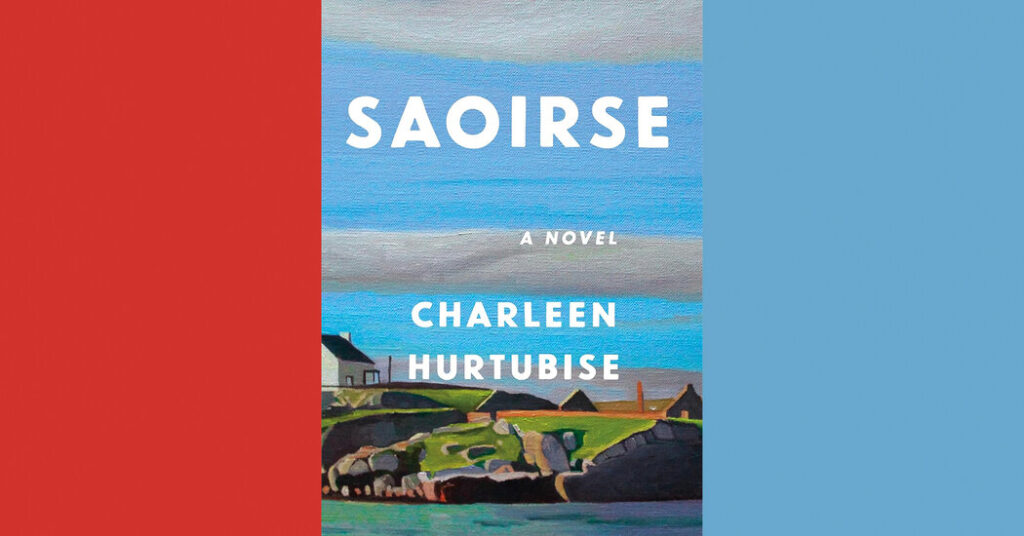
SAOIRSE, by Charleen Hurtubise
The problem with promoting a book as “For readers of Colm Toibin and Claire Keegan” is that those readers will look for Colm Toibin’s nuanced storytelling or Claire Keegan’s exquisite prose.
Charleen Hurtubise’s compelling but uneven “Saoirse” revolves around a young woman forging a new identity (Toibin?). There is misogyny in her story (Keegan?), but aligning this novel with two masterful writers feels unfair and undermines its strengths.
Hurtubise, an American-born longtime resident of Ireland, is her own kind of writer, and “Saoirse” (pronounced SIR-sha, meaning “freedom”) is its own kind of accessible, plot-propelled novel, one that provokes thoughts on art, coastal beauty, the vulnerability of girls and young women, and the infuriating positions where men’s disruptive behavior so often leaves them. I thought of how the “freeze” in the “fight, flight, freeze” response gets overlooked. I thought of how real safety and freedom only come with self-honesty.
The story opens in October 1999, and our eponymous Saoirse — a mother of two young daughters, reluctantly successful painter with an upcoming exhibit in Dublin — is pulling up to the coastal home built by her dreamboat partner, Daithi. The home is in a remote corner of Donegal where “houses have no numbers, only names” and “the midmorning brightness splits the surface of the bay into shards of light.”
Saoirse has barely stopped the car before she starts sketching Daithi standing at the front door. When it occurs to her that he’s not at work like he should be, she is seized with panic. “He knows,” Saoirse thinks, and the reader is put on alert.
It turns out Daithi only wants to deliver a phone message that she has won a major art prize. (I wondered, wouldn’t an administrator want to speak to the artist directly? Perhaps not, but it was the first of many little logistical reality checks that I let slide in this novel.) What is Saoirse hiding?
Cut to nine years earlier, and Saoirse is Sarah Roy, a 17-year-old on a Dublin-bound flight from Boston traveling with a stolen passport of an Irish expat look-alike named Sarah “Sasa” Walsh. Her seatmate is an Irish medical student called Paul Byrne who attentively and annoyingly chats Sarah up, and whose family will become her primary anchor, for better and for worse. From here, the novel follows Sarah’s evolution over the next nine years to the Saoirse we met on the first page.
What is Sarah Roy running from? Who is Sarah Walsh? Hurtubise answers these questions through flashbacks and first-person italicized chapters that share titles with the paintings that will hang in Saoirse’s upcoming exhibition. “Lavender, oil on board,” for instance, is an early memory involving her drug-addict mother dropping her off at her grandparents’ tidy home, and then manically swooping her back up with a stepfather, Lou, in tow.
These first-person segments have a writing-prompt vibe, but they are also searing and intimate. Sarah/Saoirse’s rough past in Michigan, her first stirrings as an artist and a lover, and the sordid drug-dealing world into which Lou entraps her with her beloved little sister as collateral — it’s in these passages that an otherwise remote character feels closest to the page, and I wondered why Hurtubise chose not to write the entire novel from Sarah’s point of view.
Hurtubise is adept at description — the crisscross of dialogue and the rhythms of people coming in and out of rooms, on and off beaches, in and out of memories. Because of that, I found myself wanting to erase full paragraphs of explanation or pry apart summed-up sentences to get to the meaty stuff. “She is on her own then, with her thoughts” — can we hear those thoughts? “She tells him about what happens to her when she draws, how she loses herself.” What happens? How?
But maybe the point is that Saoirse is remote, from herself and other characters. She is an adolescent frozen in survival mode. Just as an actor might bring a character to life, so might a reader.
Regardless, the plot overtakes everything at a runaway pace. Readers will enjoy the twists and turns, though some will wish that the resolution were not so neat — instead allowing room for Saoirse’s internal changes to be deeply felt, rather than seen.
SAOIRSE | By Charleen Hurtubise | Celadon | 256 pp. | $27.99
The post A Stolen Passport, a Girl on the Run. What Is She Hiding From? appeared first on New York Times.