As part of a job search, outsourcing and offshoring company Oceans asked candidates to make a video answering one question: What is your most controversial personal conviction about the workplace? The company received more than 300 responses and most of them were eerily similar.
“It was abundantly clear it was [artificial intelligence],” Matt Wallaert, Oceans’ chief experience officer, said of the repeated answers, which also followed the same structure. It was like “you did the laziest possible … you failed the basic task of sharing your personal beliefs.”
The situation left Wallaert and the hiring team bewildered on how to evaluate the candidates, as even some of the most qualified blended together.
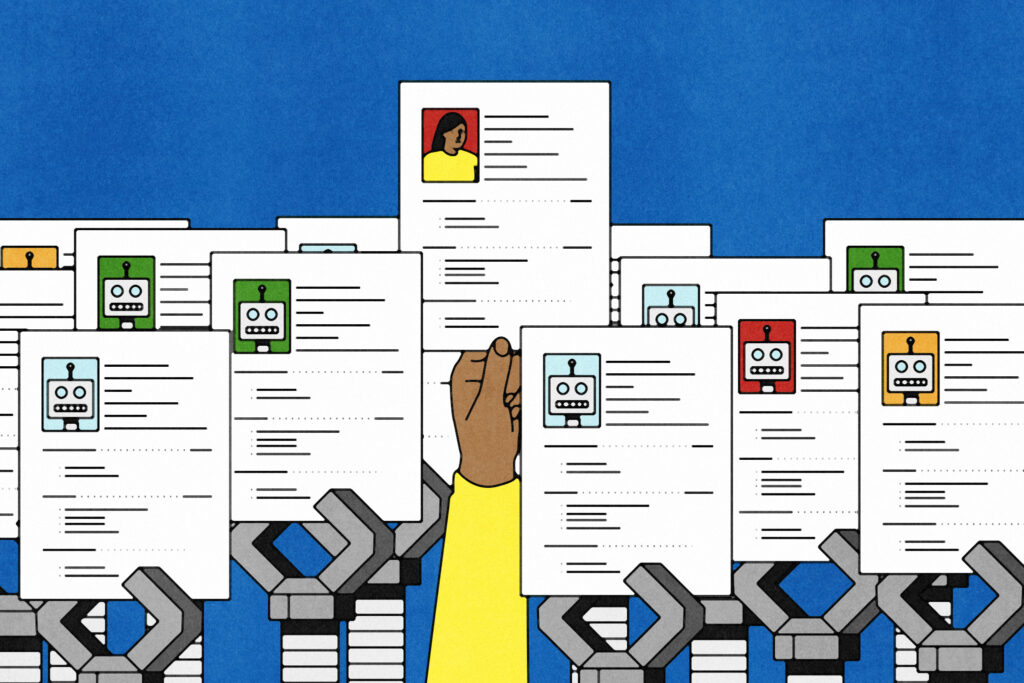
Job seekers are turning to AI to help them land jobs more quickly in a tough labor market. With a plethora of AI tools, some employers may be screening applicants’ résumés, deprioritizing them as candidates. Employers say that’s having an unintended consequence: Many applications are looking and sounding the same. AI has complicated the process for both employers and job seekers leaving both sides at odds over how to get what they want.
It’s easy to spot when candidates over-rely on AI, some employers said. Oftentimes, executive summaries will look eerily similar to each other, odd phrases that people wouldn’t normally use in conversation creep into descriptions, fancy vocabulary appears, and someone with entry-level experience uses language that indicates they are much more senior, they added.
It’s worse when they use auto-apply AI tools, which will find jobs, fill out applications and submit résumés on the candidate’s behalf, some employers said. Those tend to misinterpret some of the application questions and fill in the wrong information in inappropriate spots. If these applications were evaluated alone, employers say they’d have a harder time identifying AI usage. But when hundreds of applications all have the same issue, they said, AI’s role in it becomes obvious.
Joseph Eitner, chief human resources officer for New York-based investment firm Eaton Capital Management, said he has no issue with candidates turning to AI to add some keywords, clean up their grammar, or even help them think through a question on the application. But ultimately, he said, candidates should do the writing themselves, express their own ideas and personalities, and take the time to manually submit their applications.
“If that’s how you apply and how you work, I don’t want to hire you,” he said. AI auto-apply services are “snake oil. It’s a disservice to yourself and to the people you’re applying to.”
Not all employers rely heavily on AI to screen applicants, according to Ron Sharon, chief information security officer in Denver at financial advisory firm PTMA Financial Solutions, and some only use it to help them prioritize people with the necessary experience. Sharon said he uses an AI tool that assigns percentages to candidates based on their qualifications. Anyone who hits a 75 percent or above will be considered for the job, he said, but AI never automatically rejects a candidate.
“I use AI as a tool to help me augment what I do,” he said. “Job seekers should use it to help them augment what they do. They shouldn’t use AI for the complete process.”
But some job seekers say the ways that employers started using the technology to rank candidates prompted them to adopt it.
Stephen Harris, a 37-year-old in San Antonio who’s seeking a job as a tech support specialist, said he’ll stop using AI to write his résumé once recruiters stop using AI to evaluate it.
“You’re saying, ‘You shouldn’t be doing this’ when I know a good chunk of them do this,” Harris said.
Employers are often focusing too hard on finding the perfect candidate and losing some of the most adaptable ones in the process, he said. And while he still tries to stand out by sending his résumé via mail, he says using AI to quickly tailor his résumé makes it easier to be among some of the earlier applicants.
Job seekers say one of the benefits of AI is it can help people make ideas flow better, punch up their words and fill in blanks they may struggle with. But some employers say they’d much rather see the person as they are.
Prateek Singh, founder and CEO of the start-up LearnApp in New Delhi, said when candidates use AI for their applications, it doesn’t allow him to evaluate what excites them about the job and what they’re less interested in. In their cover letters, candidates are asking him to “chat over coffee,” a phrase he said isn’t common in India.
“This is the best time for you to stand out based on all of your flaws and eccentricity,” he said. “If 100 applicants come to us with AI, and you are authentic, you stand out.”
The advice rings true to applicants such as Sneha Sharma, who said when she stopped using AI for her résumé, she started to gain more traction in her job search.
In the course of about six months she had applied to up to 300 jobs, using AI tools such as ChatGPT and some that helped her find leads. She briefly tried an AI application that auto-applied to jobs for her but gave up on that in a couple weeks. But she couldn’t land any interviews.
After taking a break, she adopted a new approach: She stopped using AI, built a couple of résumés from scratch, adding a little personality such as including details about her move to the United States, cold calling and emailing recruiters. Within two weeks she landed seven interviews, and in less than two months, she had a job.
“Don’t be blinded by the internet and that ChatGPT will do everything,” she said. “Use your brain, keep changing and experimenting.”
Wallaert, the Oceans executive, said the company planned to reach back out to qualified candidates who used AI to tell them to try again. The company also plans on updating the application’s instructions to ask that candidates not use AI for their video response. Wallaert has faith that eventually the problem will solve itself, but in the meantime, he feels badly for candidates who may lose out because of relying too much on AI.
“This gap will close over time but at what cost?” he said. “That’s the bummer.”
The post Employers to job seekers: Your AI résumé isn’t fooling anyone appeared first on Washington Post.