The Supreme Court spent a year signing off on nearly every policy of President Donald Trump that came before it, but in a sharp reversal Friday, the justices struck down what is arguably the centerpiece of his agenda — his sweeping tariffs.
That decision along with a ruling in late December blocking Trump’s deployment of the National Guard to Chicago marked the justices’ first significant rulings against the president. More may be on the way. Last month, the justices expressed skepticism during arguments on Trump’s efforts to remove Lisa Cook from the Federal Reserve Board.
Taken together, the rulings and argument could signal the start of a new and fraught era of relations between a president who chafes at limits on his power and justices tasked with checking excesses by the executive and legislative branches.
At a news conference on Friday, Trump lashed out at the justices, who voted against his use of emergency powers to enact tariffs, calling them “disloyal” and a “disgrace to our nation” — language he has never previously used in referring to the court, although it is similar to what he and his appointees have said about lower-court judges.
But the president indicated that he would respect the court’s decision and impose tariffs using different laws.
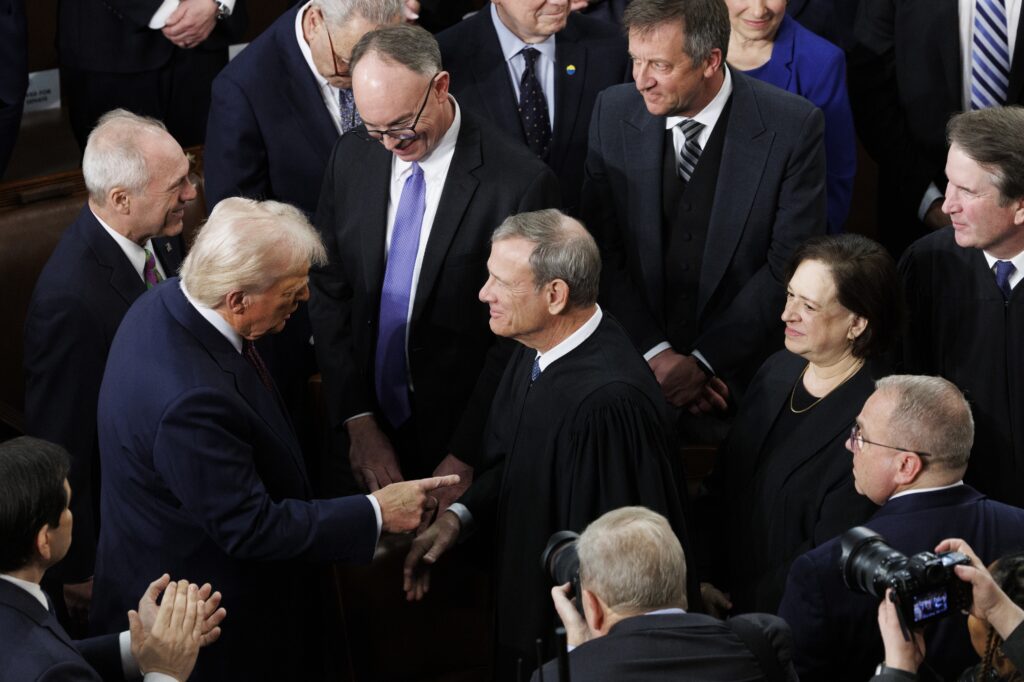
Further indications on the state of the relationship between the court and the White House could come Tuesday, when Trump is scheduled to give his State of the Union address. Traditionally, some of the justices attend.
Leah Litman, a professor of law at the University of Michigan, said the country may be seeing the beginning of a pattern that has played out between the high court and previous presidents as their administrations wear on.
“The court is more willing and inclined to rule against presidents toward the end of their tenure, as they are less popular,” Litman said. “The rulings would be consistent with that trend since we have seen dwindling support for Donald Trump, and the tariffs are not all that popular.”
Litman pointed to major high court rulings against President George W. Bush involving detainees at Guantánamo Bay and President Harry S. Truman over his seizure of steel mills during a strike in the 1950s. Both decisions came as terms waned.
Trump is only entering the second year of his final term, but voter approval of the president has steadily dropped in recent months to some of the lowest levels since he took office again in January 2025. Just 34 percent of Americans said they approved of Trump’s handling of tariffs in the latest Washington Post-ABC News-Ipsos poll, while 64 percent disapproved.
Litman cautioned, however, about interpreting the tariff ruling as a political shift by a staunchly conservative court, since many on the right, including the U.S. Chamber of Commerce and the Cato Institute, a libertarian think tank, opposed the import taxes.
Another factor in the shift in Trump’s success rate at the high court could be that the rulings in his favor last year came on the court’s emergency docket. Those were temporary orders designed to establish the legal status quo while the underlying cases worked their way through lower courts. Now the justices are starting to grapple with final decisions.
“Many sophisticated court observers argued that it was too early to judge the court based on the emergency docket decisions, which were largely about procedural and jurisdictional issues, rather than the substantive legality of these measures,” said Richard H. Pildes, a New York University School of Law professor.
“This term, the court will begin to confront much more fully the substantive legality of major initiatives of the Trump administration. We will have a much better sense by the end of this term of the relationship between the court and President Trump.”
In coming months, the justices are set to rule on Trump’s attempts to fire Cook, a move that has been widely seen as an effort to undermine the independence of the Federal Reserve, and hear arguments in his bid to end birthright citizenship. Many legal experts think those cases could result in more losses for the president on key priorities.
But the court will also issue an opinion on whether Trump can fire the heads of independent agencies without cause, a move that could result in one of the biggest restructurings of the federal government in decades. Most legal experts think he will win that case.
The outcomes will have significant ramifications for the authority of the court, the delicate balance between the branches of government and the success or failure of Trump’s bold executive moves.
Some experts say the recent rulings against Trump put the court’s overall thinking into sharper focus.
Ilya Shapiro, senior fellow and director of constitutional studies at the Manhattan Institute, a conservative think tank, said the court is giving “broad leeway” to the president in reorganizing the executive branch — signing off on mass firings and Trump’s efforts to shake up federal agencies.
But it is taking a hard look at “creating new law or affecting the prerogatives of Congress,” in areas such as troop deployments and tariffs. The Constitution assigns the power to levy import taxes to the legislative branch.
“That will continue in what we’ll see in 2026,” Shapiro said.
Richard Re, a professor at Harvard Law School, similarly argues that the Supreme Court rulings have involved a combination of “carrots and sticks.”
Carrots, he said, are wins for the president on issues such as firings and what many experts say will likely be a ruling in favor of removing the heads of most independent agencies. Sticks, on the other hand, are rulings on tariffs and the potential defeats on birthright citizenship and the Fed.
Last year, the court delayed ruling on “edgier” cases, such as the National Guard and Federal Reserve cases, Re noted. Those delays are now “coming due,” he said in an interview.
“Part of what’s happening is that things that have been delayed for a while can’t be delayed forever,” he said.
The recent rulings against the administration mark a shift from the opening months of Trump’s term.
The court, largely led by its conservative majority, sided with the administration in 20 cases on the emergency docket, while ruling against his policies on just four occasions.
The decisions allowed Trump to strip deportation protections from hundreds of thousands of migrants, ban transgender soldiers from the military, gut the Education Department, unilaterally freeze some foreign aid and grant the U.S. DOGE Service access to sensitive data.
The string of wins for Trump drew sharp criticism from Democrats, who accused the court of rubber-stamping Trump policies. The court’s liberals often protested as well in dissents, including one by Justice Ketanji Brown Jackson that excoriated her conservative colleagues for allowing Trump to cancel nearly $800 million in NIH grants for research on issues that affected minority and gay communities.
In that dissent, Brown referenced a game played in the “Calvin and Hobbes” comic strip.
“This is Calvinball jurisprudence with a twist,” Jackson wrote of the ruling. “Calvinball has only one rule: There are no fixed rules. We seem to have two: that one, and this administration always wins.”
John Mikhail, a professor at Georgetown Law, said there’s another way to look at many of the court’s rulings on the emergency docket: They should be viewed less as victories for Trump and more as a right-leaning court ratifying positions that legal conservatives have long pushed for, he said. The conservative majority would have issued the same rulings “independently of what Trump had done,” he added.
Mikhail said Trump is likely to fare poorly in some of the upcoming cases like birthright citizenship because they demonstrate aggressive, untested assertions of authority that have not previously had much buy-in from conservatives.
“I don’t think this court wants to stray far from what is a conservative legal consensus,” Mikhail said.
One major question is how Trump might react to adverse rulings from the Supreme Court.
Friday, after the justices ruled 6-3 that Trump did not have the authority under the 1977 International Emergency Economic Powers Act (IEEPA) to impose extensive import levies on goods from nearly all of the nation’s trading partners, Trump harshly criticized them.
“The Supreme Court’s ruling on tariffs is deeply disappointing,” Trump said. “And I’m ashamed of certain members of the court — absolutely ashamed — for not having the courage to do what’s right for our country.”
Asked about his two appointees who sided against him, Justices Neil M. Gorsuch and Amy Coney Barrett, Trump said their ruling was an “embarrassment to their families.”
Trump praised the three dissenting justices, Brett M. Kavanaugh, Clarence Thomas and Samuel A. Alito Jr., by name, saying he was proud of their “strength and wisdom and love of our country” in voting to uphold his tariffs.
Some legal scholars have worried Trump might defy the Supreme Court, plunging the nation into a constitutional crisis, but Pildes and others said they think that possibility is increasingly remote.
“In the National Guard litigation he fully complied,” Pildes noted.
Shortly before Christmas, the high court ruled that Trump could only federalize National Guard troops in “exceptional” circumstances. The White House issued a relatively muted statement, reiterating its arguments that the troops were meant to protect law enforcement.
About a week later, Trump announced he would end his efforts to deploy the troops in Chicago and Portland, Oregon, where a federal judge had also temporarily blocked troop deployments in apparent deference to the high court’s order.
Trump faced more headwinds in January, when the justices took up his bid to fire Cook. Eight of the nine justices asked probing questions of Solicitor General D. John Sauer, taking issue with many aspects of the government’s case. The unified front was striking for a court that is usually polarized on high-profile cases.
Mikhail said he thinks that while Trump will sometimes lash out over rulings that don’t go his way, he won’t defy the justices.
“I’m not sure that’s a winning posture for Trump,” Mikhail said of defiance. “It would probably be counterproductive because he wins more than he loses at the court.”
The post Handing defeats to Trump, Supreme Court signals potential course change appeared first on Washington Post.