In a world where geopolitical power is being defined partly by the race between the United States and China to dominate artificial intelligence, India has a pitch for those left behind.
The South Asian giant has neither America’s homegrown A.I. giants like OpenAI and Anthropic, nor China’s know-how and stores of the rare earth elements that power everything from chips to data centers.
Instead, India is using technology as a tool of foreign policy, casting itself as a moral voice for the smaller, developing countries of the Global South, which may lack the resources to tackle the A.I. superstorm that has hit the world.
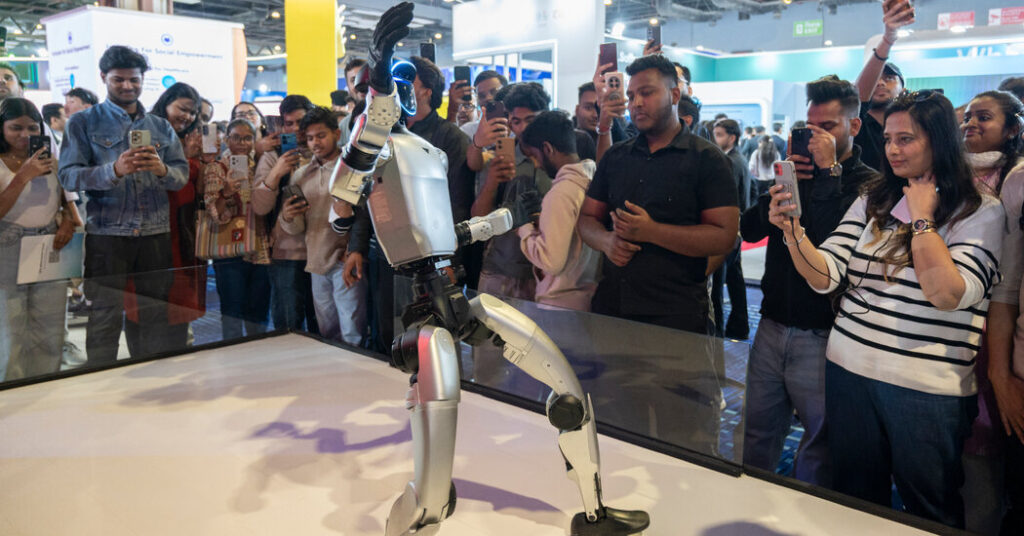
At the A.I. Impact Summit in New Delhi this week — attended by the leaders of countries including Spain, Bolivia, Mauritius and Sri Lanka — India emphasized that the main questions were about how A.I. should be governed and how it should be used for the welfare of the people. It also dangled its pool of I.T. workers and huge domestic market as a test case for applications of the technology.
During his address at the summit, Prime Minister Narendra Modi of India likened artificial intelligence to nuclear power; both are technologies that have immense power to destroy but also to be directed for good, he said. If A.I. becomes “directionless,” Mr. Modi said, it will lead to destruction. A core question is not about what A.I. can do in the future, but what it can accomplish now to serve people, he said.
Many analysts saw his approach as trying to make the most of a situation where India, like many other countries represented, has no clear advantages in a field led by American and Chinese companies.
“India is trying to position itself as a distinct, third-way alternative, centered on the Global South and A.I. as a public good,” said Sushant Kumar Yaduka, who teaches at the Jindal School of Government and Public Policy. It “made sense” for India to take this approach rather than try to join the “geopolitical-technological arms race” between China and the United States, he said.
Coming as it did amid a seismic shift in the world order, where countries are running helter-skelter to protect their interests and form new alliances after President Trump tossed out old orthodoxies and where China appears unstoppable, international relations were hard to ignore.
“You can’t think of foreign policy without thinking of technology,” said Arun Teja Polcumpally, a JSW Science and Technology Fellow at the Asia Society Policy Institute. “India is trying to show it is a country that can be a trusted platform for emerging economies” by doing the groundwork to deploy A.I. responsibly, Mr. Polcumpally said.
India is also seizing the moment to bolster relations with other so-called middle powers — countries with which it can build stronger trade ties and whose support could help its global ambitions, analysts said.
Mr. Modi and President Emmanuel Macron of France held separate bilateral talks alongside the A.I. summit that resulted in commitments to strengthen defense cooperation, including a pathway for India to procure 114 Rafale fighter jets from France’s Dassault Aviation. The Indian government said the two countries had elevated ties to a strategic global partnership that would guide their relationship for decades. Clips of Mr. Modi and Mr. Macron embracing and holding hands aired on social media.
India is also hosting President Luiz Inacio Lula da Silva of Brazil, who arrived in New Delhi on Wednesday on a state visit and is attending the A.I. summit, which was extended through Saturday. The two countries have expanded their trade ties in recent months, and India said on Saturday that the two countries had agreed to collaborate on a range of areas, including energy, pharmaceuticals and critical minerals.
India appeared eager to showcase a keystone of its foreign policy, a version of its Cold War nonalignment approach that, under Mr. Modi’s leadership, was redefined as “strategic autonomy.” Senior government officials have described it as India joining forces with those who best align with its interests and ambitions.
After years courting the United States by positioning itself as a counterweight to China, India has been backed into a corner by the demands of Mr. Trump, especially in reducing its purchases of Russian oil. It eventually struck an interim trade deal with the United States this month that will result in tariffs falling to 18 percent from 50 percent, although the U.S. Supreme Court’s recent ruling invalidating some of Mr. Trump’s tariffs could throw the deal into disarray. On Friday, India signed the Pax Silica Declaration, becoming the tenth member of the U.S.-led initiative to protect supply chains for artificial intelligence and advanced computer chips.
But India has already made progress in spreading its bets: Over the past year, it has struck several major trade deals, including with the European Union and Britain.
“We are very much wedded to strategic autonomy,” said S. Jaishankar, India’s foreign minister, at a recent panel during the Munich Security Conference. India will continue to do things its own way, he said. “It’s very much a part of our history and our evolution.”
Anupreeta Das covers India and South Asia for The Times. She is based in New Delhi.
The post At A.I. Summit, India Tries to Find a Way Between the U.S. and China appeared first on New York Times.