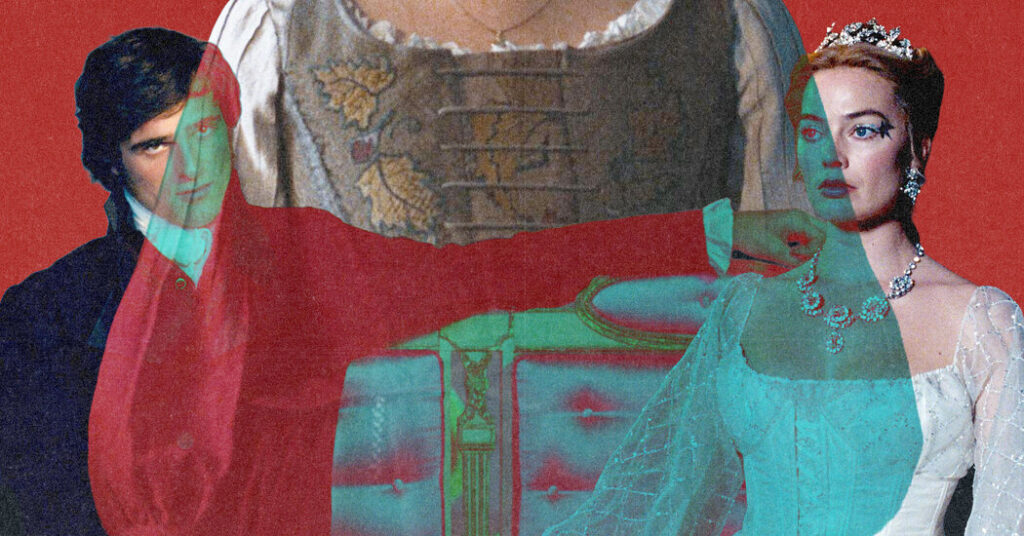
Emerald Fennell’s “Wuthering Heights” has become the No. 1 movie in the country in large part because of its extreme horniness. But to me, the most relatable scene comes when the servant Nelly Dean flops into a chair and gazes wearily offscreen, seeming to wonder how she got caught up in such a hot mess. As played by Hong Chau, this version of Nelly isn’t just a servant to the story’s chaotic lovers; she’s a nonwhite character in a film that has been accused of whitewashing.
Those barbs have been directed at Ms. Fennell because she cast Jacob Elordi as a swoony, sadistic and white-as-they-come Heathcliff, the film’s romantic lead, a lowborn orphan who has a tumultuous relationship with the well-born Cathy Earnshaw (played by Margot Robbie). Many literary scholars contend Heathcliff was not white in the 1847 novel.
Emily Brontë variously describes the foundling in her book as a “dark-skinned gipsy,” a “Lascar” (or South Asian laborer) and possibly even a slave, whose “owner” cannot be found before he’s adopted by the father of his eventual romantic obsession. Given that the author’s father, Patrick Brontë, had ties to the abolitionist movement, it’s certainly likely that Heathcliff’s racial ambiguity matters.
Mr. Elordi is not the first white Heathcliff onscreen. Laurence Olivier, Richard Burton and Ralph Fiennes have all played the part. (Andrea Arnold’s 2012 film features a rare Black Heathcliff, played by James Howson.) But imagining Heathcliff as white ignores a central tension in the book.
The irascible Heathcliff embodies imperial anxieties about the uncivilized other — and what happens when he’s welcomed into society and eventually seeks revenge. Ms. Fennell scrambles those racial politics, dumbing down the story in service of a lust that’s less charged than it might have been.
In the confession that seals their ill-fated separation, Cathy tells Nelly that marrying Heathcliff would degrade her. Stung, the eavesdropping Heathcliff flees, leaving Cathy to accept the proposal of Edgar Linton, a supposedly more suitable match, played by Shazad Latif, who is part South Asian.
It’s possible to argue for the presence of Asian people in Brontë’s England, but Ms. Fennell doesn’t seem to be engaged in that here — a gentleman coded as a colonial subject would clearly not be the more respectable husband. Cathy’s fear of degradation somehow refuses to recognize race when it’s standing right in front of her. (This, while her freaky bedroom walls are the color of her own white skin, with freckles!)
Popular entertainment went through a phase when it thought it could, or should, be colorblind. Back in the Bill Clinton-era 1990s, it was a liberal code of honor to say that you didn’t see race. During Barack Obama’s tenure, “Hamilton” imagined nonwhite founders as both a political gesture and a creative conceit, while calls for representation in the media reached a fever pitch.
But not anymore; all that has come to a decisive end, of course, under President Trump. Look anywhere and try to profess colorblindness, and people will think you’re somewhere between disingenuous and delusional. Race figures as a primary visual vocabulary through which meaning is constructed, in our world and in the stories we tell. Ignoring it assumes a collective naïveté that no longer exists, if it ever really did.
There is contemporary pop-culture precedent for Regency-era romance suffused with diversity in “Bridgerton,” which released the first episodes of its fourth season on Netflix in January. Its fantasy of multicultural concord, which accounts for race while sublimating it to the feathery flights of courtship, was heralded for its ingenuity when the series premiered in 2020. In the years since, creators have more often approached period dramas with a keen eye toward race as a forceful driver of narrative friction.
HBO’s “The Gilded Age” features a parallel world of Black upper-middle-class New Yorkers alongside the old- and new-money white aristocracy battling for dominance of Fifth Avenue. Colorism, or prejudice against darker-skinned people within a racial group, is rarely addressed in mainstream culture and has become a significant thread as the series enters its fourth season.
This year’s top Oscar contenders for best picture dramatize America’s inflamed racial schisms into bloody revenge fantasies. Race is both subtext and text in Ryan Coogler’s “Sinners,” a social horror that draws alliance between Black sharecroppers and Chinese American grocers as they are attacked by both white supremacists in human form and appropriation-hungry vampires who seek to literally and metaphorically suck them of their culture. (The film is largely expected to win the new award for casting.) Far less allegorical is “One Battle After Another,” which pictures a left-wing revolution led by Black women against a white-nationalist state that’s capturing and deporting Latino immigrants.
Race is harder to ignore onstage. The most egregious example of misguided colorblind casting in recent memory was the 2018 Broadway revival of “Carousel,” in which the Black actor Joshua Henry played a monstrously abusive husband to a white damsel — in a musical set just years after the Civil War. The production was short-lived.
Lately the casting of nonwhite actors in traditionally white roles has added dynamic resonance to classic texts, as with Audra McDonald in the recent “Gypsy” revival and Wendell Pierce in the 2022 revival of “Death of a Salesman.” In both, the protagonists’ struggle to achieve their American dreams was assumed to be compounded by racial prejudice, adding a layer of dimension to the existing drama.
But I don’t think it’s necessarily antiwoke to tell an all-white story or to relegate nonwhite characters to the margins, if that’s where they fit the creative intentions. In the modernized “Oedipus” starring Mark Strong and Lesley Manville that concluded its Broadway run this month, the director and writer Robert Icke cast the doomed political dynasty as all white and its ancillary servants — a butler and a driver — as Indian and Black. The production didn’t specify an exact setting, but the casting choices told the audience everything it needed to know.
That’s the problem with “Wuthering Heights”: Ms. Fennell’s casting of Asian actors in supporting roles is, at best, oblivious of how they’ll be read onscreen and, at worst, a cheap kind of scapegoating. Edgar is the boring, undesirable cuck, and Nelly is the scheming servant who’s to blame for Cathy’s thwarted romance and premature death. Either way, the choices tell a confusing story about otherness in the world of the film while pretending that it doesn’t matter in ours.
Ms. Fennell has said that she wanted to make a movie that reflected how she felt reading the novel at age 14, when, of course, the Heathcliff illustration on the cover looked just like Mr. Elordi. There would have been something much more honest had she simply chosen to make an all-white film.
Naveen Kumar is a critic and journalist. He is the associate director of the National Critics Institute.
Source photographs by Warner Bros.
The Times is committed to publishing a diversity of letters to the editor. We’d like to hear what you think about this or any of our articles. Here are some tips. And here’s our email: [email protected].
Follow the New York Times Opinion section on Facebook, Instagram, TikTok, Bluesky, WhatsApp and Threads.
The post Whitewashing ‘Wuthering Heights’ appeared first on New York Times.