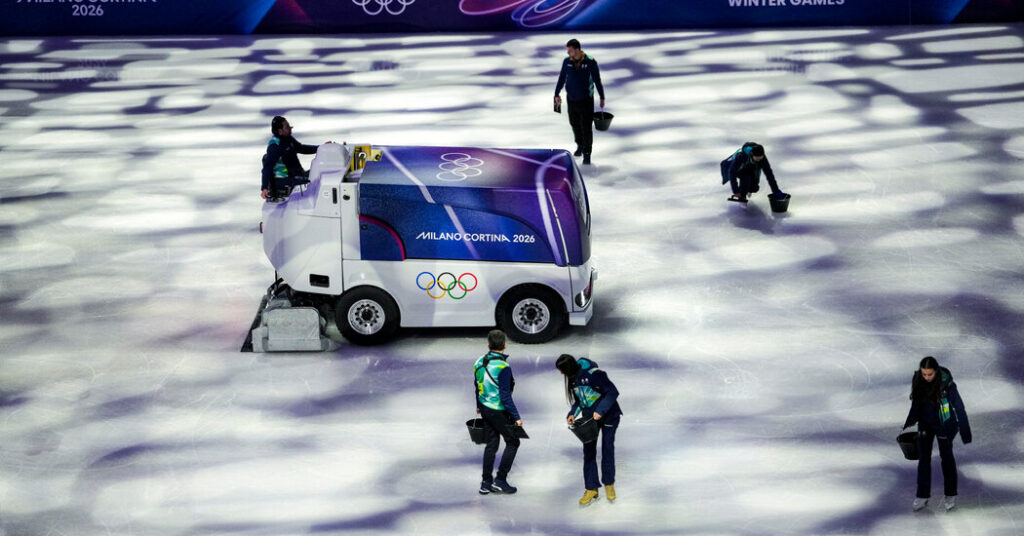
At the Winter Olympics, it is not just the figure skaters attempting acrobatic jumps and speedskaters whizzing around at almost 35 miles per hour who have been executing daily feats of technical and choreographic skill on the ice.
Consider the Zamboni drivers, the highly skilled operators who restore the frozen surface to pristine condition between each Olympic contest. They help keep the ice at the right thickness and temperature, while other technicians maintain the humidity in the arena so that the skaters can achieve their peak performance.
Before, during and after every race or competition, the drivers maneuver ice-resurfacing machines known as Zambonis onto the rink, circling the perimeter and going back and forth in steady, mesmerizing moves. In a matter of minutes, the drivers shave off a tiny layer of scratched ice and lay down another thin layer of filtered water that freezes to form a new, even surface.
A lot can go wrong: With restricted sightlines, the drivers can skid and crash into a wall. If they turn a wheel on the control panel imprecisely, they might leave a hole in the ice.
Just like the skaters, the Zamboni drivers need to “know the ice perfectly,” said Remy Boehler, who oversees the drivers and engineers at the ice-skating arena in Milan.
And not unlike the skaters, the Zamboni team has often been involved in drama. The arena is used by both figure skaters and short-track speedskaters, two groups that need different kinds of ice. As a result, some athletes have complained that they have gotten the worst of both worlds.
Figure skaters need slightly warmer, softer ice that can give a little during their landings after spins or jumps. Speedskaters perform best on colder, harder surfaces that enable their blades to glide faster.
Mr. Boehler said he closely monitors the ice temperature and the arena’s humidity on his cellphone and laptop, and adjusts for spikes in temperature that are sometimes caused by the arrival of more spectators. He and a team of engineers can change the ice temperature by adjusting the heating and air-conditioning system and pumping ethylene glycol — similar to antifreeze in a car — through pipes embedded beneath the rink. Sometimes, he even goes out on the ice to clear stray slush and check for divots or holes.
Still, the resulting ice can be “a bit of a compromise between what they need and what we need,” said the Italian speedskater Lorenzo Previtali, after racing on Wednesday night.
The two sports have shared rinks at past Olympics. “The ice technicians in general do a great job,” said Drew Meekins, a U.S. figure skating coach. But the constant swing in temperature “does take its toll on the ice quality,” he added.
Some competitors in speedskating races on Wednesday night said the ice felt softer than they were accustomed to, which might have accounted for more stumbles. “The grip factor is very important,” said Mirei Nakashima, a Japanese speedskater. “I think the conditions are a bit unusual.”
Mr. Boehler, a veteran of five Olympics, is used to occasional complaints. “Usually you have different opinions with the ice,” he said.
The margin for error is slim, according to Mark Messer, who supervises the ice experts at a separate arena for long track speedskating in northwest Milan.
“If we make the ice too cold, it’ll shatter,” said Mr. Messer, who is working his seventh Games. “If we make it too soft, they don’t get any speed. So we have to find a balance in between.”
Operating a Zamboni — which is made by an American company founded by the son of Italian immigrants — at the long track rink is particularly tricky because the drivers move in tight formation in the same counterclockwise direction as the racers. With steering wheels on the left side of the Zambonis, the drivers’ sightlines are sometimes obscured when they drive close to the padded wall that encircles the oval.
At the Olympic ice hockey rink, inside a new concert arena, the thickness of the ice depends on whether men or women are playing on it.
When women play, the drivers shave a thinner slice of the ice because the players weigh less on average, according to Don Moffatt, hockey’s chief ice maker who has worked the last five Winter Games. The men’s heavier body weight means their skates tend to cut deeper into the ice during game play.
“So we have to shave more off the top to make it smooth for them for the next period,” Mr. Moffatt said.
Mr. Moffatt has dealt with a few mishaps. At the Turin, Italy, Games in 2006, one Zamboni driver failed to stop the flow of tire wash coming out of his machine. Another driver, while trying to signal to his partner to turn off the wash, neglected to stop the flow of warm water from his machine. Within minutes, both Zambonis had melted holes in the ice, exposing the concrete slab below.
“Needless to say,” Mr. Moffatt said, “those two Zamboni drivers didn’t drive again.”
Juliet Macur contributed reporting from Milan.
Motoko Rich is the Times bureau chief in Rome, where she covers Italy, the Vatican and Greece.
The post At the Olympics, Drama on the Ice Is Not Limited to the Skaters appeared first on New York Times.