A magistrate judge on Friday sharply admonished the Justice Department for failing to tell him about a rarely invoked law that restricts searches for reporting material when it applied last month for a warrant to search a Washington Post reporter’s home.
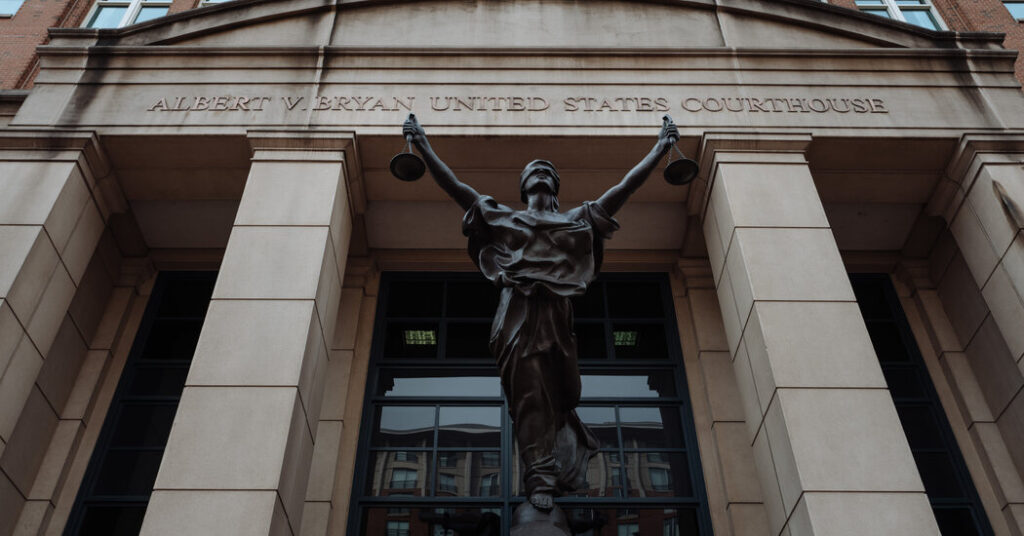
“Why didn’t you raise it?” Judge William B. Porter of the Eastern District of Virginia asked during a heated stretch of a hearing at the federal courthouse in Alexandria, Va. “It’s a threshold question in this case.”
The assistant U.S. attorney who submitted the warrant application, Gordon D. Kromberg, later conceded that he had known about the law, but also said he had been following department policy in not bringing it to the judge’s attention.
“I apologize to you,” Mr. Kromberg said.
First Amendment scholars say the search of the home of the Post reporter, Hannah Natanson, was unprecedented. It was part of a broader investigation into a government contractor’s handling of classified material.
The Privacy Protection Act of 1980 says that a search for reporting materials “shall be unlawful” unless there is probable cause the reporter committed certain crimes to which the materials relate.
Searches for reporting materials are exceedingly rare, and the Privacy Protection Act raises numerous legal questions. Among them is who decides whether the law’s standards have been met: the Justice Department when it wants to conduct a search or the judge being asked to issue a warrant.
Several specialists in legal ethics have faulted Mr. Kromberg for failing to bring the law to the judge’s attention. They said that if he knew about it, the omission appeared to violate a rule of professional conduct that requires telling a court about adverse legal authority, or laws and court precedents that could harm or contradict their clients’ position.
A First Amendment advocacy group, the Freedom of the Press Foundation, filed an ethics complaint against Mr. Kromberg with the Virginia State Bar over his failure to alert the judge to the 1980 law. The bar declined to review the matter, saying it was for Judge Porter to assess.
It was unclear whether the judge’s rebuke would be the extent of his response, or whether he intended to pursue the matter further.
Judge Porter initially grilled another federal prosecutor, Christian Dibblee, about whether the department knew about the 1980 law and its additional requirement of probable cause when it sought his blessing for the search.
Mr. Dibblee said he was not involved in the application, and Mr. Kromberg tried to interject. Judge Porter, spotting Mr. Kromberg’s movement, shouted, “Sit down!”
The judge repeatedly said that he found it hard to believe that the law did not apply, and pressed Justice Department lawyers to explain why the government had failed to tell him about it. “How could you miss it? How could you think it doesn’t apply?” he asked.
Mr. Dibblee told the judge he understood his “frustration,” and said the decision had been made by higher-level officials in the Justice Department. Judge Porter replied, “That’s minimizing it!”
Judge Porter also disclosed that the Justice Department had sought a warrant to search Ms. Natanson’s home multiple times, and that he had rejected earlier versions of the application before approving it. After he finished grilling Mr. Dibblee, he allowed Mr. Kromberg to defend the department’s actions, remarking, “I didn’t mean to be intemperate.”
The search of Ms. Natanson’s home was part of an investigation into Aurelio Perez-Lugones, a government contractor accused of disclosing classified information to her.
The judge had scheduled the hearing several weeks ago to consider a request by The Post and Ms. Natanson to return various electronic devices that the government seized in the search.
The seizure of those devices has raised questions about whether the Trump administration would review her data to determine sources unrelated to any leak of classified information. Ms. Natanson, who covers the federal bureaucracy, wrote last December that 1,169 officials across the executive branch had contacted her during the first year of President Trump’s second term.
Mr. Dibblee expressed confidence in government protocols for filtering information from seized devices and ensuring that materials irrelevant to the case at hand do not reach investigators.
Simon Latcovich, a lawyer representing The Post, argued that the government’s seizure of Ms. Natanson’s devices amounted to having “commandeered the entirety” of her “professional life.”
But the hearing diverted into tense exchanges over the Privacy Protection Act. The Trump administration apparently decided that the 1980 law did not bar the search, because it concluded for itself that Ms. Natanson had probably violated the Espionage Act, which bars the unauthorized retention and dissemination of national security secrets.
That theory also raises an untested First Amendment issue: whether it is constitutional to criminalize ordinary news-gathering activity. The government has never charged a traditional reporter under the Espionage Act.
Mr. Kromberg, who was involved in the investigation of Julian Assange, the WikiLeaks founder, cited past cases in defending the department’s actions.
The one previous known instance in which the Justice Department sought a search warrant for reporting material as part of a classified leak investigation involved reading a Fox News reporter’s emails in his Google account in 2010. The department’s application materials in that case alerted the judge to the Privacy Protection Act.
When the search came to light in 2013, it was treated as a scandal across party lines. Attorney General Eric H. Holder Jr. issued a rule barring investigators from portraying reporters as criminals to circumvent the Privacy Protection Act’s ban, unless they intended to bring charges. Last year, Attorney General Pam Bondi rescinded it.
Charlie Savage writes about national security and legal policy for The Times.
The post Judge Rebukes U.S. Over Application to Search Reporter’s Home appeared first on New York Times.