The economic disruption inflicted on Canada by President Trump has largely not been caused by the tariffs struck down by the Supreme Court on Friday. In fact, the ruling offers no relief on the American tariffs harming key Canadian manufacturing sectors — auto, steel and aluminum — as well as the Canadian lumber industry.
The court ruled that Mr. Trump had exceeded his authority in using a decades-old law on emergency powers to justify many of his tariffs. One of the tariffs that falls in that category was a 25 percent levy on most Candian goods imposed a year ago, for which Mr. Trump citing groundless claims of vast influxes of fentanyl and migrants across the border. He then raised the levy to 35 percent. But most of the goods thus taxed qualified for duty-free crossing under the United States Mexico Agreement, a trade pact.
The result is that 89 percent of Canadian exports still entered the United States tariff-free last month, according to an analysis by the Royal Bank of Canada. Prime Minister Mark Carney of Canada, who is an economist and former central banker, has estimated that the effective tariff rate is 5.5 percent, while other calculations place it as low as 3.1 percent.
The tariffs that have disrupted Canadian industries, led to layoffs and raised concerns about the survival of some factories and jobs fall into a different category: those imposed as national security measures. Those are not affected by the Supreme Court ruling.
“What’s hurting the Canadian economy are the sectoral tariffs under a different American law,” Dominic LeBlanc, the member of Mr. Carney’s cabinet tasked with handling trade relations with the United States, told CBC News on Friday. “This just reminds us again of the importance of diversifying our trading relationships.”
The tariffs he referred to include a 50 percent levy on Canadian steel, aluminum and some copper products, and a 25 percent levy on Canadian automobiles, trucks and buses. Mr. Trump also imposed additional tariffs on top of longstanding duties on Canadian lumber. The Royal Bank report said that exports of those products “fell sharply” in 2025.
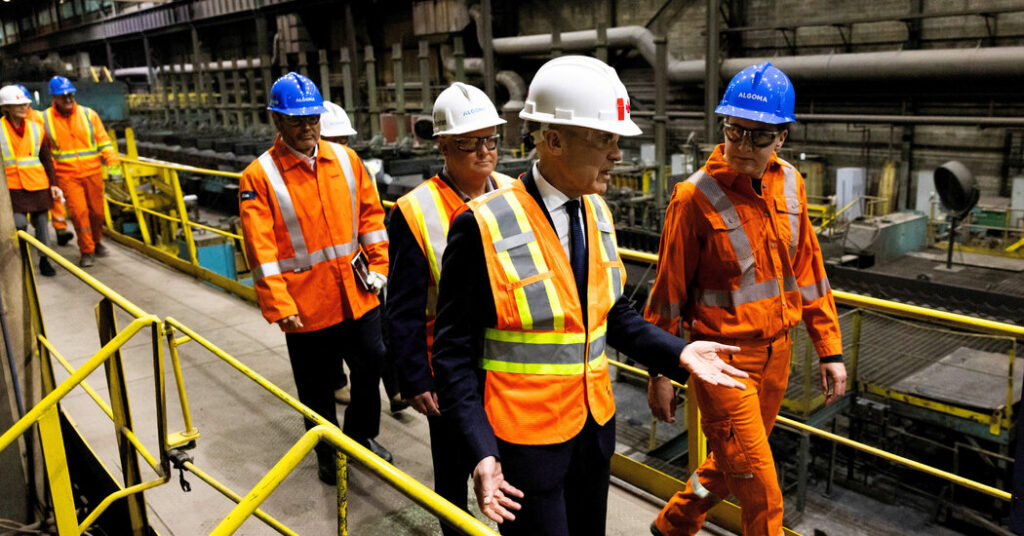
Algoma Steel, the only Canadian-owned steel mill, laid off employees. The auto maker Stellantis abandoned the retooling of a factory in suburban Toronto after moving production of its Jeep model to Illinois. And General Motors closed a factory that made electric delivery vans. Late last month, G.M. laid off one shift at a pickup truck plant in Ontario.
.
There have been other disruptions, too, as Canadian businesses, many of them small, have simply given up on selling to the Americans. Under U.S. rules, Canadian retailers must pay the 35 percent tariff on products that would be duty-free if delivered by mail. And Mr. Trump eliminated a longstanding exemption from tariffs for shipments valued at $800 or less.
Ian Austen reports on Canada for The Times. A Windsor, Ontario, native now based in Ottawa, he has reported on the country for two decades. He can be reached at [email protected].
The post The U.S. Tariffs Causing the Most Pain for Canada Remain in Place appeared first on New York Times.