Times Insider explains who we are and what we do and delivers behind-the-scenes insights into how our journalism comes together.
Every two years, a new Olympic Games gives the visual teams at The New York Times a chance to produce something fresh. One of our favorite things to create are miniature athlete visualizations, like the dozens of snowboarding and figure skating videos published over the last two weeks.
The Times has animated nail-biting moments and photo finishes from Olympics events since at least 2008, and in recent years we’ve made 3-D visualizations of swimming, running and figure skating. Ahead of this year’s Milan-Cortina Games, we pushed ourselves to visualize another winter sport: snowboarding in the halfpipe. Snowboarders like Shaun White and Chloe Kim have become household names by pushing the sport forward with newer, bigger, crazier tricks. Creating their world would be a new challenge.
In figure skating, there are only six types of jumps. By creating animations of those jumps, we can generate a video of almost any possible routine. And figure skaters submit their routines ahead of the event.
Halfpipe doesn’t work that way; the combination of tricks is practically infinite, and athletes do not share their routines before competing.
Even with the added complexity, we thought it was possible. But to pull it off would take a team with a variety of skills.
Seven people, including designers, developers, 3-D experts and editors, needed to develop a new strategy and build a system that could take in a variety of halfpipe runs and generate videos illustrating what had happened. It required close collaboration and experimentation.
Halfpipe athletes want to do high-scoring tricks, which narrows down the list of moves they might perform. We watched runs from the top athletes, tracking all of their tricks over the past year to get a manageable repertoire of skills that we expected to see.
In January, we animated more than 100 moves that could be spliced together to make a seamless run through the halfpipe. The number of variables we had to consider also increased compared to figure skating — for example, which foot the athlete put forward while riding, the direction of a spin, even the entry onto the ramp.
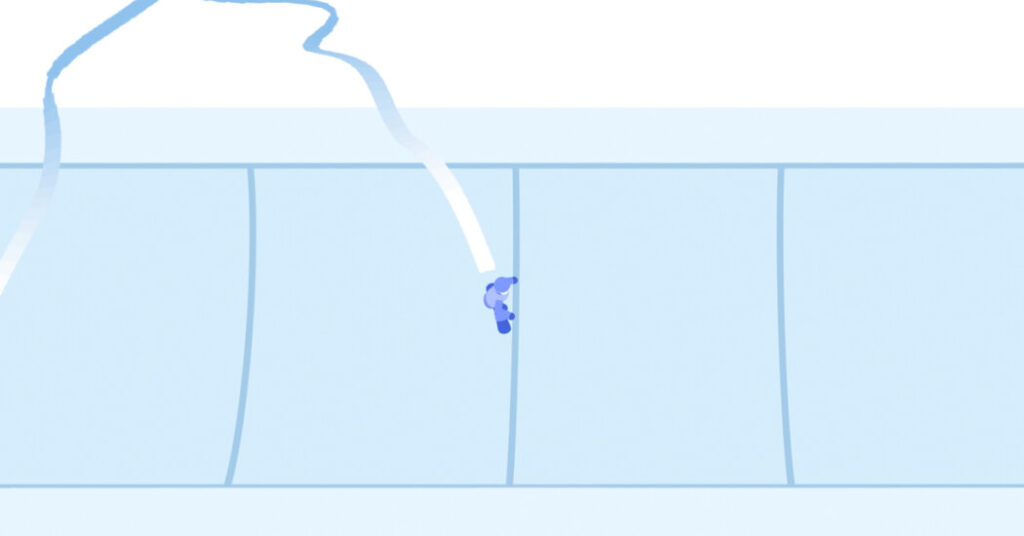
Building the halfpipe itself brought challenges. Our little athletes tend to move in straight lines in the pool, but a halfpipe snowboarder slides up U-shaped walls that, in reality, are about 22 feet high and 64 feet apart from lip to lip.
All the animations are driven by codes from the Olympic data feed, so our system is designed to recreate a run within a minute of the judges’ score — as long as we have the right tricks. We added at least one new animation during the competition: Scotty James did a backside 1440 that we weren’t expecting.
We also wanted to show a level of analysis in our animations. With figure skating, every jump gets points based on how well it is executed. Snowboard halfpipe doesn’t have this breakdown, only an overall score given when the run is complete. For someone who doesn’t usually watch snowboarding, the difference between a 1260 and a 1440 can be difficult to differentiate. Our animations show a trail that follows each move, which helps readers visualize the number of rotations and flips of each trick.
We also got to work closely with composers and sound designers at The Times to produce original music and sound effects, giving the videos a unique personality and making them more memorable for readers.
The videos have been hugely popular on social media, and it’s fun to see commenters enjoying the simulations, though some have suggested that A.I. was behind the effort. We talked about this likelihood when we were building our mini athletes, and made sure to include our credits in social media posts.
The team’s next big question: What should we build in 2028 for the Games in Los Angeles?
Wilson Andrews is an editor in The Time’s Graphics department who leads the election results team.
The post Some Readers Thought Those Little Olympians Were A.I. Here’s How We Made Them. appeared first on New York Times.