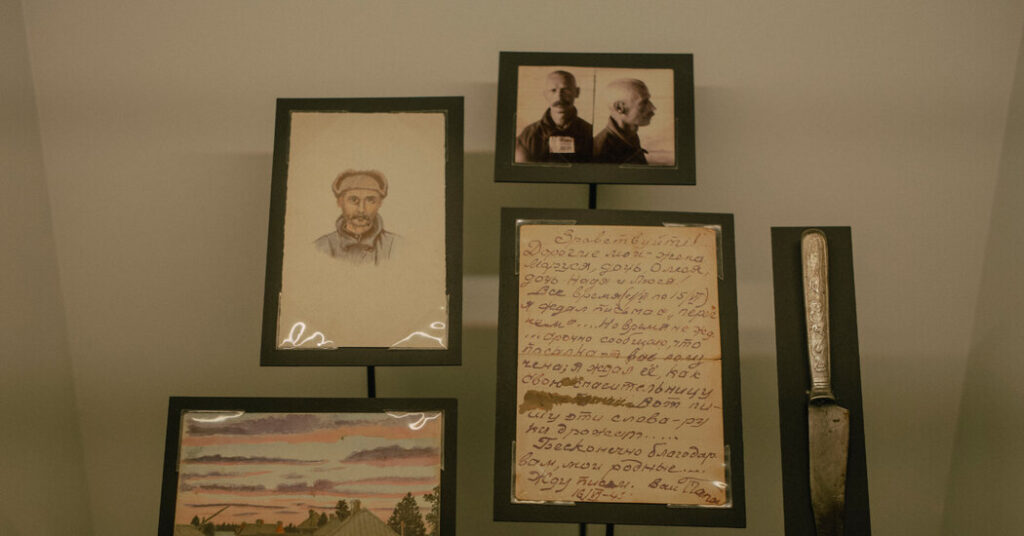
The Gulag History Museum in Moscow, the last prominent Russian institution dedicated to preserving the memory of Stalin’s labor camps, is being replaced by a new museum focused on Nazi war crimes and the “genocide of the Soviet people,” the city government announced on Friday.
The museum stopped admitting visitors in November 2024, citing unspecified “fire safety violations.” Its website was replaced by a brief statement from the Culture Department of the city government announcing the change.
President Vladimir V. Putin has attempted to justify the invasion of Ukraine by falsely characterizing the government in Kyiv as a continuation of the Nazi threat to Russia. While there is no doubt that citizens of the Soviet Union suffered atrocities at the hands of the Nazis, the Kremlin has long sought to downplay crimes the Soviet Union committed against its own people.
“Any reminder of the crimes of the Russian state is very inconvenient for the current authorities,” said Nikita Sokolov, a historian and editor now living in Germany. “A victorious people can only have a victorious history — there should be no dark pages in it.”
The Gulag museum, he noted, had organized seminars and other public events focused on the brutal history of Stalin’s repressions.
Attempts to memorialize the millions imprisoned under Stalin emerged after the collapse of the Soviet Union in 1991, but the Kremlin began dismantling them about a decade ago, after Mr. Putin returned to power.
The Gulag Museum at Perm-36, a preserved former labor camp near the central city of Perm, was reorganized around 2015, with exhibitions that emphasized things like timber production at the camp and the challenges faced by the guards.
A human rights organization, known as Memorial, which documented the crimes of the Stalin era, won the Nobel Peace Prize in 2022. The Russian government closed it the year before. Many employees fled the country.
Mr. Sokolov, the historian, was involved in the organization’s “Last Address” project, which put the names of Stalin’s victims on small metal plaques on the apartment houses where they last lived. In the four years since the Ukraine war started, many of the signs have been torn down, he said.
Since Mr. Putin launched a full-scale invasion of Ukraine in 2022, Russia has banned the annual ceremony commemorating the Day of Remembrance of Victims of Political Repression, when people lined up all day outside the headquarters of the secret police in Moscow to read aloud the names of the victims of Soviet repression.
The Gulag History Museum was founded in 2001, after the collapse of the Soviet Union, through the efforts of Anton Antonov-Ovseyenko, whose father, a Bolshevik commander, was executed, and whose mother hanged herself in prison.
Its first home was a cramped building incongruously located behind the Gucci store in downtown Moscow, with a reconstructed watchtower and coils of barbed wire visible down an alley next to the store.
In 2015, it moved into a newly restored building. Natalya Reshetovskaya, the widow of the Soviet writer and Gulag survivor Aleksandr Solzhenitsyn, spoke at its opening ceremony. “There are lots of people, particularly the young, who do not know they are walking on bones,” she said.
The museum’s permanent collection included an array of battered cell doors from different camps, and its special exhibitions featured unique memorabilia, like the clandestine diary of camp life drawn as cartoons. Its exposed brick walls, black metal fixtures and dim lighting were meant to evoke the camps.
Museum researchers also carried out research expeditions around the country to gather oral history from those who had survived the camps, and the museum put a special emphasis on documenting the repression of ordinary people.
The city government’s statement on Friday about the new museum did not mention the Gulag History Museum, and the Ministry of Culture did not respond to a request for comment. But Russian news reports said the Gulag museum was being replaced.
The new Museum of Memory will include exhibits like the recreated room of a Leningrad resident during the extended siege, the statement said. It quoted Natalya Kalashnikova, the new director, as saying, “One of its key goals is to instill in the modern generation a strong rejection of Nazism in all its manifestations.”
Mr. Putin has put a renewed emphasis on what Russia calls the Great Patriotic War, or World War II, when Hitler invaded the Soviet Union in 1941. An estimated 27 million Soviet citizens were killed in the war.
The Kremlin has repeatedly suggested that its invasion of Ukraine was prompted by Western plans to use the country as a staging grounds to attack Russia.
Mr. Putin has tried to create “a picture of the world in which Russia is always the victim and never the aggressor,” said Mr. Sokolov, the historian.
Alina Lobzina contributed reporting.
Neil MacFarquhar has been a Times reporter since 1995, writing about a range of topics from war to politics to the arts, both internationally and in the United States.
The post Russia Takes the Gulag Out of the Gulag History Museum in Moscow appeared first on New York Times.