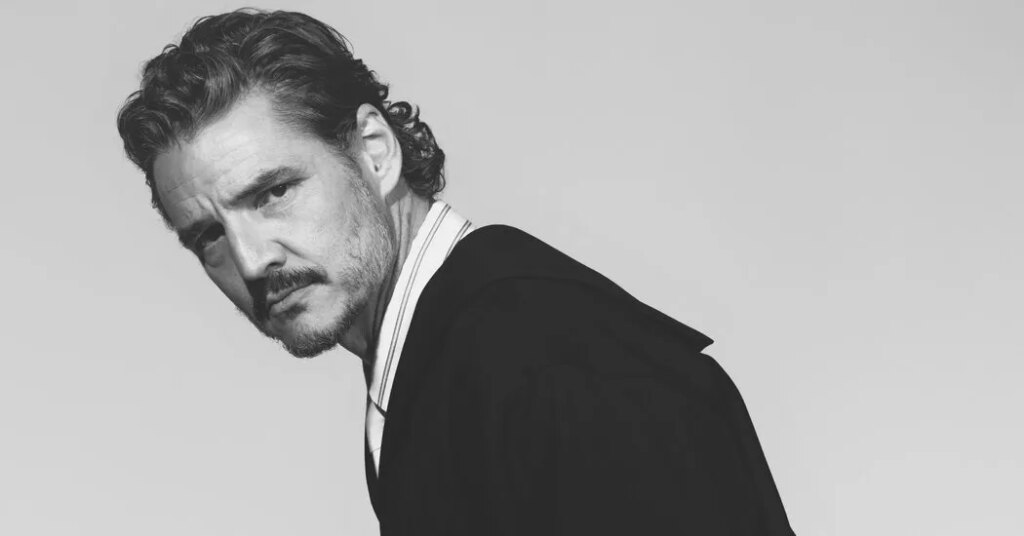
There is sometimes a strange alchemy in interviews where you can get to a deeper, more complex place with someone despite your role as a journalist and theirs as a subject. The person being interviewed has to be willing to talk meaningfully about their life, sometimes their past, and reflect on it. Celebrities in particular can be understandably hesitant to do that. There was a personal reason I wanted to try to have that sort of conversation, though, with Pedro Pascal.
Pascal had a dramatic and painful rupture in his childhood in Chile that would shape the rest of his life in ways that he is only just coming to fully understand. His family fled their home country, ended up in exile in Texas and then later moved to Orange County, Calif. While he eventually found home and community in the theater in New York City, his mother never recovered, as he tells me, from the strain of displacement.
Pascal came to fame and professional success late in life, when at 39 he played Oberyn Martell in “Game of Thrones.” That role catapulted him into an A-list career, with roles as an interplanetary bounty hunter in “The Mandalorian” and a fierce father figure in the postapocalyptic saga “The Last of Us,” among others. His latest part is perhaps his most personal. In “Behemoth!” directed by Tony Gilroy and opening Dec. 4, he plays Alex, a nomadic, middle-aged cellist who is trying to come to terms with his life. It’s a role Pascal, now 51, told me he can really identify with.
Subscribe: Apple Podcasts | Spotify | YouTube | Amazon | iHeart
“Behemoth!” is hard to describe. It’s like being locked in a dream or a memory. But I also think it plays into some of the themes that I want to talk about with you. You play Alex, a celebrated cellist in midlife, and the film unfolds over a series of flashbacks. I’ve seen the film described in a lot of ways, but to me it’s about generational trauma. I agree with you on a deep level. It’s very simple in its characters and in its humanity, but it’s very unusual in its structure. You’re figuring things out as the character is figuring things out. It wasn’t until a particular line in the movie where I realized that this character is, in his way, attempting to end generational trauma. But I didn’t think about that until we were doing it, so I’m very moved that you picked up on that.
Alex says very little in the film. There’s not a lot of dialogue. And there’s been a lot of discussion about how you, as an actor, are able to express things nonverbally in many of your roles. I’ve seen your face described as having incredible emotional depth, and also that you have “sad eyes.” Can you talk me through what is happening in a role like this, where you have to communicate so much but are not talking? There’s something delicious about a character who has a big internal life and is not skilled at expressing themselves externally. To have the entire story inside you and know that you’re only sharing it with the camera. That’s your secret self, almost.
You gave a great Spanish-language interview to your cousin, published in Chile, and you talked about what you give to a role. You said, “I put all my confusion, my joy, my sorrow, my ambivalence, my hostility, my rage, my love, my lust, my greed, my compassion, ignorance and knowledge” into your characters. That is a deep cut.
It is, and I was reading all those words and thinking, God, that must be wrenching. It can be wrenching to experience all of the things in life as we do. This is one of my early interviews, but what I got from that quote was a little bit of earnestness. I’m speaking to one of my older cousins, who was a really big deal to me as a kid. Her father is my godfather. It was always [lowers voice to a pity whisper] “He wants to be an actor.” They would probably all deny it, but I think there was a lot of pity and concern, especially that it was something I was continuing to pursue as a young adult and it wasn’t going my way. So then, for all of them, there was this kind of like: “Holy [expletive]! This son of a bitch got away with it!”
It’s an interesting interview because of her insight into your early life. And I’d like to talk a little about that, because I think that’s where a lot of those emotions come from. My family came from Cuba as political refugees, and there’s something very specific about that experience. Your family had to flee Chile when you were still an infant. Your parents were caught up in what was happening at that moment, a U.S.-backed coup that had thrown out the democratically elected government of leftist Salvador Allende. What was your parents’ involvement? My dad was doing his residency at the hospital of the university in Santiago, and my mother was in college. They were very progressive thinkers and, without too much calculation or preparation, did what they could when they could. Specifically, somebody had been shot in a gunfight and he was brought to my parents’ house knowing that my father was in medicine, and they hid out in our home. I must have been 4 months at the time, which would have made my sister 3 years old. And I remember a story about her being really pissed that there were guns on her bed.
So someone who brought this wounded man to our home was taken into custody, was tortured, and he gave names. And that included the names of both my mother and my father. Like a scene from some kind of political thriller, my father was lucky enough to get word that there was an officer at the hospital asking for him. And then that same officer put his hand on his shoulder and, as my father describes it, says, “Are you Dr. Balmaceda?” God, it’s fascinating to talk about these things because as much as I have tried to get details from my father, it still slips away. I don’t know how much he told me. I don’t know how much I put together myself. I do know that there was a moment of luck when a woman complained that she had been waiting so long in a room and that she was in pain and needed to see a doctor. She was an older woman, and you know in our culture, La mama manda [Mom is in charge].
You have to attend to it immediately. Exactamente. It’s like, “Well, Mom says. …” So I wonder if she knew what she was doing, and I don’t know if my dad knew that she may have known what she was doing to save him. Because he ended up taking her to the room, and he went out the back door, got my mom and then they went into hiding for six months.
They went to the Venezuelan Embassy, and you were taken care of by your cousin’s family because they had to leave without you. Your mother could not leave the embassy grounds, so your aunt would take you to see your parents through a window. Your mother couldn’t touch you, she couldn’t hold you, and you were a baby. Your early life was marked by such separation and fear. How do you think that specific period impacted your whole family? It’s a good question. It’s strange because we found ourselves landed on a different planet altogether — you know what I mean? — in San Antonio, Texas. And I’m none the wiser as a child, going to the movies with my father and being in the public school system in Texas and gradually coming to understand that there’s this entire large family in this world far away. I was sent back to Chile when I was 4 years old, before my parents were allowed back. It sounds like I’m making it up, but I was 4 and my sister was 7 and we flew by ourselves. My parents handed us over to the stewardess, who was just this wonderful-smelling ——
You remember it? I can recall taking a woman’s hand and feeling safe, weirdly. And then being escorted to the family waiting for us in Santiago and spending an entire summer there while it was winter in the States. It’s crazy to think about the things that you didn’t talk about, because obviously my parents needed help. They couldn’t manage things. And so somebody must have come up with the idea of, “Let us take the kids for the summer, sort your [expletive] out.”
My parents fled Cuba. My mother had two children. She was pregnant with a third. She was only 20 years old. And it sent her on this life of constant transition. And in my estimation, it made her a hoarder. She’s got warehouses filled with stuff that just sits there, old VHS machines that she never wants to throw away. And she’s explained that because she lost everything so young and then had this constant movement, things changing all the time, she wants to just hold onto things very tightly. And because I grew up with her, it makes me want to purge and get rid of everything! Did you have something like that? Did that trauma affect them in a particular way and it impacted you? I’m still negotiating with all of that. When we started the interview and we were speaking in Spanish, I was telling you that I feel a little embarrassed by being a first-timer around some of these things at my age. I’ve been having a year where I marvel at how young I feel inside — not in terms of vitality, unfortunately [laughs], but in how young I feel emotionally. How vulnerable I feel. This sounds like this way of tricking you into thinking about “Behemoth!” because the central character is totally evaluating his life and is having all of these memories triggered by music, and we’re part of this life evaluation slash life puzzle that has a big surprise. Well, that’s the [expletive] I’m going through.
You mentioned this very early physical separation as an infant between me and my mother. I’ve been having a lifelong struggle with sleep. I’ve been in therapy for most of my adult life, on and off. You feel like you make a lot of progress, and you slip back a lot, too. All of these things are so nonlinear. I talked to a doctor about this sleep issue over and over again. They start to ask you about your past. And I was like, “Well, it was a pretty tumultuous start.” And they’re like: “Hold on a second. Your mother went into hiding with you?” And I was like: “No, they went into hiding by themselves. My aunts took care of my sister and me.” And they’re like: “So you were physically separated from your mother? For how long?” And I was like, “For six months.” And they’re like, “Everything that was the most familiar to you was suddenly taken away from you.” And I was like: “That’s [expletive] great! What the hell am I supposed to do about that? I don’t have any memory! [Laughs] How am I supposed to fix that?”
I do feel kind of helpless against that sometimes. I also feel very, very grateful. I have such an incredibly rich life. All four of my siblings, we are close, we are thriving. But there’s still perplexity for me over how I navigate the very early conditions that have authored how I live inside my body. Maybe there’s way more therapy than I realize in playing parts. So in a safe environment, you can work out the grief of your own daughter dying in your arms or getting a chance to play a character who is just as nomadic as you are.
What was the catharsis of Alex in “Behemoth!”? He may fail the expectations of relationships that he’s in and is partly a victim to the circumstance of the dysfunctional dance his parents seemed to be trapped in and how they unload that onto him and to his talent. There are so many different reasons he is single and is not setting roots anywhere. And then he begins to make a decision. There comes a point where he is at a stop sign and he has the right blinker on, and then it turns to the left blinker. And that could be one of the first monumental moments in this character’s life, where he is making a decision and stepping toward the truth, because as soon as he makes this decision, it’s green lights toward a revelation. By making the decision to move toward an answer, what do you do with that? [Pascal chokes up] I think it’s an age thing.
Tell me what you’re feeling. I just think it’s moving. It’s moving because you have the opportunity to end a cycle of pain. That’s really beautiful. You talk about how our lives began without our choosing. And that’s what we have, our puzzle pieces. And we can choose to put the puzzle together and look at the picture and understand it, embrace it and understand ourselves as best as we can so that we can give the best of ourselves to the people that we love.
I’m going to bring something up that’s painful, because I think what you’re feeling is part of it. And first I want to say I’m so sorry. Your mother ended up taking her own life when you were in college. And she was your person in the world. I remember looking at that early experience of yours, that rupture, and then wondering how unimaginable it was to lose her that way. How do you understand that now? I want to be very careful how I talk about it because there are people who are still alive, whom I love very much. My mother met my father when she was 15 years old. She was a political refugee in a new country with two kids by the time she was 22 years old, and then in her mid-40s, she was back in Chile, and god knows the kind of complexities within that home that she grew up in, that she fled from as well. Not just the political circumstances but also the psychological circumstances of her own family, and then being returned to all of that. She didn’t make it. I think her heart was broken and she didn’t make it. Some people don’t survive these injuries. There were years leading up to it where she felt in peril to me. And this was my ultimate fear. We were separated by continents and I was desperately trying to get a job. Trying to get a TV series that would mean that I could pay for my mother to come live with me in the States.
You wanted her to come live with you because you saw that she was spiraling? Yeah. And it’s hard because she was not a simple person. She had kids very, very young, but she was a good mom. I think that people want to come up with, in my experience, lazy ways of understanding these kinds of losses, and they want to label it as some sort of diagnosis. I think that the one thing that we’ve never really talked about is that it was heartbreak. I wish I could remember — and I feel so bad because it helped me so much, and I can’t remember who the writer’s name is — but she wrote a book about the end of her marriage. I’m summarizing my memory of it. She was my age and her husband fell in love with someone else. The kids were raised and off to college and the marriage ended. And as a scientist she chose to study heartbreak. I found that to be really, really fascinating. [The book is “Heartbreak,” by Florence Williams.] And she says that you study the body under these circumstances — the death of a loved one, divorce, the death of a child, the death of a parent — and the cortisol levels in your body, actual inflammation of the heart, a lack of sleep, a lack of appetite, extended periods of these things can add up to heart attack, depression, anxiety and the kind of pain that your body is holding that you can no longer withstand. So the idea of choice is one to question, based on each circumstance. Can you imagine the kind of pain that you would be in to have the courage to end your life? [Pascal starts crying] I just have nothing but compassion for that, and I also understand it. I know exactly what it feels like. And what I’ve done is ask for help. I’m so sorry.
I’m so sorry. No, I’m sorry. It’s great to do this on a major public platform. Oh, god.
I’m holding myself a little together. I’m grateful to talk to you about it.
One of the reasons I wanted to talk to you is this inherited trauma of that generation — of all the things that they went through and all the tumult and the secrets that they held to protect us and the hopes that they have for us. I was thinking about that burden for you and how that played out in your career. And why, when people look at you as an actor, they see themselves so deeply reflected. Even with a helmet on.
Maybe not with the helmet on. Even faceless. [Laughs] They literally see themselves because there’s a reflection of their face back at them.
I want to talk about the professional part of this, because what you go into is this interesting period of never quite making it, which you’ve alluded to. You were trying to get pilots. What was going on then? I could come up with a lot of different answers. One boring one, and they talk about this a lot in terms of casting: What age do you come into your own? You look like such a castable 20-year-old, and that look is something that can slip away once you start getting into your 30s. Or it doesn’t develop into something that people consider “castable.” Not handsome enough or, strangely, too Caucasian for the name Pedro.
You changed your name a bunch of times. You started your career with your legal name, Pedro Balmaceda. I didn’t start changing my name until after my mother died because there was such a desperation that I felt. One, I wanted her [last] name, and two, I was in such grief, and getting work would mean that my life would make sense. Especially in New York City, there are crime shows, and I guess they were very limited in terms of casting Latinos, or allowing somebody named Pedro to play somebody named Trevor. I tried to go by Alex, but people calling me Alex felt so weird. I was already in my 20s, and I was like, I can’t do that. For better or worse, my name is Pedro. I’ll keep Pascal. It’s easier to spell, anyone can pronounce it, rather than Balmaceda. And it belongs to my mother. So that was that. There were still years of struggle, but it was a finite decision that was made, and then work started to become more and more consistent. I would get the part of Kevin or the part of Tito. I just started to be very versatile in terms of whatever opportunity presented itself.
You were doing a lot of regional theater at the time: Shakespeare, Ibsen, serious roles. It’s interesting because I didn’t get cast in Ibsen until I changed my name to Alexander. Then I got the part of Oswald in Henrik Ibsen’s “Ghosts.” Those were the types of parts I was desperate to play that I felt were kept from me because I was a white-looking Pedro. But anyway, it’s fair for you to ask about my mom because it identified the journey in a very, very particular way. I was willing to compromise professionally to get a pilot to make money and do the grind out of Los Angeles. Then after she died, I realized that I couldn’t process that grief in that environment. It wasn’t a nurturing enough environment. I had to come back to what felt like home at the time, which was New York, and to my community of friends, and to go after the experience of being in a cast and in a rehearsal process and in the run of a play and within the family of a play.
That makes so much sense. Boy, was it a mistake! It took me off track. I went back to waiting tables and felt like I had taken myself so far away from the goal. I didn’t know what was going to happen. And then finally, my first Off Broadway play, the Cuban playwright Nilo Cruz’s “Beauty of the Father.” He had won the Pulitzer for “Anna in the Tropics,” so it was a big deal. That door opened and I got into the mix and had some consistent Off Broadway work, got my first “Law & Order” and my second “Law & Order,” but I felt a ceiling in New York as far as theater was concerned. It was drying up pretty quick. I wasn’t getting auditions for Broadway, and I was getting into my mid-30s and I’ve got to be able to afford rent.
What did that period teach you? Everything. It made me stronger. It made me develop very, very strong bonds to my theater community. I became a member of the Labyrinth Theater Company. I was around artists. The creative life and being in love with the art of it, being in love with other people’s work, literature, film and creating a moral identity around what it means to be creative.
Correct me if I’m wrong, but what I’m hearing you say is that the work saved you. Without question. It saved me when I was young, too. It saved me as a child. When you say: What are the things that aren’t being spoken about? What are the things that we carry that we don’t realize that we’re carrying? What have our parents not processed and are unconsciously externalizing? Sharing with us in ways that they don’t realize? My father would take us to the movies. I fell in love with movies early, early on. That’s my identity. My truest identity is the person who’s sitting in the theater and who is in school even now.
That’s beautiful. I’m going to do a little bit of a despojo [a spiritual cleansing]. I want to talk about sex onscreen. You were 39 years old when you appeared in your big breakout role in “Game of Thrones.” Your character, Oberyn Martell, was introduced in a brothel as this sexually omnivorous and deadly prince. How do you translate sexual energy onto the screen? [Laughs] I don’t mean to giggle, but it’s a pivot.
It’s a total pivot. I get a little confused when a scene between two people that is physical, sexually, is treated so differently. There are so many different levels of vulnerabilities and forms of expression that can come through language, like we’ve talked about with “Behemoth!” and music, or with physical combat. It’s all language. And so it’s a scene like any other.
In “Behemoth!” you also play this object of desire. What do you think makes someone desirable? Because this is such a thing that people identify you with. It’s not separate. I don’t want to step into any traps, but you know as a Latina that there is culturally an openness and a friendliness and a level of affection that in some cases is deemed as flirtation. Even the idea of flirting has some purity to it. You know what I mean? That you can be a flirt without an end goal, without trying to get something. Maybe that is a piece of myself that I integrate into a character as a way of making them human and relatable. I think that that’s the best way I understand what I think you’re getting at.
As has been much discussed, you have come to epitomize a type of masculinity that is very emotionally available, sensitive, mature. You’re “the internet’s boyfriend.” What do you make of that kind of idealization of you? I think it’s strange. What I think about most is that in this time and the way media exists, so much authors itself without any of your doing. It’s so completely out of your control. It can author itself into the positive. It can author itself into the negative. It has its own life force, and you have no control over it, and that is scary. Also, I’m not young. I’m 51 now. So I’m not going to try to be something. I want you to like my work to a degree. But I guess there’s a conscious decision to just not take it too seriously. And I don’t always protect myself from it, you know? I’m totally human. The algorithm has us completely figured out. I don’t know how to put my phone down better than anybody else, and sometimes things find their way in and it can be really, really painful. And you’re like: Wait a minute, I’m 51 years old. Why do I feel like I’m 14? So it’s something to navigate. What will it be 10 years from now? I’m likely to be free of whatever that is, because at 60 if anyone is thinking about me as an internet boyfriend, we’re writing a whole other story.
If you are having thoughts of suicide, call or text 988 to reach the 988 Suicide and Crisis Lifeline or go to SpeakingOfSuicide.com/resources for a list of additional resources.
This interview has been edited and condensed from two conversations. Listen to and follow “The Interview” on Apple Podcasts, Spotify, YouTube, iHeartRadio or Amazon Music. Follow us on Instagram and TikTok.
Director of photography (video): Cal Christie
The post Pedro Pascal’s Life Began With a Rupture. He’s Still Coming to Terms With It. appeared first on New York Times.