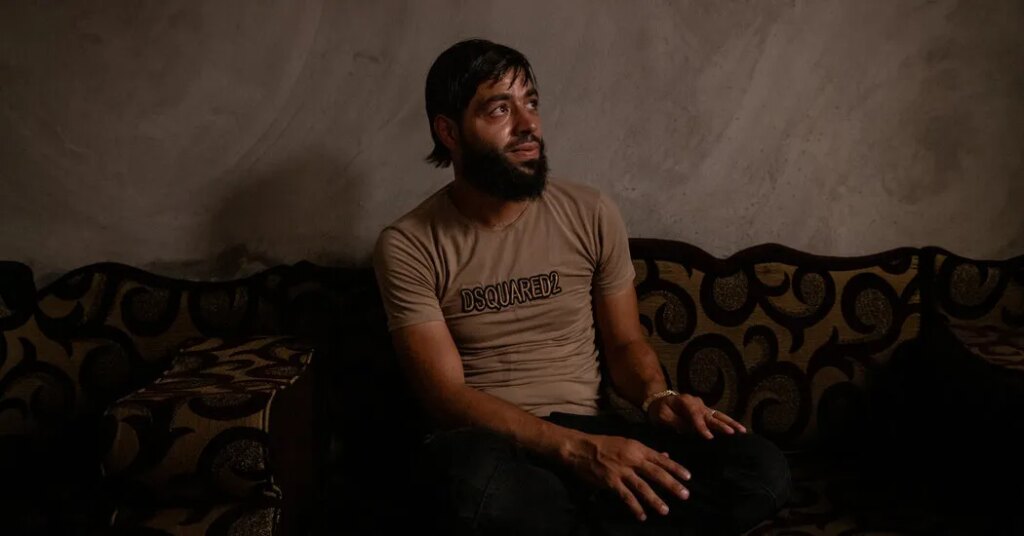
Prison is still etched on his body.
A knuckle on his ring finger smashed from a beating.
Above his left eye, a scar.
On the bottom of his feet, more scars.
His broken, rotting teeth.
And his mind.
Months after Ahmed al-Shalh was released from Syria’s most notorious prison, he still sat in the corner of the ramshackle tent his family lived in, knees gripped tight to his chest, the threats of prison guards still echoing in his ears.
When he spoke at all, he spoke in a whisper.
That was more than four years ago — before rebels overthrew the Assad regime, pried open the doors of Syria’s prisons and freed tens of thousands of prisoners like him.
The fanfare over these prisoner releases often gave the impression of a happy end to their suffering. But for many, it was just the beginning of another solitary road, one marked by deep wounds and the struggle to find a place in a broken country trying to rebuild itself.
I began following Mr. al-Shalh only a few months after he got out of prison. Since then, he has reveled in some unexpected wins — he got married and has had two children — while enduring repeated blows. He, his wife and two young children were recently evicted from their apartment because work is scarce, salaries are low and he could not pay the rent. They now live in a small, stuffy modular container — an improvement over the tent his family lived in during the war, but far from the home he envisioned for his young family.
There are few social services to help former prisoners like him. He lives a life of worry, feeling abandoned by the former rebels who run Syria’s government.
The weight of responsibility is so heavy that at times he wishes he never started a family, with three people reliant on him.
“I’m worried about my children’s future,” he said recently. “Sometimes, I wish I never got out of prison.”
Prison
Mr. al-Shalh was 19 when the Assad regime’s security forces stormed into his family’s small house in 2012, dragged him from his bed and threw him into the back of a pickup truck, according to him, his relatives and the Syrian Network for Human Rights, which documented his detention at the time.
It was in the early years of the Syrian uprising that turned into a civil war, and such arrests were common. Mr. al-Shalh was accused of being a rebel fighting against the regime and shooting at government soldiers. He denied it, insisting he had only participated in a few peaceful protests and had never held a gun.
He spent more than 10 years in prison — most of them in the notorious Sednaya prison’s dank, overcrowded cells, with little food or water.
Sometimes, he and other prisoners were made to stand outside for hours, naked under freezing rain, he said. The soles of his feet were beaten with a hose until he could not walk anymore. Interrogations meant beatings with metal rods that left some people dead, he said.
On the morning of May 3, 2022, a prison guard came to Mr. al-Shalh’s cell door and called out his name.
He thought he was about to be executed.
Instead, he was freed.
That day, hundreds of Syrian prisoners were released in surprise amnesties — one of three that year issued by President Bashar al-Assad.
Mr. al-Shalh, 30 by then, said he was given military boots with no laces to wear and a conscription order telling him to report for mandatory military service within 24 hours.
As he left, a prison guard looked at his papers and saw how long Mr. al-Shalh had been imprisoned. He recalled the guard being surprised and saying, “How have we not killed you yet?”
Mr. al-Shalh’s family said they were shocked by his release. They thought he was already dead.
He had lost nearly a third of his body weight in prison. A video captured the moments when Mr. al-Shalh returned to his neighborhood, carried on the shoulders of a cousin — his weak hands held up by two other relatives.
By then, his parents and siblings had fled their home in the coastal city of Latakia because of the war and were living in a camp for displaced people. It was not the homecoming he imagined.
He was no longer sleeping on a cold concrete floor in a crowded cell. Instead, he was in a crowded tent, sleeping on a thin mattress on the cold ground, surrounded by his family.
At times, he said he felt as if he had traded one prison cell for another.
His mother, Muna Ariditi, said she would find him tightly curled up in a fetal position, trying to make himself as small as possible.
“‘Ahmed, you’re not in prison anymore,’” she recalled saying to him, again and again, “I wanted him to forget.”
He could not. He struggled even to leave the tent.
“We lived a lifetime in prison,” he said. “That doesn’t go away overnight.”
At first, he hardly ate, accustomed to the paltry portions in prison. His broken, decayed teeth testify to years of beatings, no dental care and trying to chew olive pits when there was nothing else to eat in prison.
Even the sound of children playing outside put him on edge.
Eventually, his younger brother Mahmoud forced him to go outside. At first, they walked a few feet, around neighboring tents. As Mr. al-Shalh grew stronger — and less frightened — they walked along the windy roads around the camp.
His body ached, and he tired quickly. The only job he said he could get was picking olives during the harvest season for less than $1.50 a day.
“Everyone is asking about the detainees and demanding their release,” he said in his parent’s tent in 2023, before the Assad regime fell. “But when the detainees get out, they won’t hire us.”
“We don’t want your charity,” he said at the time. “Just give us jobs.”
Joining the Rebels
By that time, Mr. al-Shalh’s brother Mahmoud had become a fighter with Hayat Tahrir al-Sham, an Islamist rebel group, one of many factions trying to overthrow the Assad regime.
Soon enough, Mahmoud began taking Mr. al-Shalh to checkpoints and to the front line, to help him venture farther from the tent.
Mahmoud and the other rebels gave Mr. al-Shalh military fatigues to wear. Pretty soon, that was not enough. He wanted to pick up a rifle and fight. He wanted revenge.
He had been imprisoned on accusations of being a rebel.
A decade of imprisonment eventually turned him into one.
“I wanted justice,” he said, “for at least 10 percent of what I suffered in prison.”
The bang of the rifle scared him at first. His body was weak and his eyesight poor. But among the revolutionaries, being a former detainee had cachet.
The civil war had been largely frozen for several years. At the front lines, both sides would fire at each other, with little change on the battlefield. For Mr. al-Shalh, it became the only place he relaxed, shooting toward an unseen enemy and picturing the prison guards at Sednaya.
Then, in November 2024, Mr. al-Shalh and other rebel fighters were told to prepare for a major battle.
By then, though, Mr. al-Shalh had other responsibilities.
A couple of months after he joined the rebels, he and his mother visited a former detainee who had shared a cell with Mr. al-Shalh. During the visit, they met the man’s daughter, Batool al-Asaad.
Having spent his 20s inside a cell, Mr. al-Shalh was eager to catch up on milestones he had missed, marriage chief among them. And unlike many other families, neither Ms. al-Asaad nor her parents had reservations about marriage with a former detainee.
Ms. al-Asaad had already seen how her father, who had been released in 2019, struggled to adjust to life after imprisonment. He, too, could not tolerate any speaking above a whisper for months. It was a challenge, she knew, but one she understood. She and Mr. al-Shalh got married.
When the rebels issued their deployment orders, Ms. al-Asaad begged her husband not to go. By then, they already had a daughter, Muna, named after his mother.
He decided to go anyway. It was his chance to get revenge. Mr. al-Shalh took a final photo of himself with his rifle and dressed in full camouflage, in case he was killed in battle.
After the Dictatorship
Within a few weeks, Syrian rebels toppled the Assad regime, took over the government and established a new military.
Mr. al-Shalh wanted to leave fighting behind, but a lack of any other jobs has kept him in the military ranks.
So one day on the outskirts of Latakia, Mr. al-Shalh sat on guard duty at a military outpost.
His wife called to check when he would be home. Muna, then 1 year old, blabbered over the speakerphone, her voice filling the tiny bunker made of ammunition boxes and a disused refrigerator.
“I’ll see you tomorrow,” Mr. al-Shalh told Muna.
It was her birthday, but there would be no presents or cake. Ms. al-Assad was eight months pregnant at the time with their second child, and even though he did odd jobs to supplement his pay as a soldier, Mr. al-Shalh struggled to buy what they needed for a new baby.
Money Problems
The debts never go away.
A private support group for former detainees helped him buy some jewelry for Ms. al-Asaad when they got married, but she has sold most of it to help pay off their debts. He said he also sold his motorcycle.
This year, their landlord demanded more rent — nothing his $250-a-month military salary could afford — and the family moved into one of the metal prefabricated shelter units erected after the 2023 earthquake. It has no electricity or water. They live in constant fear that thieves will break in and steal what little they have.
The morning after Muna’s birthday, still dressed in fatigues, Mr. al-Shalh arrived at his uncle’s house, where his parents have been living.
I watched as he called out “Mesho,” his nickname for his daughter. She came immediately, crawling excitedly. He smiled widely, scooped her up and planted kiss after kiss on her cheeks and chubby hands.
Sometimes when he is playing with Muna, he laughs in disbelief, having never imagined that he would get out of prison alive, much less build a life.
From his backpack, he takes out two packets of instant coffee for Muna to play with. It is not much, but cradled in her father’s lap, she is happy.
PTSD
When the rebels reached Syria’s capital, Damascus, on Dec. 8, 2024, Mr. al-Shalh was in the coastal city of Latakia, celebrating with his family.
His family watched videos of the rebels storming Sednaya and other prisons, freeing prisoners. It should have been a joyous moment for a former detainee like him, but the sounds and imagery were too much.
“Enough!” he screamed, his family recalled. “Enough!”
Since his release, Mr. al-Shalh has had recurring nightmares, sometimes screaming in his sleep, Ms. al-Asaad said.
In a recurring one, he is back in Sednaya, sitting with prisoners, their backs against the wall as a prison guard approaches, yelling and turning on an electrical prod to beat them. In the nightmare, he presses up against the wall, trying to disappear.
He also emerged from prison with a temper, at times lashing out at his family, then apologizing.
That temper landed him back in prison this year.
In March, a large fight broke out outside his brother’s home. His relatives had accused their neighbors of informing on Mr. al-Shalh back in 2012, leading to his original imprisonment.
Mr. al-Shalh was coming back from his shift, still dressed in military fatigues and carrying his Kalashnikov, as the fight with the neighbors erupted. When he arrived at the scene, he said he tried to remain calm. But then he was hit in the face with a rock, breaking more of his teeth.
“I lost all sense, and I don’t remember what I did,” he said.
He opened fire on the neighbor’s home and two shop fronts, he and relatives said. No one was injured, he said, but he and others on both sides of the melee were arrested. Latakia police did not answer questions about the episode.
Mr. al-Shalh spent a month in a military prison.
“I thought I was back in Sednaya,” he said. He was not mistreated this time, he said, but “I wanted to smash my head against the wall.”
When he was released — after a judge reached a reconciliation agreement between the two families — he said he wanted to go back to Sednaya, as a free man.
Only then, he said, could he put the demons to rest.
Sednaya
Mr. al-Shalh said he wanted to revisit the cells he had been in and find where he had scratched his name on the wall.
For prisoners, scrawling their names on the walls was a way to let people know they had been there, fearing they would be executed and disappear without a trace.
He grows quiet walking the empty halls, using his cellphone’s flashlight to inspect the cell walls. On the home screen of his phone is a picture of Muna smiling on the sand at the beach, her few teeth almost a mirror of her father’s toothy grin.
The young men guarding the prison have given him only an hour. I follow him from cell after cell, where he finds nothing. He is running out of time.
He stops outside the thick metal door of another cell and goes in. Suddenly, he is almost giddy.
He finds his name, scratched in yellow paint. “This is what I’ve been searching for,” he says, beaming.
Leaving the cell, he takes out a cigarette, relaxed.
His name is still here. And so is he.
Muhammad Haj Kadour contributed reporting.
The post Freed From a Notorious Syrian Prison, but Still Trapped by Its Terror appeared first on New York Times.