Where Even Flowers Stoke Fear
April 13, 2026
The red and gold sign at the main entrance to the Defense Services Academy of Myanmar, a nation ruled by military fiat for most of its existence, displays its self-regard: “The Triumphant Elite of the Future.”
But there is no longer any elite, triumphant or otherwise, swaggering around town. Cadets from this and other military academies in Pyin Oo Lwin, in central Myanmar, are cloistered inside their campuses, the targets of occasional rocket attacks from rebels in the hills. So anxious are the schoolmasters that military insiders say they are drawing up plans to move the academies to safer grounds.
When Myanmar’s generals staged another coup five years ago, they ignited a raging civil war. They shattered the country, bequeathing it with the most fractured conflict on earth. But more than anything, the military — even as it now boasts of the trappings of civilian rule — has created a state guided, ruled and consumed by fear.
During three weeks of reporting in Myanmar, traveling through the nation’s central heartland, The New York Times photographer Daniel Berehulak and I saw how terror comes for everyone — and how it has disfigured a nation that barely a decade ago seemed a counterpoint to the global crescendo of authoritarianism.
In Myanmar today, civilians are petrified by the military’s relentless bombing and burning campaign, which last year made the Southeast Asian nation the most severely affected by conflict on earth, after Palestinian territories, according to the conflict monitor A.C.L.E.D. They are panicked by a conscription law that can dispatch any young man or woman to the front lines. They are nervous every time a soldier at a checkpoint demands to see a phone, lest an offhand message or meme land them in prison. This is a country of averted gazes and unanswered questions. People speak in code, or not at all.
The military, too, is frightened, despite its toppling of an elected government in February 2021 and its camouflaging of top officers with civilian clothes. A spree of assassinations by pro-democracy forces who picked up arms after the coup has put a bull’s-eye on anyone wearing a uniform or seen as collaborating with the generals. Army officers who used to parade around in public, trailed by briefcase carriers, have all but disappeared. Business cronies know they are also vulnerable to purges by feuding generals. Some have decamped to Dubai and other ports of self-exile.
From late December to late January, the junta orchestrated a series of elections in which no true opposition could challenge the military’s proxy party. The largest democratic force in the country, which had twice trounced the army-linked party and governed Myanmar before the coup, had been dissolved. Still, the generals were antsy. They held the vote in less than half the country and warned civil servants to cast their ballots as a show of patriotism.
The elections, which led to an unsurprising victory for the military’s proxy party and set up the junta leader U Min Aung Hlaing to be elected president this month, were an attempt to signal to the world that Myanmar is open for business. The military needs stability and foreign investment to resuscitate a broken economy. Its media outlets hailed the return to what the army has deemed a unique national political ideology: “disciplined democracy.”
But traveling through Myanmar earlier this year, we saw that fear and despair have only metastasized. Last year, more than 13,700 people were killed as the military tried to obliterate resistance to its rule, A.C.L.E.D. found. Aerial attacks on civilians are at a record high, with fighter jets, helicopters, kamikaze drones and even paragliders employed to kill. Common targets include schools, hospitals and houses of worship.
On Jan. 17, as the junta was celebrating Myanmar’s stage-managed return to the polls, two fighter jets dropped hundreds of pounds of bombs on a preschool and warren of shelters in a village in Anyar, as the nation’s arid heartland is called. Then they strafed the village with machine-gun fire. A few days later, we walked through the wreckage, rubble crunching underfoot. Describing the destruction across the street from his home — the boom of the blasts that lingers in his head, the soft screams of a dying child — Ko Myo San gulped and blinked back tears.
“We are always scared because we don’t know when they will attack us,” he said. “I don’t know when it will end.”
A pair of rocking horses lay in the ruins of the preschool, along with a toddler’s puzzle with a spot for a dove, the bird of peace.
The United Nations said that Myanmar’s military unleashed more than 400 aerial attacks during the monthlong polling period.
“The profound and widespread despair inflicted on the people of Myanmar has only deepened with the recent election staged by the military,” said Volker Türk, the U.N. High Commissioner for human rights.
In an interview, Gen. Zaw Min Tun, the junta spokesman, said that airstrikes by the military targeted rebel militias, not civilians. He referred to the military’s bombing in December of a hospital in western Rakhine State — in which more than 30 civilians were killed, according to international human rights monitors.
“We got solid information that this hospital was used by the terrorists and that the people who were hospitalized there were not civilians,” he said.
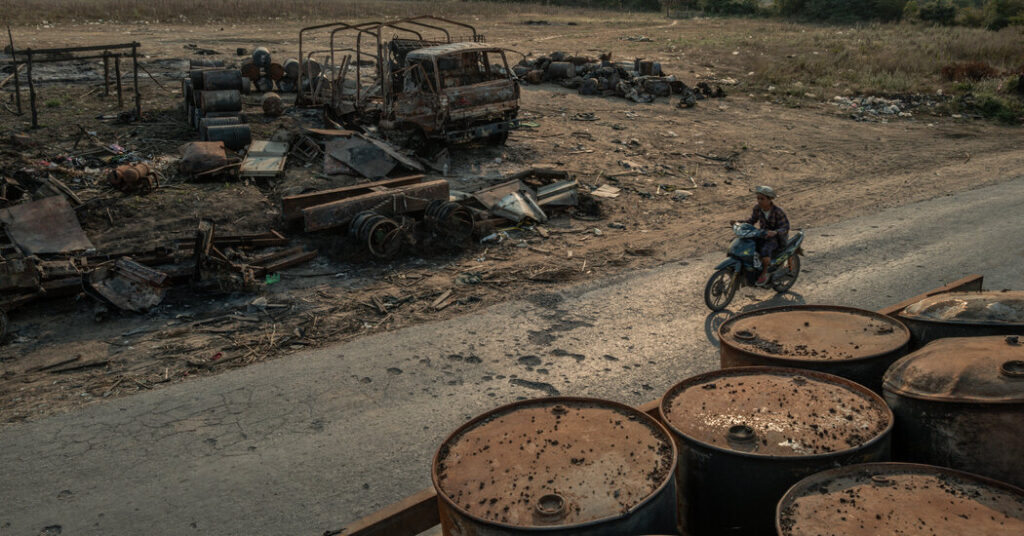
Horror does not only descend from the skies. As the military takes back territory from resistance forces or succumbs to rebel offensives, its soldiers sweep through villages, dousing homes with fuel. In Anyar, we met residents weeping over their newly lost homes. Amid the burned wreckage, troops often litter the ground with land mines. Myanmar leads the world in land mine casualties, according to a group campaigning to end the use of mines, a weapon that disproportionately kills civilians.
The misery in Myanmar’s heartland, where the nation’s Bamar ethnic majority is concentrated, was compounded last year by an earthquake that officially killed 4,000 people but most likely claimed far more lives. In areas of Anyar seen as supportive of the rebels, the junta has done little to clear the damage even a year later. Ancient pagodas in the former royal capital of Ava, also known as Inwa, once drew foreign tourists. They are now abandoned, their stupas broken, their Buddhas crushed. Locals are trying to rebuild, but nearly a quarter of the country suffers from acute hunger.
Since the coup five years ago, at least 30,800 people have been arrested in connection to political crimes, according to a prisoners’ rights group. Orwellian diktats have outlawed the using of Western social media apps (for fear of people reading real news), the riding of a motorcycle by two men (for fear of them assassinating pro-military figures) and the wearing of flowers in one’s hair on the birthday of the imprisoned civilian leader Daw Aung San Suu Kyi (for fear her popularity will endure through the blossoms that were her trademark).
The military has positioned itself apart from the country that it claims to defend. Its social media is siloed, its families cleaved from normal society. Within the moat of the palace in the city of Mandalay, once home to the royal family deposed by the invading British, an army base surrounds the gilded buildings, as if proximity to grandeur will extend a golden sheen to Mr. Min Aung Hlaing, who gave up his position as military commander to become president. The few visitors who enter the palace complex are warned not to take photos of the soldiers — one of the few places in today’s Myanmar where they can be seen in their natural habitat.
Over the years, the army has justified its repeated power grabs as necessary to keep a multiethnic country from fragmenting. But its coup in 2021 was the catalyst for the current civil war and reign of fear.
Even the triumphant elite of the future must know it. Enrollment at the Defense Services Academy, Myanmar’s equivalent of West Point, has plummeted. Before the coup, each intake was about 500 cadets. Today it is less than 100, instructors and staff members say. Upon graduation, the newly commissioned officers are sent straight to the front lines, without a day of respite. Most of their charges are conscripts.
On the outskirts of Mandalay, as dusk fell on a riverside village, a broken bridge listed, evidence of last year’s earthquake. Around the village shrine, only older women and young children came out to enjoy the evening breeze. Two men had been abducted and drafted when they stumbled home drunk at night, the villagers whispered. Wherever we went in Myanmar, the absence of young men was obvious. At least two million people from Myanmar are believed to have fled to neighboring Thailand since the coup, many to avoid conscription.
Those who remain face terror at any time. More than 400 people were charged with contravening an election protection law. Breaches included using the word “revolution.” One young man was given a 49-year sentence for protesting the polls. His brother, Ko Win, who asked to be identified by a shortened name for fear of the military, was released from prison in November. Military torture came in many forms: his body trussed like a roasted bird, army boots stomping his face, cigarettes singeing his skin.
“At the time, I was a frog in their pocket,” Ko Win said, his voice and hands shaking, remembering his vulnerability. “For young people in Myanmar, we don’t have any hope.”
Hannah Beech is a Times reporter based in Bangkok who has been covering Asia for more than 25 years. She focuses on in-depth and investigative stories.
The post Where Even Flowers Stoke Fear appeared first on New York Times.