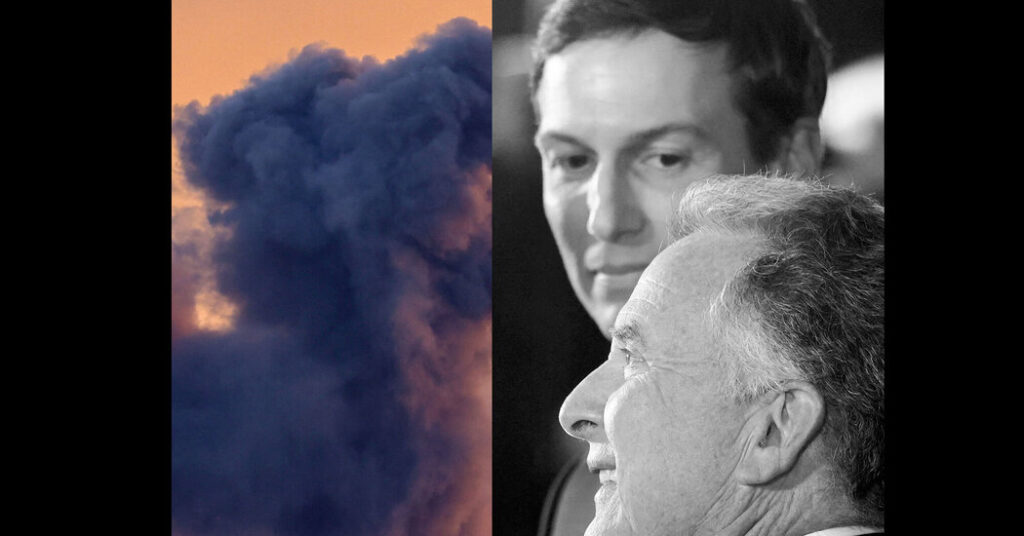
In late March, Jared Kushner sat woodenly on the stage of a Saudi investment conference in Miami. It was 26 days into the Iran war. He was introduced not as President Trump’s unofficial envoy but as the founder and chief executive of Affinity Partners. The host of the conference — the Saudi crown prince, Mohammed bin Salman, via his personal think tank — has thrown billions at Affinity Partners through his sovereign wealth fund. In recent months, Mr. Kushner has sought to raise even more money from the crown prince at the same time as Prince Mohammed has reportedly pushed for a protracted war with Iran.
The moderator wanted to know what Mr. Kushner had learned as a “deal maker in peace.”
“I think peace is not that different than business,” Mr. Kushner said. “Both things are puzzles, and I try to think about every challenge that I’m faced with as a puzzle.”
It was a remarkable exchange: Here was Mr. Kushner, onstage at an investment conference, as bombs were falling on Tehran and as the Strait of Hormuz was being booby-trapped by mines. The inability of Mr. Kushner and his partner in diplomacy, Steve Witkoff, to reach a deal with the Iranians in the weeks leading up to the war has led to a catastrophic series of events, with America and Israel killing more than a thousand Iranian civilians, Israel intensifying its attacks on Lebanon and the war expanding across the Middle East.
Mr. Kushner and Mr. Witkoff, the president’s son-in-law and special envoy for peace missions, respectively, represent the Trump mind-set: a rogue version of diplomacy that’s focused on the flashy and theatrical, a reflection of the Trump real estate developer ethos. But that ethos has failed, and Iran is proof.
In fact, in February, Mr. Kushner and Mr. Witkoff had a chance to enter into serious negotiations with Iran that could have secured a new nuclear deal and averted the American and Israeli war.
Now, after the president threatened to destroy “a whole civilization,” a two-week cease-fire is in place. But the cessation of hostilities came not through a Witkoff and Kushner-led initiative, but through emergency diplomacy led by Pakistan and China. The duo returned to the bargaining table this weekend, this time demoted, with Vice President JD Vance leading the diplomatic efforts. But the global backdrop of the negotiations — the Strait of Hormuz still in chaos, the American military still in place across the region — shows the shallowness and recklessness of their peace-as-business strategy. When it comes to peacemaking, Mr. Kushner and Mr. Witkoff are no match for the intensive work that it actually requires.
Mr. Kushner was not meant to be the face of American diplomacy in the second Trump presidency: In interviews, he indicated he would stay in private life. But Trump administrations are family affairs, and the president said he “called in Jared” for diplomatic talks between Israel and Gaza. Mr. Kushner has since joined Mr. Witkoff, another confidant of the president, in high-stakes statecraft with everyone from President Volodymyr Zelensky of Ukraine to heads of state at Davos.
Initially, the duo achieved some success with their strategy: They handed Mr. Trump a Gaza cease-fire upon his second inauguration and secured the release of an American imprisoned in Russia in time for his 2025 address to Congress. They engaged in direct talks with foreign leaders usually shunned by Washington, including Russia’s Vladimir Putin and representatives of Hamas, in pursuit of deals and supposedly ending eight wars in Mr. Trump’s coinage. This set up Mr. Witkoff, in particular, to be a global fixer and reinforced the president’s lack of trust in institutionalized government expertise.
Iran has shown the reality of their skills, or lack thereof. The two were sent to Geneva in February, as Mr. Kushner put it, “to see if there was a deal to do there.” Former officials and diplomacy experts close to the negotiations say that the February talks with Iran that Mr. Kushner participated in were botched. Real progress was being made, and Iran had shown some flexibility, but Mr. Kushner and Mr. Witkoff not only lacked experience and expertise; they also lacked the bandwidth: The same pair was also playing point on Russia and Ukraine and on Gaza rebuilding while shuttling back and forth to and from Miami. They also lacked a strong enough team to work out the details and a strategic vision to execute a transformational accord.
So on Feb. 26, Mr. Kushner and Mr. Witkoff — with no particular expertise in nuclear technology or Iranian politics — rocked up to talks in Geneva. Across the table: skilled Iranian negotiators who had hammered out the 2015 nuclear deal with the Obama administration. Unlike Mr. Kushner and Mr. Witkoff, the Iranian team was knowledgeable on both nuclear issues and how their counterparts operated, and backed by further technical experts on aspects of the science and engineering at play, and so forth.
It was only the third round of talks, but the Iranians proffered a seven-page proposal that the British national security adviser, who was in attendance, found “surprising” in a good way. A diplomatic path forward seemed within reach. Over time, a stronger deal than Barack Obama’s may have very well been possible, but it doesn’t seem that the Kushner-Witkoff duo fully understood what Iran was offering.
“As long as Iran could come away from the table saying they preserved their right to enrichment, every aspect of their nuclear program was open to negotiation,” Suzanne DiMaggio of the Carnegie Endowment for International Peace told me. “Now, if you’re a skilled negotiator with some expertise in these issues, that would be music to your ears, because you’d recognize you have a great deal of leverage to draw on to make the most of Iran’s weakened position.”
But Mr. Kushner and Mr. Witkoff understood it as a threat — that Iran would continue its nuclear program no matter what — and they had come to see any nuclear enrichment on Iran’s part as a nonstarter.
“This is a challenge of face-saving: how to put together an agreement that would enable the Iranians to say they have that right to enrichment, but at the same time, puts the program under the strictest constraints ever negotiated,” Ms. DiMaggio explained. “A serious diplomat would be intrigued by that challenge and see the potential to secure an effective deal.”
Instead, Mr. Witkoff reportedly kept shifting demands, asking for more and more. According to one in-depth report, he also seemed to have misinterpreted the use of one key site, the Tehran Research Reactor, which had actually been converted to create medical isotopes.
Two days later, American and Israeli bombs were falling on Iran. It may have been that diplomatic talks were doomed from the start: The Israeli prime minister, Benjamin Netanyahu, was making a hard sell to Mr. Trump in favor of striking Iran while negotiations were unfolding. But as Tehran burned, any trust the Iranian team had in Mr. Trump’s envoys dissipated. This was the second time that talks had collapsed and led to war.
If Mr. Kushner and Mr. Witkoff fashion themselves as savvy businessmen entering the world of statecraft, it’s worth considering their business dealings. In Mr. Kushner’s approach, private business dealings follow in the wake of diplomatic missions. His investment firm is powered by big Persian Gulf money. He says he didn’t strike any business deals while he was a senior White House adviser from 2017 to 2021 and dismisses accusations of having conflicts of interest — even as he today solicits foreign government-linked investments while moonlighting as the president’s negotiator. Mr. Witkoff, for his part, built his career as a New York tough guy in real estate and hotels — not exactly traditional arenas of global affairs.
Despite their slight credentials in government life, the president is relying on the same bench as talks with Iran continue. Mr. Witkoff and Mr. Kushner are part of a small brain trust — Bloomberg described it as a “Yes, Sir,” cabinet — which didn’t push back on Mr. Trump’s decision to start this war of choice. The Trump team is so cautious of leaks, like the one about the Iranian foreign minister’s ignoring Mr. Witkoff’s texts (which the administration disputes), that their circle is only narrowing.
At a recent televised cabinet meeting, Mr. Witkoff assured the president, “I have no doubt that we exhausted all efforts,” in talks with Iran in an effort to confirm that the war was the right move. Experienced negotiators express well-informed doubts. “We’re seeing the consequences of a system where you denigrate expertise and you don’t engage in the interagency policy process to any degree,” Alan Eyre, a retired career diplomat who was a core member of Mr. Obama’s Iran negotiating team, told me.
Mr. Witkoff and Mr. Kushner (now joined by Mr. Vance) pale in both number and expertise to the Obama team that negotiated the 2015 nuclear agreement. That agreement was the most significant diplomatic achievement with Iran after the 1979 Islamic Revolution and brought in the world powers on the United Nations Security Council to uphold a landmark arrangement that strictly monitored Iran’s nuclear program.
Mr. Obama’s negotiating team was led by experienced diplomats working painstakingly, first through back channels and mediators in Oman, with highly technical working groups reviewing complex details of enrichment that resulted in a 159-page document, including several annexes, before the countries reached a deal. The agreement came as a direct result of the expertise that we have built up in the U.S. Foreign Service and in the diplomatic corps.
The Trump administration has systematically taken apart the National Security Council and the Foreign Service. “The State Department, for all intents and purposes, doesn’t really exist anymore,” Mr. Eyre told me.
Mr. Kushner and Mr. Witkoff fashion themselves as businessmen unencumbered by the weight of government bureaucracy, but even businessmen need experts, not sheer deal-making prowess. “As a technical nuclear expert, I must say it was painful listening to Steve’s mangling of several nuclear facts,” David Albright of the Institute for Science and International Security said upon hearing Mr. Witkoff discussing negotiations on “The Mark Levin Show.”
This business-focused approach is not even very good for business. The closing of the Strait of Hormuz was a shock to the global economy. Suddenly, capitalists from the Levant to the Gulf are complaining that they can’t get money in or out of their countries. Rising energy prices are driving up costs across businesses, and disruptions will continue even as the strait slowly reopens.
Diplomacy is complicated. Even the best chief executives can’t do it, but are these the best chief executives?
This weekend’s talks in Islamabad ended with the status quo. After 21 hours of negotiations with the Iranians, Mr. Vance said Tehran chose not to accept the White House’s “final and best” offer. Mr. Vance gave his statement while Mr. Kushner and Mr. Witkoff stood awkwardly behind him, an apparent demotion from their previous role in these negotiations. Still, the two sides are said to have met face-to-face, the highest level meeting between America and Iran since 1979.
But it’s unrealistic to expect success so quickly. Iran, with its control of the strait, might be in its strongest negotiating position to date. It notched a small win, having gotten Mr. Vance, who is associated with a less militaristic foreign policy, to the table.
At this point, one almost wishes the White House were running foreign policy like a business — that is, like a real business. What we’re seeing instead is that the Trump team is running it like a Trump subsidiary, and if this reckless war goes bust, then all of us — and none of them — are bound to face bankruptcy, moral and otherwise.
Jonathan Guyer is a foreign policy journalist and a program director at the Institute for Global Affairs. He also hosts a podcast called “None of the Above.”
The Times is committed to publishing a diversity of letters to the editor. We’d like to hear what you think about this or any of our articles. Here are some tips. And here’s our email: [email protected].
Follow the New York Times Opinion section on Facebook, Instagram, TikTok, Bluesky, WhatsApp and Threads.
The post Trump’s ‘Deal Makers in Peace’ Are Anything But appeared first on New York Times.