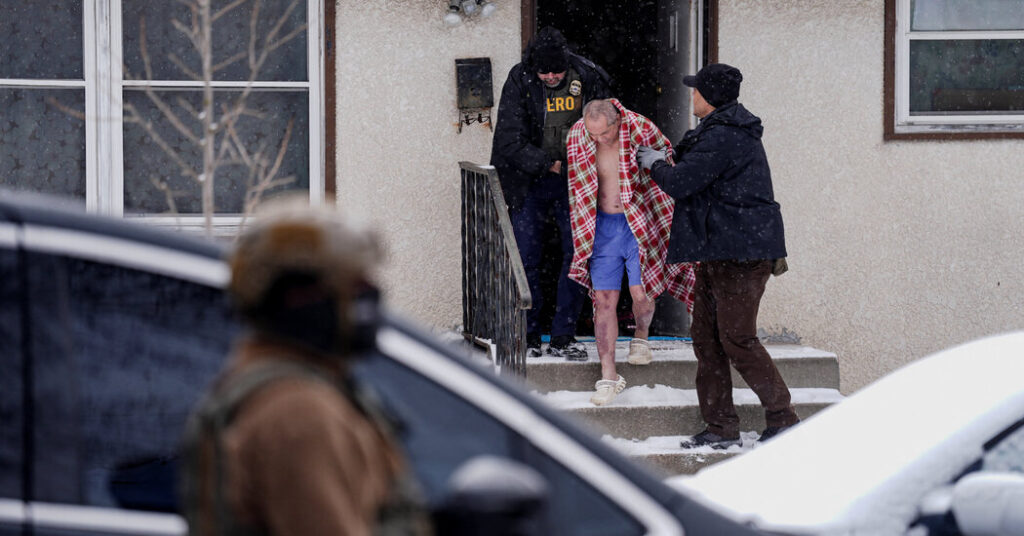
It became one of the searing images of the Trump administration’s immigration operation in Minnesota earlier this year. After using a battering ram to break down the door of a home in St. Paul, federal agents handcuffed ChongLy Scott Thao and led him outside in subzero temperatures wearing only boxer shorts and slip-on shoes.
On Monday, local law enforcement officials announced that they were weighing whether federal agents should face criminal charges, including kidnapping, burglary and false imprisonment, over the detention of Mr. Thao on Jan. 18.
John J. Choi, the elected prosecutor in Ramsey County, said that his office had formally sought information from the Department of Homeland Security about Mr. Thao’s arrest, including the names of the agents who took him into custody.
It was the latest effort by Minnesota prosecutors to pursue criminal cases stemming from the immigration operation carried out by thousands of agents in Minnesota this winter, although legal experts say that any such prosecutions would face significant legal and practical obstacles.
“We are going to be dogged in our pursuit of the truth,” Mr. Choi told reporters Monday afternoon, adding that his office was considering empaneling a grand jury to review evidence from the case. “We are not going to let this go.”
Federal agents returned Mr. Thao to his home more than an hour after taking him into custody, having concluded that he was a United States citizen without a criminal record. The Department of Homeland Security later said its agents had been seeking two convicted sex offenders when they came to the home.
Mr. Thao’s family said those men did not live at the house. One of them had been serving time in state prison since 2024.
Representatives from the Justice Department and the Department of Homeland Security did not immediately respond to a request for comment on the case.
Days after Mr. Thao’s arrest, which drew widespread outrage, a whistle-blower group disclosed that U.S. Immigration and Customs Enforcement told agents last year that they had sweeping authority to enter homes without judicial warrants.
That guidance, conveyed in a memo issued last May, has been widely criticized by legal scholars as a violation of the constitutional protection against unreasonable search and seizure.
Mr. Choi said there was no evidence that federal agents had a judicial warrant to enter Mr. Thao’s house.
Bob Fletcher, the Ramsey County sheriff, said investigators do not know the identity of the agents who took Mr. Thao into custody. He said federal agents swapped license plates on a vehicle used during that incident, which he called a violation of Minnesota law.
Two of the shootings resulted in the deaths of American citizens, Renee Good and Alex Pretti. The third wounded Julio Sosa-Celis, a Venezuelan immigrant.
Legal experts say that local prosecutors would face formidable challenges in pursuing criminal charges against federal agents. The supremacy clause of the Constitution gives federal agents broad immunity from prosecution by state officials. Also, the Trump administration has thus far been unwilling to provide basic information on the cases state officials are investigating.
Ernesto Londoño is a Times reporter based in Minnesota, covering news in the Midwest and drug use and counternarcotics policy. He welcomes tips and can be reached at elondono.81 on Signal.
The post Prosecutors Investigate ICE Agents Who Detained a Minnesota Man in His Underwear appeared first on New York Times.