When Pope Leo XIV embarks on Monday on a 10-day tour of Africa, he will visit a continent that both represents the demographic future of the Roman Catholic Church and bears some of its deepest ideological fault lines.
Leo’s decision to visit Africa so early in his tenure, less than a year after his election, reflects the importance of a continent where Catholicism is growing faster than anywhere else in the world. It is also where the church leadership in Rome faces some of the strongest regional resistance to changes made by Leo’s reform-minded predecessor Pope Francis, who inflamed conservatives in Africa when he allowed priests to bless same-sex couples.
On his four-country tour to Algeria, Angola, Cameroon and Equatorial Guinea, Leo will encounter societies where Christianity vies for influence with Islam; where Catholicism faces growing competition from evangelical and Pentecostal rivals; and where the Vatican is navigating cultural norms, like polygamy, that contravene Catholic theology. On a continent hosting the youngest population on earth, the pope may also face questions about how the church will modernize and appeal to the next generation.
The ideological battles being fought in Africa “will define the future of the Catholic Church,” said Ebenezer Obadare, a senior fellow for Africa Studies at the Council on Foreign Relations in Washington.
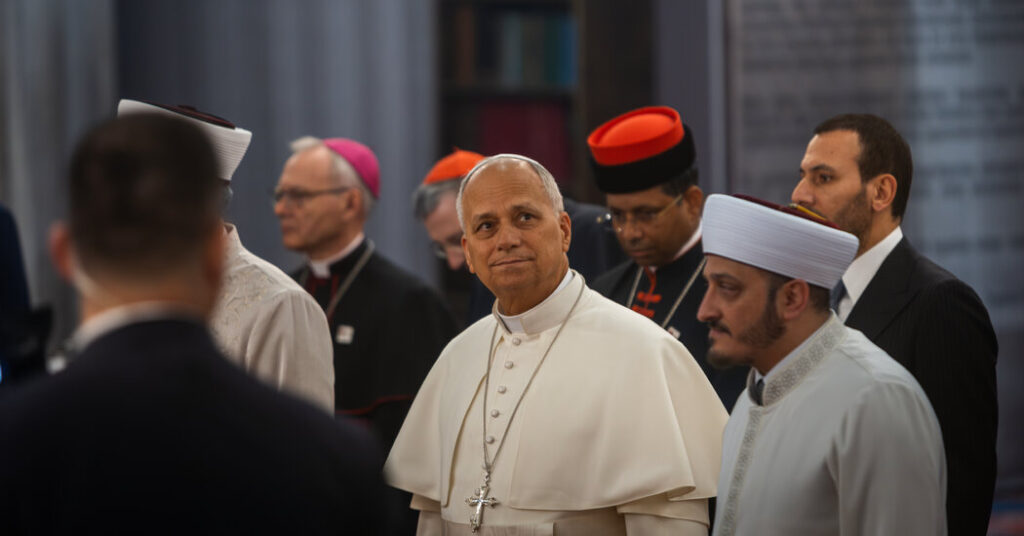
Above all, the pope — the first from the United States and one with Afro-Caribbean roots — will come face to face in Africa with one of the church’s most glaring power imbalances.
There are now 288 million African Catholics, representing more than one in five of the faithful worldwide, yet Africans remain a small minority in the ranks of Vatican leadership, which is still dominated by Europeans. Of the 121 cardinals who can elect a pope, only 14 are from the entire continent of Africa. Italy alone has 18.
A cardinal emeritus, John Olorunfemi Onaiyekan, a retired archbishop of Abuja, Nigeria, said, “It is not something we can force the pope” to address — not least because cardinals are not selected to fix statistical shortfalls. But, he added, “the pope cannot close his eyes” to the demographic shift to Africa. “The new arrivals in the Catholic family cannot be ignored.”
During his tour, Leo will often meet people affected by poverty, war, climate change, youth unemployment and outward migration. All but Angola are ruled by authoritarian governments that have undermined democratic institutions and cracked down — sometimes brutally — on dissent.
Stepping off Shepherd One, as his plane is known, the pope will start the trip in Algeria, the birthplace of Augustine of Hippo, the eponymous saint of the Augustinian order, which Leo led before becoming pontiff. Algeria is a predominantly Muslim country, and Leo, who engaged in interfaith dialogue on his first international trip as pope to Turkey and Lebanon, will continue that outreach in the country.
On this trip, Leo will not visit the countries with the largest Catholic populations, including the Democratic Republic of Congo and Nigeria. Sectarian and religious tensions in Nigeria have fueled attacks on both Christians and Muslims, and led President Trump — against the wishes of a local bishop — to blame Muslims for a “Christian genocide.”
The pope will instead visit countries that “people might tend to overlook as unimportant,” said the Rev. Agbonkhianmeghe E. Orobator, the dean of the Jesuit School of Theology at Santa Clara University in California. In doing so, Leo has raised expectations that he will speak out against undemocratic governance, particularly in Cameroon and Equatorial Guinea, which are led by the two longest-serving presidents in Africa.
“How do you go to that kind of place,” Mr. Obadare said, “and not talk about, ‘Maybe leaders shouldn’t be in power for so long, maybe they should organize credible elections, maybe we should let the younger generation take over the reins of office,’ and all of that?”
“If the pope does not,” Mr. Obadare added, he is “going to lose credibility.”
The pope’s comments on the acts of political leaders has been evolving.
Early on, in contrast to Francis, who was often outspoken, Leo was a more measured voice. While he repeatedly spoke out against war, and advocated on behalf of the poor, the environment and immigrants, he hesitated to single out individual leaders.
In Turkey last November, Leo met President Recep Tayyip Erdogan, whom critics have accused of using autocratic means to retain power. But in the pope’s address in Ankara, the Turkish capital, Leo said only obliquely that “justice and mercy challenge the mentality of ‘might is right.’”
Even after Defense Secretary Pete Hegseth asked the American people last month to pray “in the name of Jesus Christ” for an American military victory in Iran, the pope said that Jesus “does not listen to the prayers of those who wage war” without mentioning Mr. Hegseth or the United States.
Yet after Mr. Trump threatened to wipe out “a whole civilization” in Iran before agreeing to a cease-fire, the pope, calling the war “unjust,” said that “this threat against the whole population of Iran” was “really not acceptable.” He urged citizens to contact their political leaders and congressmen to ask them to “to work for peace and to reject war always.”
Mr. Trump blasted the pope in a lengthy social media post on Sunday night, saying in a mocking tone, “I don’t want a pope” who criticizes the American attacks on Venezuela and Iran. “Stop catering to the Radical Left, and focus on being a Great Pope, not a Politician,” Mr. Trump’s post said.
But in much of the world, the pope carries significant moral authority. And in a country like Cameroon, where President Paul Biya, 93, is a practicing Catholic, the pope’s visit could still have an effect even if he does not directly criticize the leader.
“It’s not impossible that he could do a lot of good just by putting it out there that governments are meant to represent the people and work for the people,” said Paul Gifford, an emeritus professor of history and religion at the School of Oriental and African Studies at the University of London.
Pope Leo has similarly tried to find a middle ground when talking about issues within the church. While he has reaffirmed that marriage should be solely between a man and a woman, he has not repealed Francis’s permission to priests and bishops who want to give blessings to same-sex couples.
That tension is likely to resurface during Leo’s trip.
In dozens of African countries, gay relationships are banned by law. Some of Africa’s bishops discourage priests from performing the blessings permitted by Francis. “They’re not going to just jump on the progressive European bandwagon,” said Elizabeth Foster, a historian at Tufts University who has studied Catholicism in Africa.
Polygamy, legal in much of Africa, including Cameroon, poses another challenge.
Last month, African bishops released a report on polygamy that made clear that anyone with multiple spouses could not be baptized as a Catholic. But the report did offer support to those who might consider how to combine the faith with local practices and slowly begin to move away from them.
Given the timing of the document’s release, the pope may engage in some conversations about it during his African trip, analysts said.
If Leo wants the church to remain vibrant in Africa, he will have no choice but to discuss topics like polygamy, said the Rev. Stan Chu Ilo, a Nigerian priest and professor of Catholic studies at DePaul University in Chicago.
“I always remind people that we are just one out of many options on the table,” said Father Ilo, citing competition from Islam and from other Christian denominations that may be more open to polygamy and other cultural practices that clash with Catholic belief.
“Sometimes,” he added, “we as a Catholic church can be very arrogant thinking that we are the best.”
Motoko Rich is the Times bureau chief in Rome, where she covers Italy, the Vatican and Greece.
The post Pope Leo Heads to Africa to Meet the Future of Catholicism appeared first on New York Times.