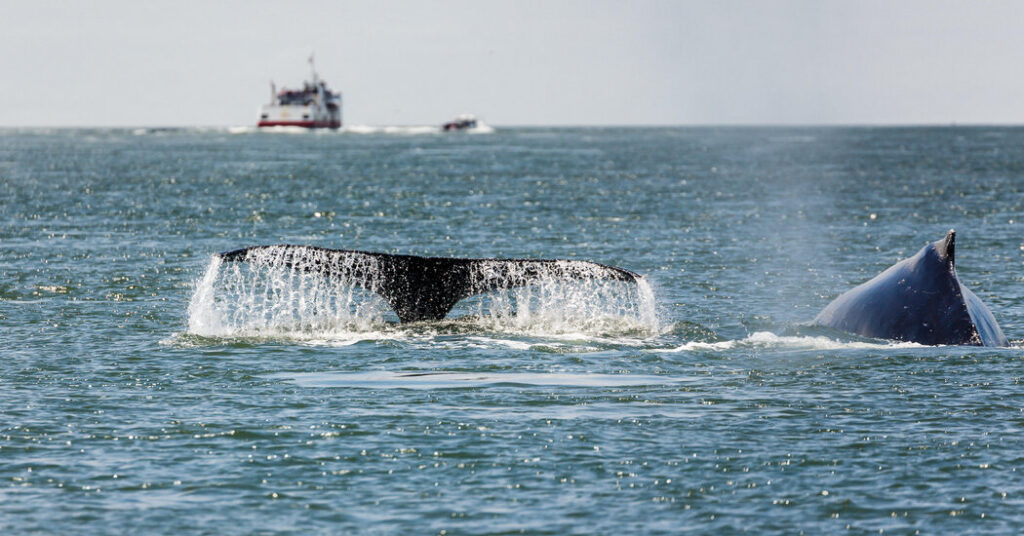
Nearly one-fifth of the gray whales that swam into the San Francisco Bay in recent years died there, mostly after colliding with ships, according to new research published on Monday.
The study estimated that 18 percent of the whales that entered the Bay from 2018 to 2025 did not survive. And among those that died, at least 40 percent had sustained lethal injuries from ship strikes.
In reality, the number of deaths is quite likely higher, the study’s authors and other experts said.
“It’s really important to understand that these are just minimums that we were fully able to confirm,” said Josephine Slaathaug, a graduate student at Sonoma State University and the lead author of the paper, which was published in the journal Frontiers in Marine Science.
Ms. Slaathaug said she and her collaborators had reason to believe that something close to half of the whales that come to the Bay Area are hit by ships and die. In just the last few weeks, at least five whales have been found dead in the area. Last year, nearly two dozen were found.
To conduct the study, Ms. Slaathaug said she manually checked tens of thousands of photos of living and dead whales spotted in the area and created a catalog that matched individual whales to carcasses found nearby.
Figuring out the cause of a whale’s death can be difficult and gory work. Dead whales are often found in varying states of decomposition, which can destroy markings used for identification. And, not all dead whales wash ashore. So, for full necropsies, researchers sometimes tow carcasses to nearby beaches. But that’s not always possible, especially when many die at once.
“There are times that this work is more difficult than others,” Ms. Slaathaug said. “Especially when you really get to know a whale for several months, and then to see it dead and clearly from human causes.”
There are two distinct populations of gray whales, found on either side of the Pacific. The group near East Asia and Russia is considered to be critically endangered, with fewer than 200 thought to remain. The population near North America is not currently listed as endangered but has been declining rapidly in recent years, with numbers estimated to have fallen by half over the past decade.
The gray whales in the Pacific off North America have one of the longest migrations of any marine mammal, ranging from feeding grounds in the Arctic to the Baja Peninsula of Mexico, where calves are born.
Before 2018, they were only sporadically spotted in the Bay Area. Scientists aren’t yet sure why they have started stopping by, but the leading theory is that they are looking for new sources of food.
“With climate change, there’s less prey available to them in the Arctic,” said Kathi George, director of cetacean conservation biology at the Marine Mammal Center in Sausalito, Calif., who was not involved in the study. “So whales aren’t getting as much food as they need to survive these long migrations.”
In the Arctic, whales eat small crustaceans on the ocean floor, which in turn rely on seasonal phytoplankton blooms that are linked to sea ice changes. But as the planet warms and Arctic sea ice vanishes, the dynamics of this food web are changing.
Researchers like Ms. George say the whales might be foraging in the mud at the bottom of the Bay. It’s hard to catch them in action, but this theory is backed by evidence like large mud plumes observed in the water near whales and the stomach contents of autopsied whales, she said.
The waters of the Bay Area are relatively confined and crowded. There are several major container shipping terminals and dozens of public marinas and ferry routes, all of which mean large and fast-moving vessels that can hit whales.
“It’s such a uniquely complex and busy waterway,” said Rachel Rhodes, a scientist with the Benioff Ocean Science Laboratory at the University of California in Santa Barbara who was not involved with the study. “Then you add whales into the mix, and there’s just not a lot of room to coexist.”
If the whales are already malnourished and exhausted from migration, they may be more likely to succumb to injury or less able to avoid ships, she said. Some of the spots with the highest ship traffic overlap with ones where whales tend to gather.
Ms. Rhodes leads a team trying to make the area safer for whales by detecting the animals and sharing their locations with ship captains. The project, called Whale Safe, encourages mariners to slow down or adjust their courses to avoid hitting whales. Another project, Blue Whales Blue Skies, works with shipping companies on voluntary speed reductions.
There are some speed limits in California’s coastal areas, but they vary based on vessel type. Some boats in the Bay, like high-speed ferries on tight schedules, travel at around 30 knots, while tankers typically travel at around 15 knots. Research on other species of whales shows that the animals are more likely to survive collisions with ships moving slower than 10 knots.
Sachi Kitajima Mulkey covers climate and the environment for The Times.
The post More Gray Whales Are Visiting San Francisco Bay, and Many Die There appeared first on New York Times.