In 1977, a 19-year-old African American musician arrived at Sound 80, the world’s first digital recording studio, in the Seward neighborhood of Minneapolis. After the studio technicians set up the equipment, the musician reportedly said, “OK, now leave the studio,” much to the bewilderment of the engineers, according to Steven Orfield, who owns Orfield Laboratories, the building that houses Sound 80.
A few hours later, the musician — a teenage one-man band named Prince Rogers Nelson — emerged with a handful of recorded songs in which he played all the instruments, sang the lead and backing vocals, and mixed and edited the recordings. They would form the basis of his first album, “For You.”
This oft-told tale may or may not be exaggerated, but it helps add to the mystique of a musical genius in the making.
What helped make Prince a singular force in pop culture — he won one Academy Award and seven Grammys and had many hits — is the town where he was born and bred.
“If Prince had moved to Chicago, New York or Los Angeles, his music would have still been phenomenal, but it would have sounded very differently,” said Rashad Shabazz, an associate professor of African American studies and geography at Arizona State University, and the author of “Prince’s Minneapolis: A Biography of Sound & Place.”
“Prince’s genius was that he took the Black-inflected music from the community where he was born — Minneapolis’s Near North Side — and synthesized that with the city’s other sounds,” Mr. Shabazz said.
I closely followed Prince’s career through his many reinventions, hairstyle changes and blistering guitar solos. And so, as we near the 10th anniversary of Prince’s untimely death on April 21, 2016, I followed “the purple trail” in and around Minneapolis.
Paisley Park
You’ll learn on a guided tour that in the last few years of his life, Prince began turning Paisley Park, his 65,000-square-foot complex in Chanhassen, about 20 miles south of downtown Minneapolis, into a museum by bedecking hallways with his many framed gold and platinum records, awards and the covers of albums by other artists who recorded there (among them, Madonna, R.E.M. and Stevie Wonder).
Built in 1987, Paisley Park has four recording studios, a soundstage, a professional-grade kitchen, an atelier for fashion designers, and a residence where he lived the last few years of his life. Visitors can choose from three tours, with two options allowing guests to play on Prince’s Ping Pong table. If you’re looking for a crash course on Prince’s career, Paisley Park is a must.
From June 3 to 7, an annual celebration will take place here and at various sites in Minneapolis. This year’s event, called “10th Anniversary Celebration of Life,” will feature live performances, panel discussions and other experiences.
Paisley Park, 7801 Audubon Road, Chanhassen, Minn. Tours cost from $75 to $199 per person.
First Avenue & 7th St Entry
In 2004, David Carr wrote in The New York Times that “there are few rock clubs in the country with the cultural weight and history of First Avenue.” Housed in a former bus station in downtown Minneapolis, the 56-year-old, 22,000-square-foot First Avenue & 7th St Entry attracts nationally known acts, but it’s most famous for its starring role in the 1984 film “Purple Rain,” which propelled Prince into mega stardom.
Besides shooting the film here, Prince performed at First Avenue numerous times. A V.I.P. box was built for his regular visits to hear live music, such as local acts like Soul Asylum and Lizzo. You can catch shows from local and national bands, as well as attend themed dance parties.
First Avenue & 7th St Entry, 701 North First Avenue, Minneapolis. Tours are available for groups of 10 to 25 people. Tickets generally range from $15 to about $75, depending on the show.
Downtown Murals
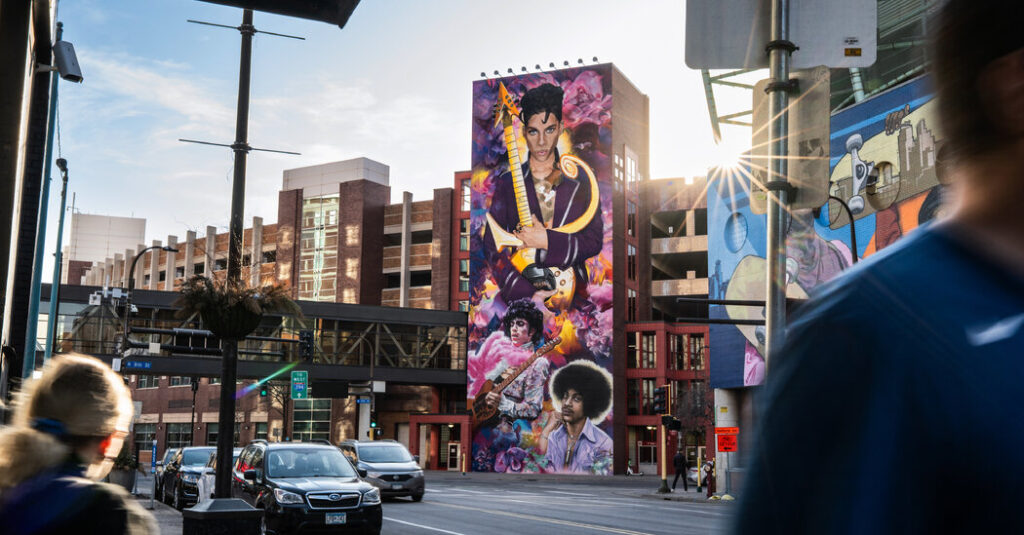
The 100-foot-tall Prince mural by the street artist Hiero Veiga, painted in 2022, is at the intersection of North Ninth Street and North First Avenue. The colorful mural features Prince through his various looks and styles over the decades.
A 10-minute walk from there, on South 10th Street and South Marquette Avenue, is the Schmitt Music Mural, a three-story rendering of sheet music of Ravel’s “Gaspard de la Nuit,” designed by Schmitt Music’s art director Jill Sprangers. In 1977, Prince’s first manager, Owen Husney, hired the photographer Robert Whitman to take photos of a 19-year-old Prince here for the musician’s media kit.
Orfield Laboratories/Sound 80
Boxy Orfield Laboratories may not look particularly welcoming from the outside, but people gravitate to this multi-sensory design research laboratory for a couple of reasons. Among them is spending time in the anechoic chamber, which the Guinness Book of World Records has certified as the quietest place on earth.
Prince fans make the pilgrimage here because Orfield Laboratories is also home to Sound 80. According to the owner, Steven Orfield, Prince wanted to buy Sound 80 from its original owners, Tom Jung and Herb Pilhofer, in the mid-1980s. But when the owners countered his offer, Prince backed out and had Paisley Park built instead. Mr. Orfield ended up purchasing Sound 80 and turned it into Orfield Laboratories in 1990.
Orfield Laboratories/Sound 80, 2709 East 25th Street, Minneapolis. Various tours are available.
Electric Fetus
Prince’s favorite record store — or, as he liked to write it, “wrecka-stow” — has been peddling music since 1968. This family-run shop sells Prince merchandise — T-shirts, hoodies, coffee mugs — and stocks nearly all the artist’s albums and CDs. Prince would often show up here unannounced. Aaron Meyerring, a co-owner, said he turned up on April 16, 2016, Record Store Day, five days before his death, and bought CDs by Stevie Wonder, Joni Mitchell, Santana and the Missing Persons. Mr. Meyerring said, “He told me he loved Electric Fetus because, as he said, ‘You’re the funkiest record store in the world.’”
Electric Fetus, 2000 Fourth Avenue South, Minneapolis.
Darling
Prince loved the cooking of Ray and Juell Roberts, his private chefs from 2012 to 2016. The couple said they would get phone calls at 3 a.m. to come cook for him and his friends hanging out at Paisley Park. “And yes,” Ms. Roberts said, “at that hour we’d make pancakes.”
At Darling, the Roberts’ casual restaurant in the Seward neighborhood of Minneapolis, you can eat some of the dishes they cooked for Prince, including citrus-accented salmon and a vegetable-loaded yellow curry. Prince was not a vegan, but a pescatarian, according to Ms. Roberts. “When I asked him about why so many people thought he was vegan, he said, ‘People are going to believe what they want to believe,’” she said.
Darling, 3311 East 25th St., Minneapolis, Expect to pay about $40 for dinner.
Cheesecake Funk
From 2013 to 2016, Vanessa Drews sold Prince merchandise at Paisley Park during parties and performances. One day she made cheesecake and Prince, who loved it, called it “Cheesecake Funk.”
In September 2025, Ms. Drews opened Cheesecake Funk in Excelsior, four miles north of Paisley Park. The purple walls are bedecked with photos of her former boss. She makes a variety of cheesecakes — banana cream, white chocolate caramel, blueberry lemon — that are excellent, but one taste of the turtle cheesecake (topped with chocolate, caramel and crushed pecans) and you’ll understand why it was Prince’s favorite.
Cheesecake Funk, 2419 MN-7, Excelsior, Minn. Mini cheesecakes cost $4, and slices are $7.
Dakota
In January 2013, Prince debuted what would be his last backup band, 3rdEyeGirl, a female trio, at a surprise show at Dakota, a jazz club and restaurant in downtown Minneapolis. Prince would come here about once a month to watch a show, sitting in his reserved spot, Table 299 on the mezzanine. He showed up just two days before his death to see the jazz and gospel singer Lizz Wright perform. On the evening I visited, the jazz musician and former Prince collaborator Esperanza Spalding performed.
Dakota, 1010 Nicolette Mall, Minneapolis.
Bunker’s Music Bar & Grill
The longtime Sunday night act at Bunker’s, in the North Loop neighborhood, is Dr. Mambo’s Combo, a collective that has long featured members of Prince’s bands. Currently, the former New Power Generation bassist Sonny Thompson is in the band, playing covers of 1970s and ’80s funk and soul songs.
Bunker’s Music Bar & Grill, 761 North Washington Avenue, Minneapolis.
Follow New York Times Travel on Instagram and sign up for our Travel Dispatch newsletter to get expert tips on traveling smarter and inspiration for your next vacation. Dreaming up a future getaway or just armchair traveling? Check out our 52 Places to Go in 2026.
The post In Minneapolis, Following Prince’s ‘Purple Trail’ appeared first on New York Times.