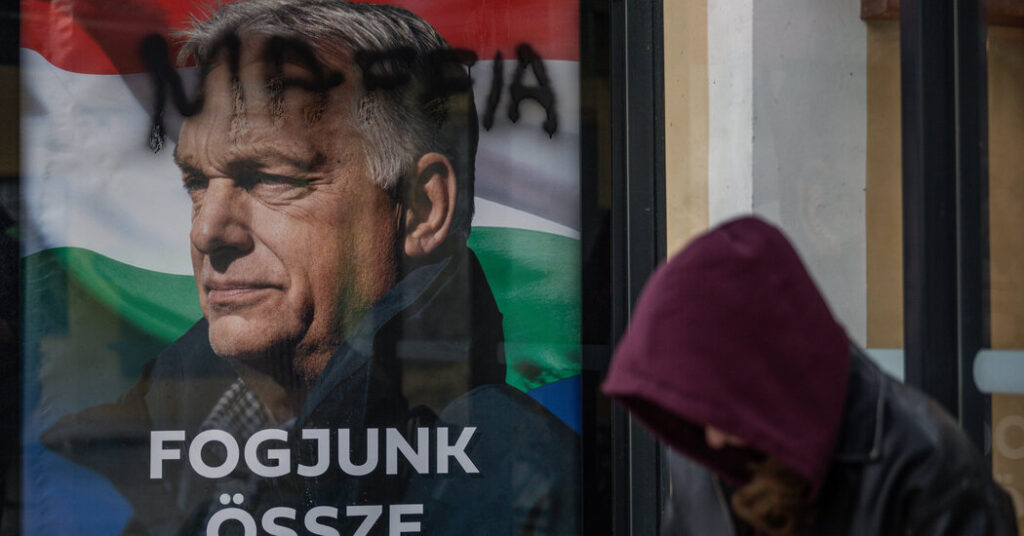
Prime Minister Viktor Orban of Hungary was for years Europe’s pre-eminent political wizard, a leader endowed with uncanny insight into his people’s desires and fears and the ability to steer political tides.
He won four thumping election victories in a row — more than any other current E.U. leader — and declared liberal democracy passé long before President Vladimir V. Putin of Russia pronounced it finished, in 2019, or President Trump first won the White House, in 2016.
On Sunday, it became clear that Mr. Orban had lost his magic.
Peter Magyar, the opposition leader whose Tisza party scored a crushing victory in Hungary’s general election, told cheering crowds that they had ushered in “regime change.”
“You have worked a miracle,” he said, “Hungary has written history.”
What had really happened, however, was that Mr. Orban had failed to rewrite a basic rule of politics, particularly for populists: You have to be popular to win elections.
The result on Sunday did not represent an ideological earthquake or a sudden swerve among Hungarians from right to left, but rather something highly personal. Voters toppled a strongman leader who, increasingly cocooned in the flattery of sycophants and the praise of a sprawling propaganda machine, had lost his touch.
“The fall of the Orban regime feels as sudden and cataclysmic as the collapse of communism in 1989,” said Imre Karacs, a veteran journalist who covered the unraveling of communist governments at that time.
“But both events seemed inevitable to people who dared to believe,” he added.
Mr. Orban’s spell was broken by Mr. Magyar, a conservative former Orban loyalist who shares many of the departing prime minister’s views on matters like immigration. But Mr. Magyar offered a less pugnacious, less divisive style, promising a “humane” Hungary at peace with itself and the European Union.
Tisza won 138 seats in Parliament — more than two-thirds of the total — and left Mr. Orban’s Fidesz party a shellshocked rump with just 55. The win delivered a slap in the face to President Trump, Vice President JD Vance and right-wing Europeans like Geert Wilders of the Netherlands, all of whom had enthusiastically endorsed Mr. Orban and jumped into Hungary’s election campaign on his behalf.
In the end, Hungary’s pioneer of right-wing populism stopped being popular. The same had happened earlier to Janez Jansa, a three-time prime minister in Slovenia and a fervent admirer of Mr. Orban who in 2022 lost a parliamentary election.
Mr. Orban and other right-wing populists who have floundered in office ignored the Russian maxim that politics always involves tension between “the television” — propaganda — and “the refrigerator” — people’s lived reality.
Mr. Orban put all his chips on the television, deploying a vast apparatus of Fidesz-friendly media outlets to vilify his opponents. Mr. Magyar was variously presented as a crook, as a Ukrainian puppet, as a sex maniac with a taste for teenagers and as an abusive husband, while President Volodymyr Zelensky of Ukraine was demonized as an existential menace who would bring war to Hungary if Mr. Magyar won.
After Mr. Orban’s landslide election victory in 2022, he promised a “golden age” for Hungary’s economy. But, deformed by corruption, the country tipped into recession. Although slightly less sickly now, Hungary still has the slowest growth in the region. Unemployment is at a 10-year high.
“The gap between the television and the fridge becomes unbridgeable,” said David Pressman, a former U.S. ambassador to Hungary under the Biden administration and a frequent target for Mr. Orban’s propaganda machine.
“There is only so much propaganda can do when a citizen cannot get medical care in a hospital but knows their prime minister has exotic animals roaming a palatial countryside estate,” he said. That was a reference to opposition accusations that Mr. Orban’s family had stocked a vast country estate it owns west of Budapest with zebras.
Even some of those sympathetic to Mr. Orban had voiced dismay before the election that he was paying so little attention to the economic woes of ordinary Hungarians, including dilapidated schools and hospitals without toilet paper. At a panel discussion last week organized by the Danube Institute, one of a galaxy of government-funded think tanks set up to sing Mr. Orban’s praises, premonitions of the approaching defeat filled the room.
John Fund, a writer for National Review, complained that Mr. Orban was “fighting the last war,” referring to the 2022 election campaign, which Fidesz won by stoking fears that Hungary would be dragged into the Ukraine war if Mr. Orban was not in charge.
“This is not what most people will be voting on. They will be voting on whether their lives will get better,” Mr. Fund said. “The average Hungarian has been standing still.”
Mr. Orban blamed Hungary’s economic troubles on Ukraine and the European Union, as did Mr. Vance, who visited Budapest last week in a last-ditch effort to lift the Hungarian leader’s fortunes. “Brussels bureaucrats,” Mr. Vance said, standing next to Mr. Orban, had “tried to destroy the Hungarian economy” to sway the election on Sunday “because they hate this guy.”
Most officials in Brussels and European leaders didn’t like Mr. Orban, but the bigger problem was that neither did many Hungarian voters, including onetime supporters who tired of his fear mongering about Ukraine and who grew frustrated by the country’s grandiose corruption — the worst in the European Union, according to Transparency International — and by his claims that life was getting ever better.
For many voters, Mr. Magyar’s biggest asset was not his policies on education, health care or the European Union, which he never elaborated on in any detail, but that he was not Mr. Orban.
Referring to Mr. Orban, Benedek Szabo, 39, a musician, said, “I can’t believe he’s going. Sixteen years! I thought it would never end but everything happened so suddenly.”
“Orban grabbed all the power but everything fell apart,” he added.
Mr. Orban even had what some called a “Ceausescu moment,” a reference to December 1989, when the Romanian dictator Nicolae Ceausescu realized in disbelief that a crowd gathered to cheer him was actually booing. Opposition-friendly news media published photographs and videos of Mr. Orban looking stunned — and then very angry — when people started booing him at a campaign rally in the western city of Gyor.
Mr. Orban was never a dictator — he conceded defeat on Sunday with grace and dignity — but he did undermine democratic norms.
During his 16 years in power, he remade Hungary in his own image, eliminating many checks and balances by stacking the judicial system and nominally independent agencies with Fidesz loyalists, and taking control of most news outlets. In 2014, he gave this construct a name: “an illiberal state, a non-liberal state.”
It was a model he sought to export but, according to a pre-election analysis by the Cato Institute, an American research group, “Far from being a model, Orbán’s Hungary is a cautionary tale of what results from an unrestrained executive with strongly centralized power, crony capitalism and the systematic dismantling of the rule of law.”
Until 2024, Mr. Magyar was part of this system, and, Mr. Karacs, the journalist, said that his views were “not that distant from mainstream Fidesz apparatchiks — which is what he was just two years ago.”
Leftists and liberals, Mr. Karacs added, had “swallowed their misgivings for the sake of the cause: Get rid of Orban.”
Andrew Higgins is the East and Central Europe bureau chief for The Times based in Warsaw.
The post How Orban, a Wizard of Populism, Lost His Magic Touch appeared first on New York Times.