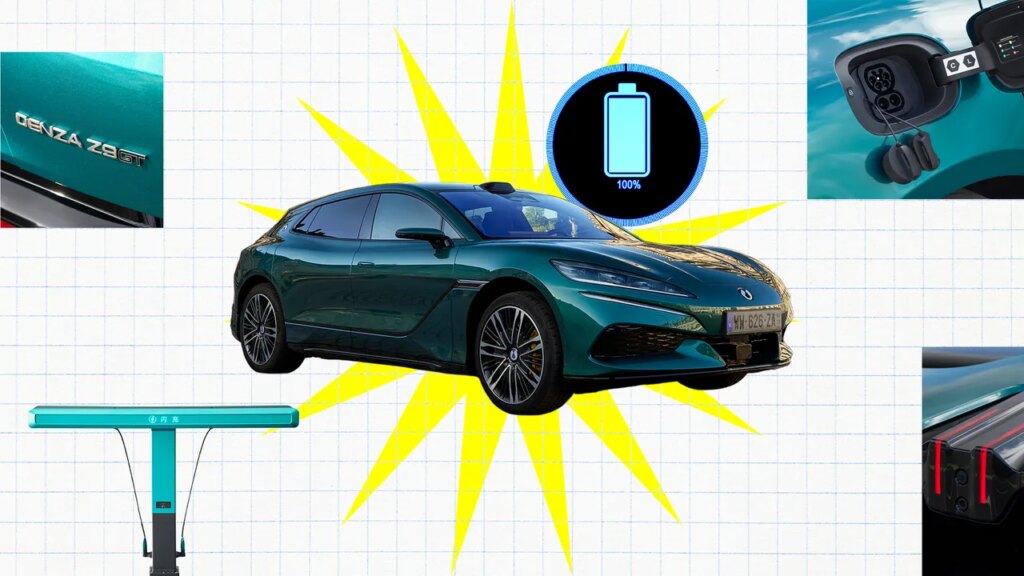
The Denza Z9 GT is the world’s fastest car—fastest at charging, that is. It’s by no means slow in speed (we’ll get to that), and it is packed to the brim with bleeding-edge tech (we’ll get to that, too). But, trust me here, it’s the formidable charging tech BYD has brought to bear here that should get you hot under the collar.
Many auto brands claim charging times that are, shall we say, massaged. Not so with the Denza Z9 GT. I sat in the car and personally watched it go from 10 percent to full in just over 9 minutes. It makes all other EVs look like they are standing still in this department, and the Z9 GT heralds a new age of electric cars that will confound gas faithfuls whose primary argument has always been that you can’t fill EVs quickly.
Denza is BYD’s “premium” EV brand, here to bother the likes of Porsche and Polestar, and the Z9 GT is its opening salvo in Europe, intended to scare the hell out of the Western competition with a heady mix of performance, everything-as-standard abilities such as crab-walking and all-wheel steering, and an electric architecture miles ahead of any competition.
Yes, the Z9 GT has all of these, but in a rushed attempt to prove it deserves to be considered by consumers alongside the high-end German carmakers, BYD has unwisely abandoned its winning strategy of offering more for much less, and is here offering more for more.
You’re used to seeing the Chinese company seriously undercut competition, right? Well, hold onto your hat. This Z9 GT will cost €115,000 in Europe. That’s roughly $134,000. This is a staggeringly punchy price, going against one of the primary brand values we associate with BYD, and to add insult to injury, the same car sells for just £55,000 in Australia, and about £45,000 in China.
How on earth can BYD justify such a huge price hike for Europe? It certainly can’t all be blamed on tariffs, shipping, homologation, dealer networks, or even a costly Daniel Craig-fronted global ad campaign. I asked BYD, and the only other reason I got for the thumping price increase was “market contextualization.” Which, to put it simply, means BYD thinks it can get away with charging more in the EU.
But you can’t price your way into the premium market. Just because you charge the same as Porsche, doesn’t mean buyers will think of you in the same way. This smells like, in the West, BYD is trying to force its way into this part of the market without earning the brand value. Trust at this price level is built slowly, and buyers spending six figures tend to stick to what they know. We’ll see very soon if such a bold, or foolhardy, strategy works out. And all this doesn’t even factor in the painful second-hand value hits premium EV owners are facing. Porsche Taycans can lose half their value in just one year.
Stella Li, BYD’s executive vice president, tells me that the Z9 GT’s “wow factor” will stop the brand from experiencing the same residual value woes as Porsche. I wish I had her confidence. Still, Li isn’t lying about the wow. A 309 brake horsepower (bhp) motor on the front axle, combined with twin 416 bhp motors on the rear, puts out a hair-raising 1,140 bhp. Zero to 62 mph is dispatched in 2.7 seconds. Top speed is 168 mph. The independent rear wheels mean the car can crab-walk, U-turn on the spot, as well as performance park: drive in nose-first, and the rear follows you in. The 372-mile range is OK but certainly not wow, and the same goes for L2+ autonomous driving—but there is (unsightly) Lidar on the roof for a degree of futureproofing.
The main event is BYD’s Flash charging tech. The enemy of fast charging is heat and resistance inside the battery. When you push electricity in fast, the battery resists it, generates heat, and that heat damages cells. This means chargers have to slow down to stay safe. BYD’s engineers have designed new tech to make the internal plumbing of the Blade Battery 2.0 so efficient that huge amounts of electricity can flow through, including cathodes with a multi-sized particle structure. Think of it like packing different-sized rocks into a container: As the particles fit together more efficiently, allowing ions to get in and out faster, the result is that internal resistance is cut in half, as is heat generation.
BYD is also using upgraded thermal management and self-repairing tech to maintain integrity through repeated charge cycles. All this while managing to employ lithium iron phosphate (LFP) chemistry on the Blade Battery 2.0, thus avoiding expensive metals like cobalt or nickel.
This all means BYD’s coming Flash chargers will be able to push 1.5 megawatts into the Blade 2.0 without it overheating or degrading. So what? Well, 1.5 megawatts is 1,500 kilowatts. The best Tesla Superchargers can manage is 325 kW. This is effectively how BYD has managed to throw out the charge time rule book. It’s simply game-changing.
In direct competition to Tesla’s Supercharger network, BYD is now setting up 6,000 new locations globally outside China. Once these are up and running (600 charging sites alone are coming to the UK in the first wave), the real-life charging experience for those using this tech will see charging from 10 to 70 percent go from 30 minutes to just 5 minutes, and on to that confirmed full charge in 9 minutes.
Amazingly, Diego Pareschi, BYD’s global director of EV charging, tells me that these numbers are not the best the new Flash system can manage; it is operating effectively at two-thirds capacity in the EU and can potentially offer 30 percent more in the future. If this really is the case and Pareschi manages to wring out the most the fast-charging system can offer, we are looking at charging times here directly comparable to filling at the gas station. And this is before we’ve even got to solid-state battery tech.
The Z9 GT is the first car outside China to carry BYD’s new battery, and so it makes use of the Flash charging technology. But this won’t be exclusive to Denza. BYD cars will soon have the Blade 2 battery and necessary architecture. BYD will also be opening up this new network to other car brands, which will benefit from the increased power output from Flash but be limited to the capacity of their individual architectures.
Back to the Z9 GT, and aside from the unbelievable charging ability, the rest of the experience leaves the high price hard to justify. The exterior design is confusing. You could never call this car stunning or attractive, although the rear view is better than the generic front. Inside, a great deal of effort has been made to justify the premium positioning. I must have been told three times about how impressive the massaging seats are, and the fact that the rear passengers get them standard as well. The 1,100-watt, 20-speaker stereo system is by French audiophile brand Devialet, and it is superb.
The ride gives confidence, but it is a little soft. The steering is heavy, likely due to that all-wheel setup. The car weighs 2.9 tons, and far from hiding this weight like the BMW iX3, you can actually feel it. I did get close to the stated 3 miles per kWh on my short test drive, though. As for the acceleration, yes, from a standstill, it is shockingly quick, which is what BYD was going for. But it feels like too much attention may have been paid to the statistics as opposed to making it a genuinely Porsche-rivalling ride.
And this brings us back to that price problem. If you had to spend $134,000, would you buy this car? Even with all the bells and whistles, the crab-crawling, the parking, and yes, even the super-fast charging, is the Z9 GT worth the money? The answer is no, it’s not. It feels like a car worth less than that. About the amount that BYD is asking for the car elsewhere in the world, in fact. I’ve no doubt Denza will earn its place in Europe’s premium auto sector. It just might not be able to do it with its first car out of the gate.
The post BYD’s Fastest-Charging Car in the World Is Astonishing—in Good and Bad Ways appeared first on Wired.