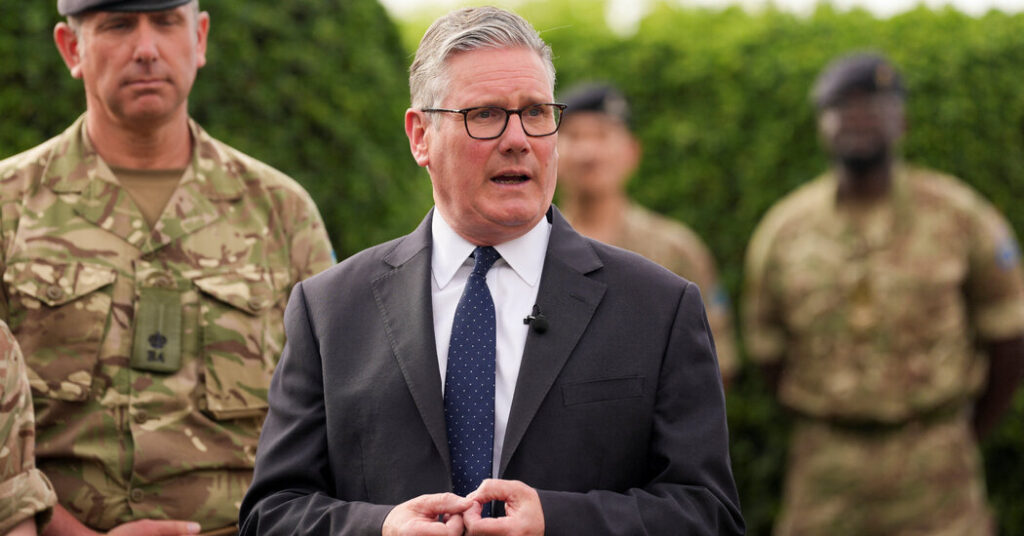
Prime Minister Keir Starmer of Britain was blunt on Monday morning. His country is “not supporting” President Trump’s threatened military blockade of the Strait of Hormuz after diplomatic talks between the United States and Iran broke down over the weekend.
The prime minister told the BBC in a radio interview that he was focused on “bringing countries together to keep the straits open, not shut,” adding that “it is, in my view, vital that we get the strait open and fully open.”
But Mr. Starmer refused to blame Mr. Trump personally for rising energy costs in Britain, saying that it was Iran that had driven up the price of oil by making the strait too dangerous for cargo ships to travel through.
After the host of the radio show pointed out repeatedly that Iran’s actions were in response to Mr. Trump’s decision to launch the war in the first place, Mr. Starmer finally said, simply: “I mean, I’m not, look, I’m not going to get involved in that.”
The interview put on display the longstanding challenge for Mr. Starmer in dealing with Mr. Trump and his chaotic foreign policy.
On the one hand, Mr. Starmer’s refusal to join the American and Israeli-led war in Iran has triggered Mr. Trump’s ire. The prime minister has said he will not give in to “pressure” from the president to drag Britain into another conflict in the Middle East.
The decision to stand up to Mr. Trump appears to be popular in Britain, where Mr. Starmer’s low poll ratings have picked up slightly.
But Mr. Starmer, who is a careful lawyer by trade, remains wary of doing too much to anger Mr. Trump, given the many security, economic and cultural ties between the two countries. Mr. Starmer has said that he still believes there is a “special relationship” between the United States and Britain that is worth protecting.
Mr. Starmer’s efforts to balance those competing interests will likely be tested further if the war with Iran begins again in earnest. The cease-fire is set to expire on April 21.
In dealing with Mr. Trump, European leaders have staked out a variety of different positions, while all declining to join any offensive military action.
Spain’s defense minister, Margarita Robles, said Monday that Mr. Trump’s plan to blockade the Strait of Hormuz “makes no sense.” Spanish leaders have been among the most critical of the U.S.-Israeli war.
“Since this war started, nothing makes sense,” Ms. Robles told Spain’s public television. “This is another episode in the downward spiral the world has been dragged into.”
In France, President Emmanuel Macron on Monday said on social media that “France stands ready to play its full part, as it has consistently sought to do.” He did not mention Mr. Trump’s threatened blockade but stressed “the need to restore free and unimpeded navigation through the Strait of Hormuz as quickly as possible.”
Britain and France have been talking to dozens of other countries in recent weeks in an effort to coordinate diplomatic and military options for keeping the strait open once the fighting stops.
Mr. Macron said the two countries were planning another conference to discuss those issues “in the coming days.” He added: “This strictly defensive mission, separate from the warring parties to the conflict, is intended to be deployed as soon as circumstances permit.”
Michael D. Shear is the chief U.K. correspondent for The New York Times, covering British politics and culture and diplomacy around the world.
The post Britain Will Not Join U.S. Blockade of Strait of Hormuz, Starmer Says appeared first on New York Times.