Republicans always expected the 2026 elections would be tough. Then the U.S. went to war with Iran.
Gas prices — one of President Donald Trump’s favorite metrics — shot up, fanning economic anxiety just as Republicans were hoping to focus on Americans’ tax breaks and refunds. Analysts say costs could stay elevated well into the year even if the war ends soon.
“Consumer Sentiment Drops to LOWEST ON RECORD,” a Friday email from the Democratic National Committee blared.
If Republicans lose one or both chambers of Congress in November, they may point to this period as a crossroads when an already daunting midterm year got harder. The fallout of the war threatens to undercut the GOP economic pitch for months, and Trump is struggling to control the conflict, alarming politicians in both parties with his recent social media threat to wipe out “a whole civilization” in Iran.
The president has suggested the war could wind down soon, and Republicans have cast it as a temporary disruption. But as the conflict enters its seventh week — with the United States still trying to reopen a key shipping route for oil — the ripple effects could prove hard to quickly reverse.
“Republicans are extremely concerned about how a longer war … drags on and into the midterms,” Republican strategist Matthew Bartlett said. “The higher prices climb, the lower polls go … and that has the possibility to turn safe seats into battleground seats.”
Other Republicans said they are not panicking yet, hopeful that the war and its aftershocks will recede from the public consciousness by the time voters go to the polls. The Trump administration is trying to negotiate with Iran, and the president’s approval rating has ticked down since the conflict started, but only slightly — 1 to 2 percentage points, according to national polling averages.
Trump’s approval ratings have declined over the course of his second term and averaged about 37 percent in recent weeks in polls tracked by The Washington Post, close to the lowest mark of either of his presidencies and to the lowest mark of his immediate predecessor, President Joe Biden.
The uncertainty surrounding the war adds to a host of warning signs for Republicans. Historically, the party in power often loses seats in the midterms, and many in the GOP are gloomy about their chances of holding on to control of the narrowly divided House. Democrats have a much harder path to retaking the Senate, where the GOP holds 53 of 100 seats, but operatives in both parties aren’t ruling it out.
White House spokesperson Taylor Rogers said Trump will not allow “the Iranian terrorist regime” to possess a nuclear weapon and remains committed to lowering costs.
“With the ceasefire now in place and a long-term peace plan being worked on, oil and gas prices will continue falling back to the multiyear lows American drivers enjoyed before these short-term disruptions,” Rogers said in a statement last week.
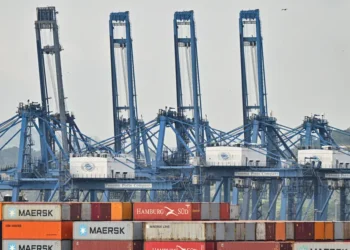
Oil prices, which had surged above $100 a barrel, dropped sharply after Trump announced a ceasefire last week — only to rise again as tensions persisted and Iran again closed the Strait of Hormuz, a key oil route.
Trump announced Sunday that the U.S. would blockade the strait after weekend talks with Iran failed to produce a deal. Asked on Fox News whether he thought the price of gas would be lower before the midterms, Trump mused that “it could be the same or maybe a little bit higher.”
As of Monday morning, the price of a barrel of Brent crude, the global benchmark for oil prices, was up 8 percent to about $103, and the average price of gas in the U.S. was $4.12, flat from the previous day.
The U.S. Energy Information Administration suggested last week that energy prices could take months to return to normal even if the war concludes soon — forecasting that if the conflict ends before May, oil supplies should “return close to pre-conflict levels in late 2026.”
Senate Minority Leader Charles E. Schumer (D-New York) emphasized that prospect of extended economic trouble in a news conference last week, predicting months of high gas prices and saying that “world oil markets will be unsettled for years.”
Republicans are eager for an off-ramp. “Gas prices need to revert to the mean in the next 45 days, or I think voters are going to punish Republicans at the ballot box,” said one major GOP donor, who, like some others, spoke on the condition of anonymity to be candid.
A GOP strategist working on midterm elections said Republicans hope the situation is at its thorniest now. “There’s an expectation this is the lowest it gets, and we only have room to grow,” the strategist said, also speaking on the condition of anonymity.
Jonathan Bridges, a Republican strategist in battleground North Carolina, echoed that there’s time for prices to come down before November.
“This summer, people are going to be making travel plans, and if we continue to have $4 gas, it’s going to hurt a lot of consumers,” he said. “But a lot can happen.”
The GOP retains some advantages heading into the midterms, including a massive war chest that outstrips that of the Democrats. But Democrats say their reasons for optimism are growing.
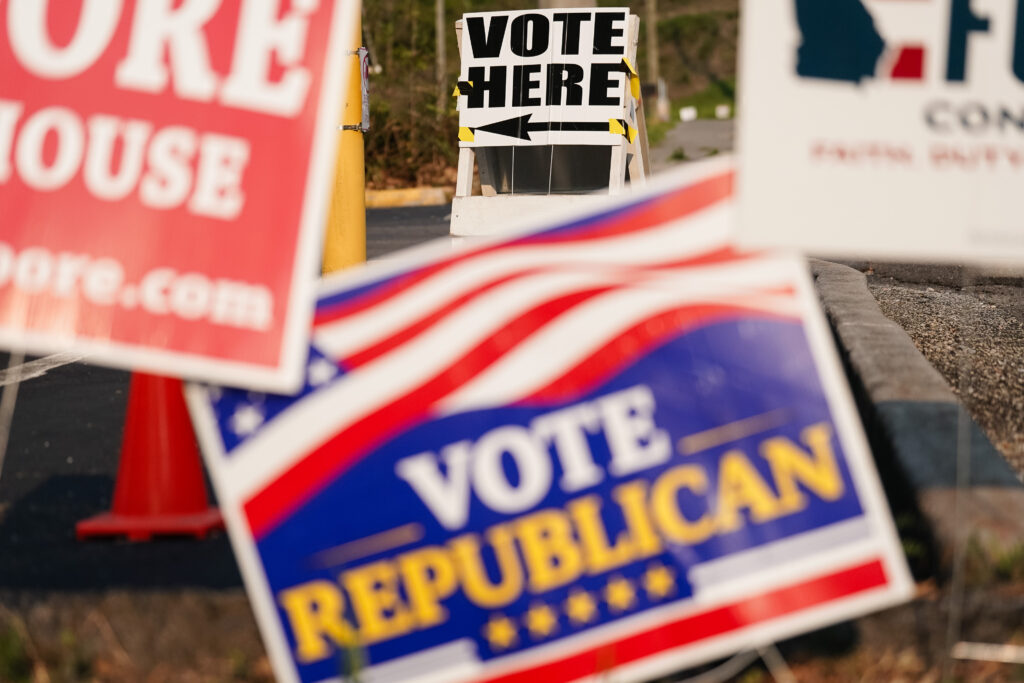
On Tuesday, they saw their biggest overperformance yet in a House special election since Trump took office last year. Republican Clay Fuller won the race to fill Marjorie Taylor Greene’s former U.S. House seat in a deep-red Georgia district, but his roughly 12-point margin of victory was much smaller than Trump’s 37-point win there in 2024 or Greene’s 29-point win the same year.
Democrats also celebrated an unusually decisive victory last week in a Wisconsin Supreme Court race. The liberal candidate won with 60 percent of the vote — a striking margin in a battleground state where races are often decided by a point or two, though Democrats’ big spending advantage in the contest this year could help explain it. Liberal candidates won with about 55 percent of the vote in the last three Wisconsin Supreme Court races.
“To get to 55 percent in these past elections is a huge deal,” Democratic pollster Jeff Horwitt said. “Sixty is just a really remarkable number.”
An nonpartisan election analyst, Cook Political Report, recently revised its assessments of several races to favor Democrats. Five House races shifted to the left in its ratings, Cook Political Report said last week, while its assessment of the Iowa governor’s race movedfrom “Lean R[epublican]” to “Toss Up.”
Trump’s dropping approval rating “makes it difficult for Republicans to both win independents and turn out their own base,” said Dave Wasserman, a Cook Political Report analyst. “It puts the Senate in play, and it means Democrats are substantial favorites in the House.”
Kyle Kondik, an analyst for Sabato’s Crystal Ball, a nonpartisan elections website and newsletter, said fallout from the war and Trump’s approval ratings put the GOP in risky territory.
“If we get to the point where the Senate would actually flip — the seeds for that are being laid right now,” Kondik said.
Scott Clement and Theodoric Meyer contributed to this report.
The post As Iran war drags on, midterm forecasts for Republicans get even worse appeared first on Washington Post.