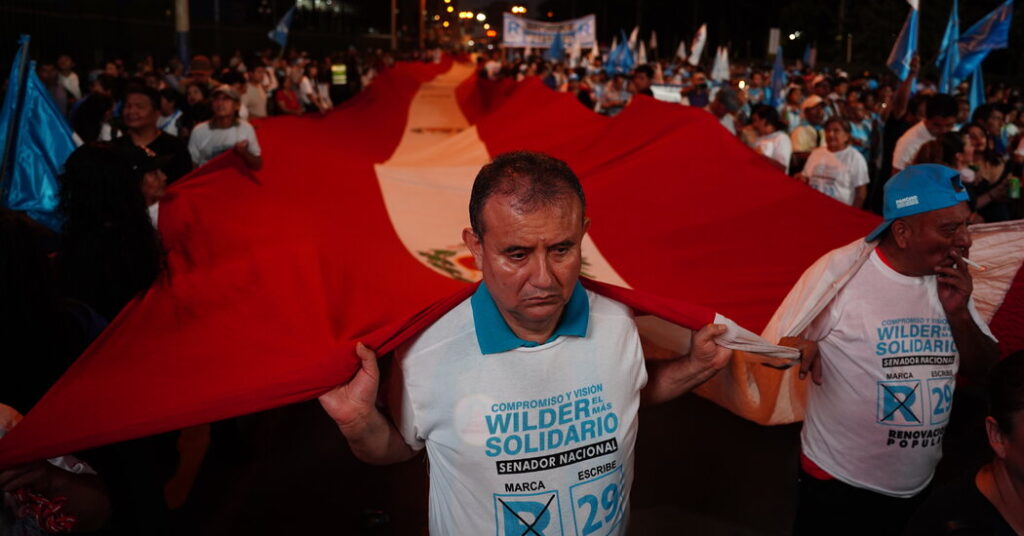
Peru extended voting by a day in parts of the capital, Lima, after widespread logistical failures left tens of thousands unable to cast ballots, an extraordinary disruption that has some candidates raising questions about the conduct of the election.
The decision by the electoral oversight body allowed voting to continue Monday in the 15 affected polling stations in Lima — as well as two locations in the United States — even as early results from Sunday’s vote had already begun to circulate.
Although authorities later called for a halt to quick counts to avoid influencing voters still casting ballots, some exit polls had already been released. At the same time, the electoral authority that organizes and runs the vote, known as ONPE, continued publishing preliminary results as they came in, creating a fragmented picture of the vote.
Exit polls by Datum and Ipsos showed Keiko Fujimori, a four-time presidential candidate and daughter of former President Alberto Fujimori, in the lead, with four candidates virtually tied for second place.
The top two candidates will face off in a June 7 runoff unless a single candidate wins more than 50 percent — a near impossibility in a race with a record 35 candidates.
The problems began early Sunday, when the delayed delivery of voting materials left some polling stations across Lima unable to open or to open on time, causing voters to wait in long lines for hours.
Television footage showed the lines stretched along a mountain path and frustrated crowds, including older voters, gathered outside schools where ballots had yet to arrive. Videos circulated of people chanting “we want to vote” and, in at least one case, forcing their way into a polling site.
Officials said delivery failures prevented the installation of 211 polling tables at 15 locations in Lima, affecting about 63,300 voters. (Nationwide, there were more than 10,000 polling places, with 27 million registered voters.)
Piero Corvetto, head ONPE, blamed a contractor who failed to provide enough trucks, so that distribution of voting materials had to continue overnight and into election morning. He added that 99.8 percent of polling tables nationwide were ultimately installed.
“We take responsibility,” he said, adding that the disruptions did not compromise the electoral process as a whole and that “there is no possibility of fraud.”
The disruptions quickly took on political overtones. Rafael López Aliaga, a leading candidate, called the situation “blatant fraud” and the election “tainted,” and said criminal complaints had been filed against Mr. Corvetto.
“Elections should be something smooth, well-organized and without problems, but they failed to follow their own schedule,” Mr. López Aliaga said in televised remarks.
Other candidates also raised concerns. Ms. Fujimori said she “deeply regrets” the logistical failures, while Mario Vizcarra said the situation appeared “suspicious” and Jorge Nieto demanded explanations. Alfonso López-Chau said it was “unjustifiable” that so many polling stations were not set up.
“Everything that has happened here is very strange, and it needs to be clarified for the sake of the country’s democratic health,” said Ricardo Belmont, a top candidate, in an interview with The New York Times.
The controversy has also sparked legal debate. Lawmaker Edward Málaga-Trillo urged authorities to consider annulling the results of the election.
Luciano López Flores, a constitutional lawyer, said the number of affected voters did not meet the legal threshold for nullification, but also said that the decision to extend the election by a day was “legally a stretch.”
Election observers and authorities have urged calm, emphasizing that the problems stemmed from logistical failures rather than manipulation.
Still, some voters expressed anger and suspicion.
Elvia Miranda, 62, a resident in Lima’s Chorrillos district, said she was able to vote but worried about those who could not.
“Imagine — so many people who couldn’t vote,” she said. “And then the president of the ONPE comes out and says ‘there’s no problem.’”
Distrust was already high before the vote. About 80 percent of Peruvians say electoral fraud is plausible and roughly seven in 10 lack confidence in the electoral authorities, a recent survey by the Institute for Peruvian Studies found.
Álvaro Henzler, head of the election observer group Transparencia, said he backed the decision to extend voting by one day, calling it an appropriate response to “this unprecedented situation in the country’s electoral history.”
He said in a news conference that the roughly 63,000 affected voters could prove decisive in a tight race. He added that the group would delay releasing its quick count until voting concluded and urged authorities and pollsters to do the same, warning that early results could be skewed toward Lima and not reflect the national outcome.
Marco Garro contributed reporting from Lima.
Genevieve Glatsky is a reporter for The Times, based in Bogotá, Colombia.
The post After Chaotic Election Day, Peru Orders 2nd Day of Voting for Some Areas appeared first on New York Times.