It was a sticky summer night and Blanche DuBois was descending into madness — not on a proscenium stage, mind you, but in a carousel house off the boardwalk in Asbury Park, New Jersey. And the soundtrack to the evening? The hip-hop beats of Cypress Hill, whose neighboring concert offered uncannily apt lyrics for the stripped-down staging of “A Streetcar Named Desire.”
Insane in the membrane! Insane in the brain.
Such are the happy happenstances that occur with the Streetcar Project, a grassroots endeavor dedicated to staging Tennessee Williams’s 1947 opus in “found” spaces.
“The audience wondered if we had planned it,” says Lucy Owen, who founded the Streetcar Project with director Nick Westrate and plays Blanche. “We had not.”
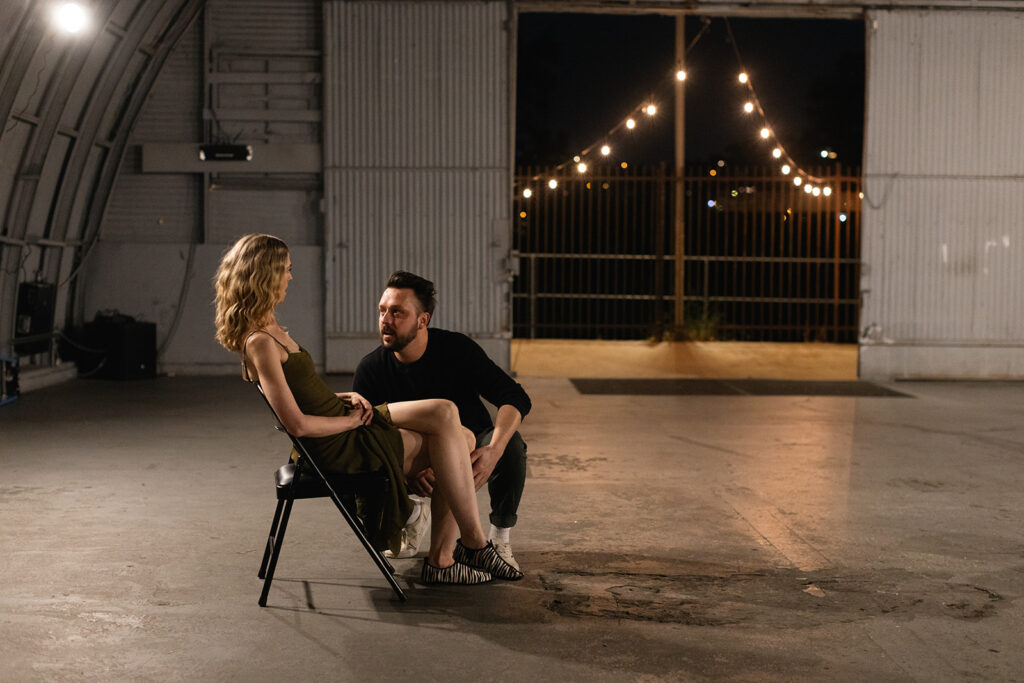
Featuring four actors, a sparse set, no props and a renewed emphasis on the play’s text, this “Streetcar” production has been performed since 2023 on all manner of improvised stages. An airplane hangar in Los Angeles. An opera house in Colorado. A dining hall, library and bar at Yale University. A Baptist church and various homes in Manhattan. It wasn’t until San Francisco’s American Conservatory Theater welcomed the Streetcar Project earlier this year that the show was staged in a genuine theater.
Now, Owen and Westrate are pulling “Streetcar” into an ideal stop: the Dupont Underground, the abandoned D.C. streetcar tunnel that has been reimagined as a subterranean arts haven.
“It is the ultimate space that we could find to do this show,” Westrate says. “We’re so lucky to get to pour this piece into this amazing vessel.”
The Streetcar Project was born out of pandemic-era ingenuity. As Owen, a New York-based theater actress, waited for the industry to reopen, she decided to pick up her favorite play and contemplate her favorite part: that of Blanche DuBois, the destitute Southern belle who moves into a ramshackle New Orleans apartment with her sympathetic sister and brutish brother-in-law. Once it was safe to gather, Owen invited actor friends — Westrate included — to read the play at her apartment.
Although Marlon Brando’s brooding portrayal of Stanley Kowalski dominated both the original Broadway production and the 1951 film adaptation, Owen’s readings — devoid of a showy, Brando-echoing performance — revealed more of a character on the periphery. Along the way, they discovered a version of “Streetcar” less about the abusive husband who lords over the household and more about the sisters — Blanche and Stella — whose relationship dissolves in the Louisiana heat.
“It’s changed my opinion of the play,” Owen says. “Our culture’s assumption about this play, based on the original production and the subsequent movie, is that it was a play about a sexy dude in a tank top, to quote Nick. And, actually, it’s a play about sisters.”
As Westrate explains: “We’ve had generations of men growing up wanting to scream the word ‘Stella’ onstage — so much that it’s all people think of. But the play actually ends with Stella screaming the name Blanche. So we hope that this production will lead to an entire generation of women who want to grow up to scream ‘Blanche.’”
Working off seed money from producer Ryan Hill, Owen and Westrate workshopped their vision for a streamlined “Streetcar” at a barn in Upstate New York and a Manhattan arts center. When they eventually brought in a design team, some of those would-be collaborators insisted that the bare-bones interpretation didn’t need an elaborate set or costuming at all.
With Westrate directing and Owen playing Blanche, the Streetcar Project has since been staged whenever and wherever an audience will join. Dressing rooms and bathrooms are optional. Acoustics and lighting are always an adventure. The same goes for blocking the play, which has been staged with as little as 90 minutes of rehearsal in a space. But with such challenges also come the unpredictable perks of repeatedly revisiting a classic in settings adorned with fresh inspirations.
“If you’re doing it in a bar, the theme of alcoholism is so present,” says Mallory Portnoy, who plays Stella. “If you’re doing it in a room with a bed, sex feels so present. If you’re outside, it feels very primal and animalistic.”
“The benefit of working on it for so long is we’ve had months off at times for the material to marinate and fester,” adds Brad Koed, who portrays Stanley. “Every time we come back to it, there’s more core themes and arguments that present themselves to us.”
Westrate, an actor whose D.C. theater credits include “Frankenstein” and “The Wild Duck” at Shakespeare Theatre Company and “Angels in America” at Arena Stage, pinpointed Dupont Underground as the perfect “Streetcar” stop after attending a workshop there overseen by his “Angels” director, János Szász.
The Dupont “Streetcar,” running from April 20 to May 4, should be characteristically intimate. Owen and her castmates will perform for about 100 theatergoers in a curved space that reopened as an exhibition venue a decade ago — more than 50 years after the last streetcar rolled through.
“It still has a lot of challenges, but it’s so beautiful and just terrifying to think of how subterranean it all is,” Westrate says. “We have always thought of the show as an underground piece of art, and to literally do it underground is very, very fun.”
The Dupont Underground may seem like the endeavor’s inevitable conclusion, but Owen and Westrate don’t see it that way. Their undertaking revels in reinvention, and they’re not sure whether they’ll ever reach the end of the line.
“As long as there are places for us to do it that are interesting to us and audiences that are interested,” Owen says, “I think we’ll keep showing up.”
The post ‘A Streetcar Named Desire’ on real streetcar tracks? Only at Dupont Underground. appeared first on Washington Post.