“There you have it, the meeting went well,” declared the Great Narrator a few hours after Saturday’s marathon, 21-hour negotiation with Iran ended. “Most points were agreed to, but the only point that really mattered, NUCLEAR, was not.”
So — wham! — President Donald Trump announced that to get a better deal he was blockading the Strait of Hormuz. Some commentators speculated that with the failure to reach a deal in Islamabad, the United States might be marching deeper into another “forever” war — that the talks could have been a prelude to a new and perhaps more dangerous phase of conflict.
After talking Sunday with people close to the negotiations, my sense is that the Islamabad impasse won’t necessarily mean a return to war. The blockade is a pressure tactic, to be sure, but not primarily a military one. Trump has no appetite for further armed conflict. He knows that the upsides are limited and the “tail risk,” as financial traders like to say, is large. His aim instead is to put a severely battered Iran into an economic vice to see if its leaders will set a different course in a big, comprehensive deal.
The American side expects that despite last weekend’s standoff in Islamabad, contacts will probably continue, through Pakistani intermediaries. Trump’s destination is still the exit ramp.
“If you cannot solve a problem, enlarge it.” That advice, often attributed to President Dwight D. Eisenhower, seems to be Trump’s strategy. With the Iranian regime still standing after weeks of intense bombardment and still holding major cards in the remnants of its nuclear program and its ability to disrupt shipping through the Strait of Hormuz, Trump decided to propose what he might call a “Tiffany” deal: a big, glittering package of economic benefits, including removal of economic sanctions, in exchange for a full renunciation of Iran’s nuclear and missile programs and support for proxies.
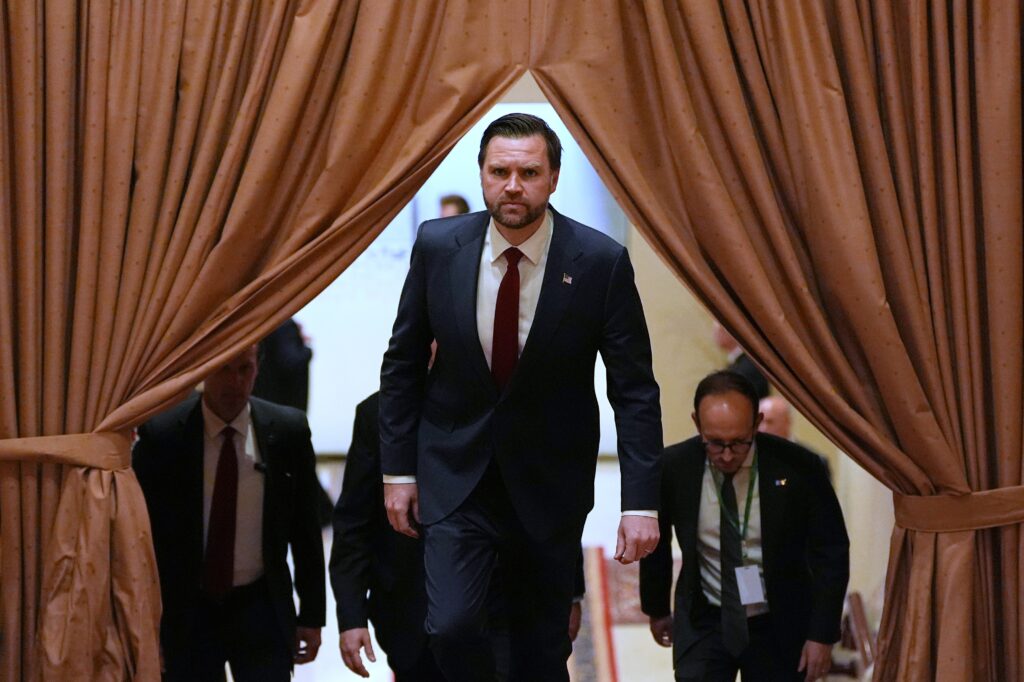
The Islamabad talks got off to a predictably hard-nosed start, as Vice President JD Vance and Parliamentary Speaker Mohammad Bagher Ghalibaf put down their markers, the knowledgeable sources said. But after long hours of discussion, Ghalibaf had impressed the American team as a refined and professional bargainer — and potential leader of a new Iran. Officials believe other officials from Iran’s Islamic Revolutionary Guard Corps are opening their own channels because they want to be part of the future as well.
This could all be wishful thinking of the sort that U.S. officials once dispensed about Iraq or Afghanistan. Ghalibaf has been trying to position himself as a pragmatic, Davos-attending alternative to the mullahs for two decades. I first wrote about him as a “tightrope walker” in 2006, when as mayor of Tehran, he wanted to fix potholes and collect garbage and “perhaps to escape the apocalyptic confrontation with the West” of his rivals. Now, 20 years later, it’s time for Ghalibaf the would-be change-maker to put up or shut up.
Iran today is ragged, for all its bravura, U.S. officials believe. It is experiencing a military version of a covid shutdown, with little economic activity in the country after 40 days of war. Trump now plans to squeeze the economy even harder, like a UFC fighter with a chokehold on his opponent, waiting for him to “tap out.” Trump, let it be said, has been waiting for that submission since he began the war Feb. 28 — and his overoptimism is widely seen by critics as his biggest mistake.
That “tap out” metaphor is the rationale for the blockade. A shorthand for this strategy might be “Operation Economic Epic Fury.” Trump is said to have recognized that a ground attack or other military escalation might lead the U.S. into a quagmire. It has dawned on the White House, as critics have been warning, that wars in the Middle East are easy to start but hard to stop.
Trump administration officials see three possible scenarios as the U.S. tightens its economic grip: First, the regime could be overthrown, an outcome they think is more likely to occur once the bombing has stopped than before; second, Ghalibaf or some other new leader could decide to cross what the Trump team has pitched as a “golden bridge” into a new future; or, third, hard-liners in the IRGC could try to break the blockade or launch other strikes to force more U.S. concessions.
If a still-emboldened Iran tries to press what it sees as its advantages, through military or terrorist attacks, Trump could be forced into the escalating military confrontation he hopes to avoid. That’s the risk of the strategy the Trump team adopted in Islamabad — they showed how much the U.S. is willing to offer to get a peace deal. But Trump doesn’t negotiate by increments. He thinks small deals produce small results.
That’s the logic here. Make the cake bigger, even as you tighten economic pressure on Tehran to accept U.S. terms. The aim is to convince Ghalibaf and his colleagues to transition from being a revolutionary “cause” that threatens the region into a real country that can modernize quickly and profitably, like its neighbors Saudi Arabia and the United Arab Emirates across the Gulf.
This arc — from cause to nation — is how former secretary of state Henry Kissinger liked to describe what was needed to stabilize Iran and the Middle East. Through history, such moments of realignment have followed wars, as he wrote in his first book, “A World Restored.” Kissinger explained how in 1815, following the Napoleonic wars, the Congress of Vienna reconciled the rising revolutionary powers of Europe with the status quo powers.
Is the world at one of those tipping-point moments that Kissinger imagined? When talking about the Middle East, it’s usually wise to bet against such hopeful outcomes. For 47 years, Iranian leaders have been making bad choices, often matched by the U.S. and Israel.
But still, this weekend’s images from Islamabad — of an American vice president and Iranian parliamentary leader talking through the night about the shape of a possible deal — had a quality at once of both impossibility and inevitability.
The post What really happened in Islamabad — and what Trump is trying now appeared first on Washington Post.