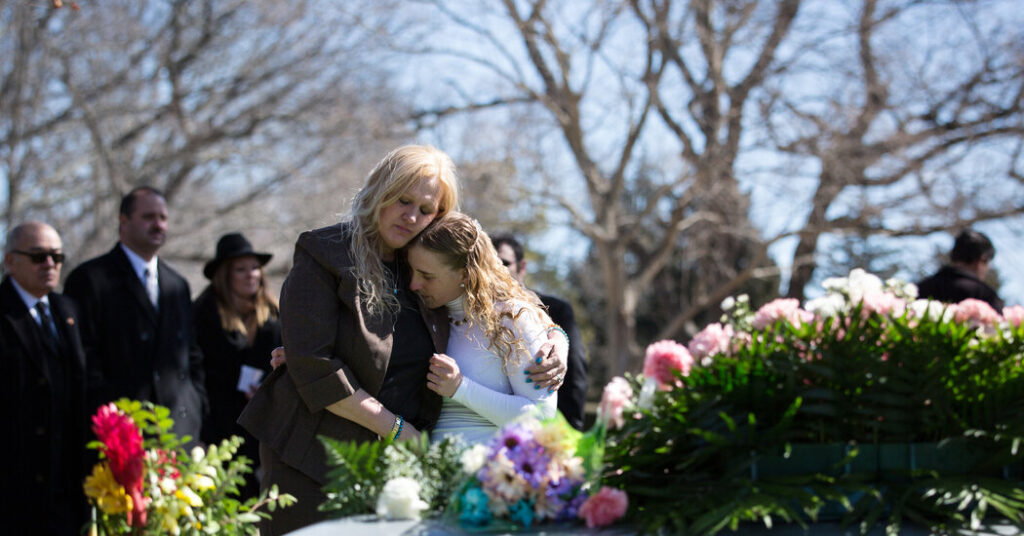
“In retrospect, I shouldn’t be here,” Mari Gilbert said stiffly. “Because my daughter has not passed.” Few people would have wanted to be where she was: at a gathering of family members of women all thought to be victims of a serial killer.
It was May 2, 2011, a year and a day after Mari’s daughter, a 23-year-old woman named Shannan Gilbert, disappeared just before sunrise in a small gated community on the South Shore of Long Island, adjacent to Gilgo Beach. That night, Shannan had traveled from New Jersey to see a man who had hired her as an escort. Hours into the appointment, she called 911 and ran screaming from the man’s house. On the emergency recording, Shannan could be heard running through the neighborhood, panting and crying, “Someone is after me” and “They’re going to kill me.” Two neighbors called the police, but by the time they arrived, Shannan was gone.
The case didn’t make news at first. But seven months after that night, in December 2010, the search for Shannan led to the discovery of four sets of remains in the bramble off the shoulder of Ocean Parkway in Gilgo Beach, a few miles from where Shannan was last seen. They were all young women who made money as escorts, like Shannan. Then in March and April of 2011, six more sets of remains were discovered along the shore. Shannan’s disappearance had formed the unlikely fulcrum of a serial-killer case for the ages.
It was after this gruesome discovery that Shannan’s mother met the families of four victims for the first time. (I chronicled the meeting in a magazine article and then a book about the case, later dramatized in a Netflix film — just one of many examples of the hold this mystery maintained over many years.) Mari did not want to be there. She did not want Shannan to be part of the case that never would have existed, if not for her.
“Without her running and screaming,” she said that day, “none of these other bodies would have been found.”
Last week, on April 8, after a protracted investigation hampered by missteps and institutional corruption, the Long Island serial killer case finally reached a disturbing conclusion. Rex Heuermann, a 62-year-old architect and married father of two from Massapequa Park, admitted in court to strangling eight women who had disappeared as early as 1993. His sentencing is scheduled for June 17, and he is expected to spend the rest of his life in prison.
Those eight victims’ families now have some semblance of an answer. Shannan Gilbert’s family does not. Despite all talk of resolution and closure for eight families of eight victims, the matter of Shannan Gilbert remains both separate from and essential to the story of the Long Island serial killer. Despite all the twists and turns that brought Mr. Heuermann to justice, Shannan’s case remains persistently, almost defiantly, open — the case’s first and last great unsolved mystery.
From the start, the police never seemed to consider Shannan’s disappearance part of the serial-killer case. Yet it had all the trappings of a locked-room mystery, offering ample fuel for speculation and conspiracy theories.
Her driver that night was her friend Michael Pak — who stayed parked outside waiting for her. When Shannan fled the house, she ran right past his car and kept going. Her client, Joseph Brewer, was also questioned and not charged or even declared a person of interest. While these two men were believed, Shannan’s statement to 911 — “They’re going to kill me” — was apparently considered suspect. The neighborhood’s video security recording was never recovered.
And then there were her remains. After being missing for 19 months, Shannan’s body was finally discovered on Dec. 13, 2011, deep in the middle of a 49-acre marsh near where neighbors said they last saw her. Her clothes and belongings were found some distance away, at the marsh’s edge.
Even before an autopsy, the police were calling Shannan’s death an accident. Richard Dormer, then the Suffolk County police commissioner, asserted that Shannan was high that night and paranoid. “It appeared she was heading toward the parkway, toward the lighting on the causeway,” he said. In her condition, he speculated, Shannan had no concept that those cars were as far as a quarter-mile away, and since she didn’t know the area, she had no idea that she was about to fling herself into a dense, murky marsh that even locals avoided. So, Commissioner Dormer concluded, Shannan must have tripped — most likely in a drainage ditch — and drowned.
Why were her belongings found so far away from her? “That’s explainable,” Mr. Dormer said, “because she’s, you know, hysterical. And she’s discarding her possessions as she moves along …. Her jeans could have come off from running in that environment. And that is a possibility.”
From the start, Mr. Dormer was out on his own on this. Within hours, a prominent former chief medical examiner from New York named Michael Baden, who also once worked in Suffolk County, pointed out to reporters just how absurd it was to think that a woman not much bigger than 100 pounds could thrash her way through a marsh that police officers had been reluctant to walk into.
“The circumstances are very impressive that the mother is right and she was murdered,” Mr. Baden said the day after Shannan’s remains were found.
On May 1, 2012, months after she was found, the Suffolk medical examiner ruled Shannan’s cause of death as inconclusive. There was no indication that she had ingested any substances, though such evidence might be hard to detect after 19 months of outdoor exposure. While refraining from calling her death suspicious, the police refused to release the body to her family or make public any further details about the investigation, including her call to 911.
Shannan’s family enlisted Mr. Baden to conduct an independent examination, in which he noted that Shannan’s hyoid bone was missing from her remains; the hyoid bone is typically damaged during strangulation, the cause of death of the other women.
But the police continued to deny she was murdered. Then in May 2022 — nearly a decade after Shannan’s disappearance and more than a year before Mr. Heuermann would be arrested — the 911 recording was finally made public, at a news conference. Kevin Beyrer, the lead detective on the case, opened by saying, “Based on the evidence, the facts, and the totality of circumstances, the prevailing opinion in Shannan’s death, while tragic, was not a murder and was most likely noncriminal.”
When a reporter mentioned Shannan’s pleas during the 911 recording, the police commissioner at that time, Rodney Harrison, shut down that line of questioning. “Listen, I’m going to simplify everything right now,” he said. “It’s a horrible accident. It’s tragic.”
On the day Shannan’s body was discovered, Lorraine Waterman, the mother of another woman found in the bramble along Ocean Parkway, was among several victims’ family members who gathered near the marsh in Long Island to support Shannan’s mother. Mari Gilbert was now undeniably one of their own.
A clutch of reporters surrounded the families, the mist of the shore enveloping them all. When one asked about the killer, Ms. Waterman’s voice grew pinched and severe. “I almost a hundred percent guarantee that this man is sitting in his home right now,” she said, “watching what is going on the TV, getting the biggest thrill of his life, seeing what he has done to these families.”
In the wake of Mr. Heuermann’s guilty plea, there are reasons for the police to separate Shannan from those other cases. She arrived that night with a driver, not alone, as many of Mr. Heuermann’s victims were — a slight but significant break in the victim pattern. Neither the driver nor the man who hired her have a known connection to Mr. Heuermann. There is no known DNA link. Shannan showed enough emotional instability to those who knew her that it is not unreasonable to speculate that she had a psychotic break and just ran into the night.
And yet the police have failed to provide explanations to many unanswered questions: How could she be unhinged enough to pull her jeans off in the marsh, and yet rational enough to keep 911 on the phone for 21 minutes? Did something happen in Joseph Brewer’s house that made her want to run away not just from him, but from her own driver?
Mari Gilbert isn’t alive to comment on the events of last week. On July 23, 2016, in a second inconceivable family catastrophe, she was attacked and killed by another daughter, Sarra, who had descended into severe mental illness in the wake of Shannan’s death. Sarra is serving a prison sentence for her mother’s murder.
It has fallen on another sister of Shannan’s, Sherre Gilbert, to find a solution to her continuing mystery. On the day of Mr. Heuermann’s guilty pleas, Sherre posted a message of support for the other victims on Facebook, adding, “The unwavering pursuit for Justice for Shannan continues.”
The post What Happened to Shannan? appeared first on New York Times.