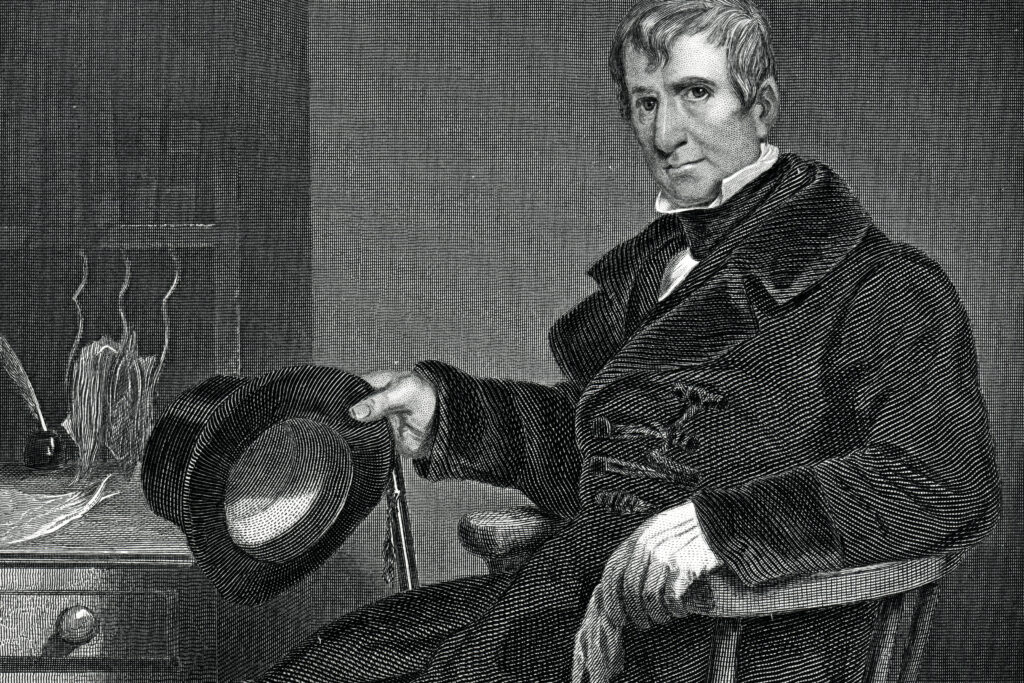
Gabe Fleisher’s April 7 Tuesday Opinion essay, “Will the next William Henry Harrison please stand up?,” was an excellent summary of a forgotten president, but it didn’t provide context as to why Harrison was so opposed to executive power. Harrison was the first Whig president. The Whig Party, formally established in 1834, was organized around opposition to “executive usurpation.” It strongly opposed President Andrew Jackson and his use of the veto. “King Andrew,” as he was known, used the veto 12 times during his presidency — more than all his predecessors combined. This was an unprecedented expansion of presidential power.
Harrison and another Whig president, Zachary Taylor, shared two distinct characteristics. They both opposed presidential power encroachment, and they both died in office. Neither man had a chance to restore the checks and balances that the Whigs perceived had been damaged by Jackson and his fellow Democrats.
Mike Henry, Richmond, Indiana
Gabe Fleisher noted that William Henry Harrison is remembered only as the first president to die in office, one month after making the longest inauguration speech in history. His successor, John Tyler, is even lesser known. Yet he had a surprisingly historic impact.
Vice President Tyler was at his home in Williamsburg, Virginia, on April 5, 1841, when two men rode up on horseback at 5 a.m. with a letter informing him that Harrison had died. Tyler traveled 21 hours by horse, train and steamboat to Washington to be sworn in the next day. The Constitution didn’t specify what happens when a president dies, so some people wanted to call Tyler “acting president,” but he insisted on just “president.” The “Tyler Precedent” stood until 1967, when states ratified the 25th Amendment spelling out succession.
Tyler also was the first president to have a veto overridden by Congress and the first to be a target of impeachment after a falling-out with his Whig Party. After his wife died while he was in office, he was the first sitting president to marry when the 54-year-old wed the 24-year-old Julia Gardiner. At White House parties, she introduced the tradition of having the Marine Band play “Hail to the Chief” when the president entered.
After one term, Tyler moved to a Virginia plantation that he called Sherwood Forest in honor of the fictional outlaw Robin Hood. He died in 1862 at age 71 while on his way to join the Confederacy. He fathered 15 children, the most of any president. History buffs can spend the night in a reconstructed version of his 1841 house in Williamsburg called the Nicholas-Tyler Laundry.
Ron Shafer, Williamsburg
The writer is the author of “The Carnival Campaign: How the Rollicking 1840 Campaign of ‘Tippecanoe and Tyler Too’ Changed Presidential Elections Forever.”
An irony unmentioned in Gabe Fleisher’s stark comparison of presidents William Henry Harrison and Donald Trump is their shared legacy as alumni of the same college: The University of Pennsylvania. They’re the only former Penn students to ever reside in the Oval Office. Talk about an odd couple!
Stanley Cohen, Baltimore
Assimilation is a good bargain
Regarding Shadi Hamid’s April 8 online column, “Muslims shouldn’t have to assimilate to belong”:
As a son of Mexican immigrants who researches immigration and assimilation, I share Hamid’s concern for the dignity of newcomers and their children. But his column defended minorities against a demand America has largely stopped making.
Hamid sees assimilation as requiring convergence with the mainstream. That version of assimilation had real force in the 20th century, when several states passed laws banning foreign-language instruction and voters in Oregon tried to outlaw Catholic schools in the name of Americanization. But today, the country’s most dominant institutions, from academia to corporations, incentivize assimilation into something else: a worldview that celebrates distance from the American mainstream.
As countless scholarships, campus centers and diversity, equity and inclusion programs geared toward expressions of cultural difference demonstrate, today’s children of immigrants are not being asked to converge on anything. In fact, their supposed foreignness is rewarded.
Gil Guerra, Washington
The writer is a senior immigration policy analyst at the Niskanen Center.
Shadi Hamid’s argument against assimilation stumbled on itself.
Demanding that Muslims leave is not a serious immigration policy. Neither is demanding an exemption from assimilation. A country serious about integration can welcome differences while still requiring that newcomers meet it halfway.
First, Hamid argued that one’s right to be in the United States “shouldn’t depend on anything.” This is a rejection of civic duty. Citizenship, of any nation, has always carried expectations. That is one of the ways it is distinguished from mere residence.
More fundamentally, Hamid treated assimilation as cultural erasure, demanding that minorities shed their identities to earn belonging. But assimilation means adopting the language, civic norms and basic behavioral standards of the society you’ve joined. Where Hamid admits that civic expectations are reasonable, he undercuts himself. His own evidence — Muslim patriotism, political engagement, opposition to political violence — makes an assimilationist argument. He cannot simultaneously argue that belonging should depend on nothing while citing proof that his community has earned its place.
Mariam Wahba, New York
The writer is a research analyst at the Foundation for Defense of Democracies.
The post The U.S. needs another president like William Henry Harrison appeared first on Washington Post.