Excitement over Pakistan brokering peace between the United States and Iran had built over several weeks. The Pakistani army chief kept an open line with President Trump and Vice President JD Vance, while the prime minister worked the phones with leaders across Europe and the Middle East.
The excitement evaporated within a few minutes on Sunday when Mr. Vance emerged with a blunt verdict after 21 hours of meetings with an Iranian delegation in Pakistan’s capital, Islamabad.
“We’ve made very clear what our red lines are,” Mr. Vance told reporters at the Serena hotel, where the talks took place, “what things we’re willing to accommodate them on.”
“They have chosen not to accept our terms,” he said.
With the cease-fire now uncertain, Pakistan faces its own urgent challenge: Can it bring the two sides back to the negotiating table?
“Pakistan cannot overcome this on short notice or coerce both parties,” said Simon Wolfgang Fuchs, a professor of Islam in South Asia at the Hebrew University of Jerusalem.
“But it could make use of the remaining nine days of the cease-fire to present a proposal on Iran’s nuclear program, to be discussed at ‘Islamabad Talks 2.0,’ shortly before the deadline,” he added.
Iran’s Parliament speaker, Mohammad Bagher Ghalibaf, said on Sunday that the United States had been “unable to gain the trust of the Iranian delegation in this round of talks,” but that “now it is time for it to decide whether it can earn our trust or not.”
Pakistan’s foreign minister, Ishaq Dar, said shortly after the talks that his country would continue to “facilitate engagement and dialogue” between the United States and Iran.
But the fate of the Strait of Hormuz remains unclear, as does that of Lebanon, where Israeli strikes have killed more than 2,000 people, according to the Lebanese authorities, devastating neighborhoods in the south and Beirut.
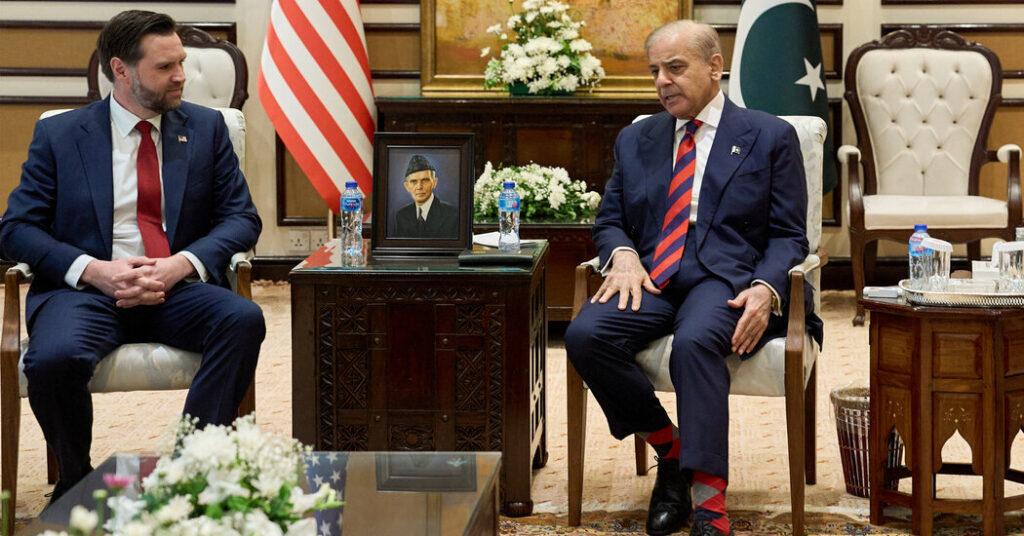
Prime Minister Shehbaz Sharif of Pakistan had pushed for Lebanon, where the Iran-backed Hezbollah militia holds sway, to be included in the cease-fire in the days leading up to the talks in Islamabad. But Israel pointedly said that Lebanon was not part of the deal.
Islamabad had been on lockdown for the talks, and its officials played a central role as the United States and Iran held their highest level meetings since 1979. Field Marshal Asim Munir, the army chief, conducted face-to-face negotiations between Mr. Vance and Mr. Ghalibaf. Mr. Sharif had hosted both leaders for bilateral meetings earlier on Saturday.
Many residents went to bed on Saturday hoping both sides would announce a peace agreement or a second full day of talks.
“For the most part there was a sense of optimism all day yesterday, till it fell apart,” said Moeed Yusuf, Pakistan’s former national security adviser.
Mr. Vance and his team sped through Islamabad’s empty streets shortly after sunrise on Sunday, following nearly a full day of talks in meeting rooms from which little information emerged. Workers removed the “Islamabad Peace Talks” billboards that dotted the city, as if tangible prospects of peace and Pakistan’s association with them were fading already.
Roads leading to the Serena Hotel and key government offices remained closed on Sunday afternoon.
Pakistan’s involvement has been motivated by its short- and long-term goals. Its economy badly needs the war in the Middle East to end and ships to safely pass through the Strait of Hormuz, where 85 percent of its oil and gas imports transited before the United States and Israel began striking Iran on Feb. 28.
Pakistan’s schools have been closed for weeks and its civil servants work only four days a week as the government tries to save energy costs.
The ambition of moving from mediator to cease-fire broker, talks facilitator and, Pakistani officials hope, peacemaking power also carried its own allure. Pakistan — a nuclear power with 250 million people but an economy crippled by debt — has been trying to rebrand itself as a destination for investments. It has been seeking to secure more financing from the International Monetary Fund and stronger partnerships with the United States and Middle Eastern countries.
Pakistan’s leadership has nurtured a close relationship with Mr. Trump over the past year and has deep ties with Iran, shaped by a 565-mile shared border, decades of common security challenges and, at times, armed clashes. Few other countries have been able to maintain a position of neutrality between the two sides, analysts say, and on Sunday Mr. Ghalibaf thanked Pakistan for hosting the talks.
Mr. Yusuf, the former national security adviser, said Pakistan would keep trying to mediate, but that it would remain difficult given the factors out of its control.
“China may be important to nudge Iran in the next phase, but the question remains whether the gap between the positions of the United States and Iran are in fact bridgeable,” Mr. Yusuf said. “It is also entirely unclear if Israel will play ball, as so far there are no indications that they were keen on ending their offensive in Lebanon.”
Zia ur-Rehman contributed reporting.
Elian Peltier is The Times’s bureau chief for Pakistan and Afghanistan, based in Islamabad.
The post The ‘Islamabad Peace Talks’ Are Over. What Now for Pakistan? appeared first on New York Times.