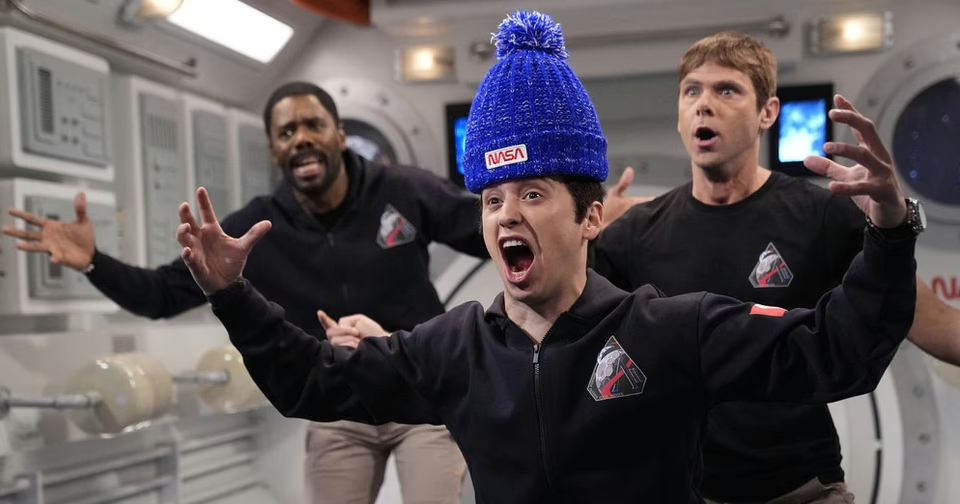
His eyes filled with wonder and his voice imbued by humility, Victor Glover—poised with his Artemis II crewmates to complete a record-setting voyage around the moon—addressed the camera. He looked out the window, awestruck by his home planet looking back at him. “Being a man of faith,” he said solemnly, “this has certainly brought me closer to God.” And then: A Pringles can drifted into the frame.
“Oh come on, guys,” Glover said, exasperated. “You’ve got to Velcro your snacks to the wall!”
Last night, Saturday Night Live paid tribute to the astronauts aboard NASA’s Orion spacecraft with a simple, effective joke. Glover (played by the episode’s host, Colman Domingo) kept trying to record an earnest message for the people back home—one that would explain why science still matters and has the power to inspire humanity. But his crewmates kept ruining the vibe.
In the sketch, the astronauts Jeremy Hansen (Marcello Hernández) and Reid Wiseman (Mikey Day), Artemis’s commander, fought over the Pringles can. “Finders keepers, you loser!” Hansen teased. Glover pleaded: “Hey, hey, I’m recording a thoughtful video. Can you guys stop messing around?” Hansen was nonplussed. “It’s Day 9, and we’re just kinda bored, okay?”
The vastness of space is humbling to behold. But it can undoubtedly make even the most sober-minded astronauts go a little stir crazy. The sketch was driven by the tension between the nobility of the Artemis II mission and the realities of being stuck in a metal tube with three other people and no privacy. At one point, Wiseman, a stream of goo hanging from his nose, marveled that his sneeze had frozen in place (“I mean,” he said, giggling, “this is totally happening right now”); later, Hansen burst in, struggling with a bathroom mishap (“My pee-pee’s stuck in the tube again!”).
Now, this might be because I grew up in Orlando, not that far from the Kennedy Space Center at Cape Canaveral, but when I was learning about NASA in elementary school, nearly every discussion devolved into one in which the students pestered the teacher with questions about how the astronauts went to the bathroom. Space exploration is a symbol of science at its most sophisticated, but the subject has always elicited a few prurient chuckles among civilians about what day-to-day life must really be like for the astronauts. The sheer extraordinariness of space travel—what it takes to go to the stars—is more than many people can comprehend. But anyone can understand how tricky it must be to use a tube to relieve yourself.
NASA and space exploration have long represented the sum total of what humanity can achieve when humans work together and pursue knowledge as an ultimate goal, even when conditions back on Earth are turbulent. The Apollo 11 mission and Neil Armstrong’s famous phrase—“That’s one small step for a man, one giant leap for mankind”—came as the United States reeled from the deaths of John F. Kennedy and Martin Luther King Jr., and as backlash to the Vietnam War bitterly divided the nation. It has become shorthand to note in history books that the Apollo 11 mission served as a beacon of hope and cultural unity in a dismal and fractious time. And though such an observation may flatten out the complexities, the idea has endured for a reason.
[Read: A different moon from the one we’ve known]
The Artemis II mission occurred in a very different political and cultural moment—one in which the theories and practice of science have been relentlessly attacked by the Trump administration. This is a time when the secretary of Health and Human Services has expressed open contempt for science and when “gullicism” rules the day. (During “Weekend Update,” Michael Che joked that the Artemis II astronauts had “returned safely from their 10-day trip—around a Hollywood soundstage,” an allusion to long-standing conspiracies that the moon landing was faked.) It is also a time when social media and cable news have made for a far more diffuse and scattered information environment, fostering in many people a pervasive sense of confusion, distraction, and, often, myopia.
This is a state of affairs that SNL captured cleverly. Domingo, as Glover, repeatedly attempted to elicit something profound by quoting legendary NASA astronauts. And repeatedly, those efforts were stymied. “‘We do not realize what we have on Earth until we leave it,’” he read, quoting Jim Lovell (famous for the Apollo 8 and Apollo 13 missions). He then observed: “Those words hit very different right now—” Cut to a snoring, open-mouthed Christina Koch (played by Sarah Sherman, who didn’t need lines to earn laughs), floating across his line of sight. “Hey guys,” Glover groaned, “Christina fell asleep un-Velcroed again.”
Glover regrouped: “I’d like to read another quote from another great astronaut, Sally Ride,” the first American woman to go to space. “‘Looking back at Earth from orbit makes you realize how fragile our existence truly is.’” Once more, his crewmates couldn’t be serious. Koch bobbed by again, this time with glasses and a Harry Potter lightning bolt doodled on her face.
[Read: The Artemis astronauts are studs]
But the Artemis II voyage showed that science can still inspire awe, and that Americans have not been completely lost to cynicism. On Friday evening, my social-media feed was filled with people (including Glover’s daughter) cheering the crew’s return home, a welcome bit of uplifting news at the end of a week that started with Donald Trump threatening to wipe out a “whole civilization.” NASA’s effort, and SNL’s sketch, also illustrated that although both science and hope have lately taken a beating, neither is quite down for the count.
As the skit neared its end, Glover tried, one last time, to send Earth an important message. “I’m going to make this quick because folks are going space-crazy,” he said. “My one hope for everyone on Earth is this—” And then Hansen and Wiseman zoomed by, with the pee tube. Glover cut to the chase: “Video over. Everyone, be kind to each other.” The zero-gravity bathroom humor might have undermined the moment, but the unifying message came through loud and clear.
The post SNL Goes to Space—And Returns With Pranks appeared first on The Atlantic.