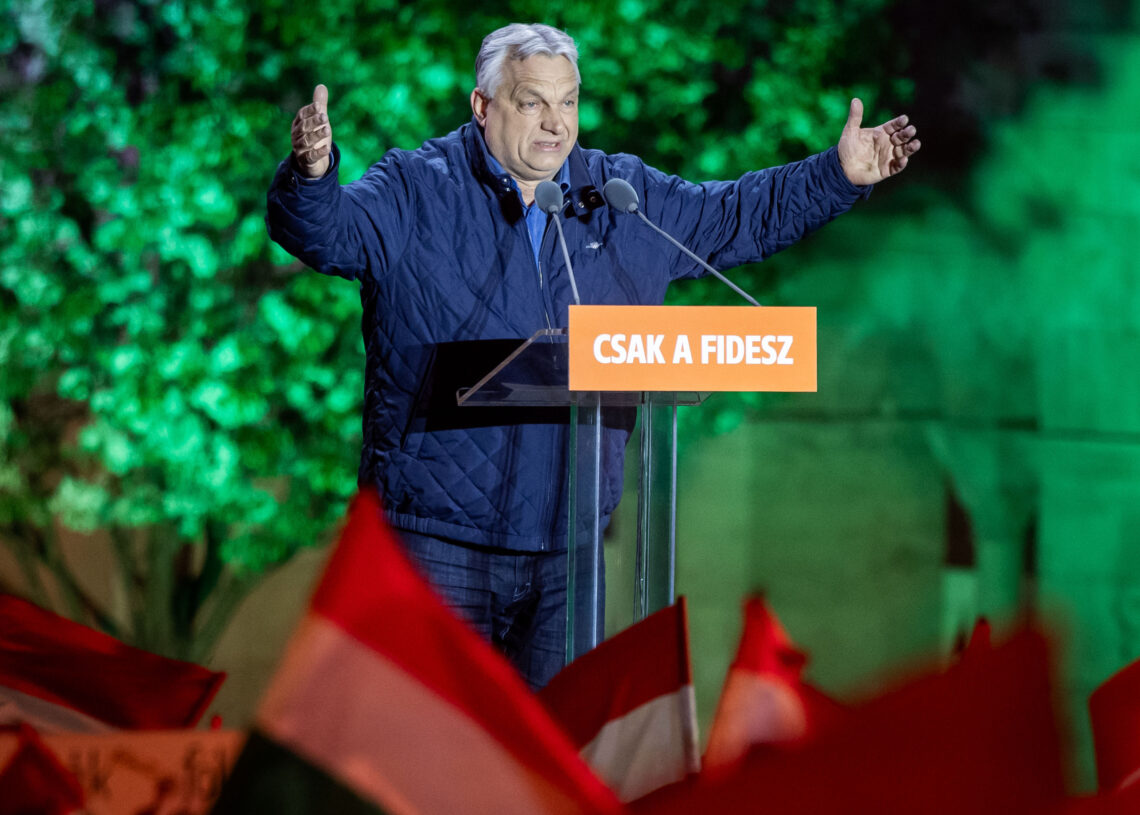
In an election that has President Donald Trump and Russian President Vladimir Putin rooting for the same outcome, Hungarians turned out in record numbers on Sunday for a vote that will decide the fate of Prime Minister Viktor Orban, the self-proclaimed champion of illiberal Christian democracy who is a darling of MAGA-aligned American conservatives, an ally of the Kremlin and a proud antagonist of European Union leaders in Brussels.weak economy
Orban, 62, who has governed Hungary with increasing authoritarianism since 2010, and his Fidesz party are facing a stiff challenge from Peter Magyar, 45, a center-right, socially conservative member of the European Parliament, and his party Tisza — in what is arguably the country’s most consequential vote since the end of the communist era. Vice President JD Vance visited Hungary last week to campaign for Orban.
By 6:30 p.m., a half-hour before polls closed, turnout was at nearly 78 percent, well above the 62 percent from four years ago. Analysts predicted that the record turnout could favor Magyar, signaling excitement about voting for a fresh approach. There are no exit polls in Hungarian elections.
At a news conference Sunday evening shortly after the polls closed Magyar described himself as “optimistic but cautious” in response to some opinion polls pointing to his victory.
Viktor Orban’s political director, Balazs Orban, alleged that Magyar’s Tisza party was involved in vote buying and intimidation, potentially laying the groundwork to contest the results. Viktor Orban, who is not related to Balasz, himself in a social media post said “too many people are voting” and called on “patriots” to vote to protect Hungary’s security.
For all the international interest and allegations of foreign interference from multiple actors, Hungarian voters seemed focused primarily on domestic problems, including weak economy and underfunded health care and education, allegations of corruption and fatigue with a leader who has served 16 years consecutively and had little new to offer voters to justify another four-year term.
“Their biggest mistake was lack of innovation — this is the third big election Fidesz was running on basically the same message supporting families and trying to protect Hungary from the war,” said Nora Schultz, an independent Hungarian political scientist. “And people seem to want something new.”
This year’s race was viewed as one of the dirtiest in Hungarian history. Budapest is plastered with posters depicting Magyar as a two-faced puppet of Brussels and Kyiv, while damaging material about the Orban government’s ties to Russia has filled the independent press in recent weeks, culminating in a leak of recorded conversations between Orban and Putin.
Orban’s xenophobic nationalism made him a leading critic of immigration in Europe and other leaders followed, making the E.U. far less welcoming of migrants and refugees. He has also been a vocal critic of military and economic aid to Ukraine and often sought to block E.U. sanctions against Russia and thwart efforts to cut reliance on Russian gas and oil. In the election, Orban has tried to stoke fears that Magyar would pull Hungary into Russia’s war in support of Ukraine.
Magyar has run on a platform largely focused on domestic issues, accusing Orban of mismanaging Hungary’s weak economy and railing against corruption and cronyism, and lambasting a government procurement system that he says has enriched Orban’s family members and political allies.
Trump has offered full-throttle support to Orban, including a video message endorsing him for reelection that was broadcast on the morning of the Conservative Political Action Committee (CPAC) annual meeting in the Hungarian capital. It was the fifth annual Budapest gathering for CPAC, the right-wing forum, which originated in the United States and built a strong bridge between Orban and the Trump administration.
Vance’s two-day visit to Hungary put a spotlight on the shared ideology and rhetoric between Orban and the MAGA movement as both men criticized the E.U. in Brussels, migration and Ukraine. In speeches, Vance decried what he called “disgraceful” foreign interference in the election by the E.U., while declaring that he wanted to “help as much as I can possibly help” to get Orban reelected.
On Sunday morning, Donald Trump Jr. called on “friends in Hungary” to vote for Orban: “We hope you will vote for independent thinking and for someone who stands for Hungary First,” he posted on X. “We hope you will vote for my father’s friend and ally.”
A loss for Orban would be a threshold moment in Brussels, where the Hungarian premier has made an art form of obstructing E.U. policies, which often require unanimous approval of the bloc’s 27 member nations. A defeat would also show limits to the global reach of Trump’s political movement. The U.S. president is unpopular in Europe, where even his ideological allies oppose the war in Iran and were disturbed by his threats to seize Greenland, an autonomous territory of Denmark.
Orban has cast the election as the fight for “the soul of the West,” and Vance called the U.S. and Hungary representatives of “the defense of Western civilization.” Hungary under Orban plays an outsize role in MAGA lore and ideology. Although Hungary trails behind most E.U. countries economically, Orban has become an icon for populist, right-wing conservatives worldwide.
If Orban is ousted, Russia would lose one of its most valuable assets in Europe: a friendly government inside the E.U. capable of blocking sanctions and watering down resolutions, particularly on Ukraine aid and sanctions. Orban has leveraged his veto power to squeeze exemptions out of the E.U. and keep its decision-making in gridlock, while securing cheap Russian energy. Similarly to the MAGA movement, Orban’s fall would also deal the Kremlin an ideological blow, as he has offered living proof that “illiberal democracy” can take root, win elections and endure within the EU.
Many recent polls had shown Orban and Fidesz trailing, in some cases by more than 10 percentage points. Analysts said that voters were unlikely to be swayed by the allegations, trumped by Vance and Orban, that Ukraine and Brussels sought to influence the election.
“I don’t see it as a game changer,” said Peter Kreko, director of Political Capital, an independent think tank in Budapest. “It could maybe bring a bit more support among undecided voters, but I’m not entirely convinced, given how low an importance foreign policy seems to have for the Hungarian public at the moment.”
Kreko added: “Voters are much more focused on domestic issues: corruption, health care, economy.”
Orban, who first served as prime minister from 1998 to 2002, returned to the premiership in 2010 and has won three consecutive elections since. Critics say he has dismantled democratic institutions and restricted press freedoms, asserting heavy-handed state control over much of Hungary’s news media.
Orban appeared unusually tired on Saturday as he delivered a campaign speech the day before the election, drawing concern from some Fidesz supporters.
In his speech, Orban repeated his criticism of European aid to Ukraine, telling voters that Tisza would direct Hungarian money to Kyiv. Orban also repeated his attacks on Volodymyr Zelensky, alleging that the Ukrainian president wanted to cause chaos and install “a pro-Ukrainian government” in Budapest.
A recent survey by Median, a Hungarian agency that accurately predicted Fidesz’s two-thirds majority in the 2022 national election, showed Tisza with 58 percent compared with 33 percent for Fidesz. Other local pollsters showed Tisza running ahead of Fidesz by smaller, but still significant, margins.
Orban, however, has shown no willingness to concede defeat, and Magyar’s path to power might not be straightforward, even if his party wins a majority of votes.
Over 16 years, Orban has reshaped the country’s political system to favor himself and Fidesz, rewriting the constitution and redrawing parliamentary districts to favor the government party.
The country’s president, who must approve election results and formally issue a mandate to form the next government, is an Orban ally, as are the supreme court, the prosecutor’s office and the constitutional court. Any party in power also needs a two-thirds majority in parliament — 133 of 199 seats — to push through significant changes.
While Orban shared a stage with Vance, Magyar toured small towns and villages — a contrast that captured the vastly different campaign styles of the top contenders.
Orban has relied on orchestrated rallies and the vast media control he has built over 16 years, with about 70 percent of outlets linked to Fidesz or allies of the prime minister.
Magyar, a former supporter of Orban and longtime member of Fidesz, rose to prominence in 2024 and built a substantial base of support by relentlessly touring the country — delivering up to seven speeches a day, particularly in small communities that are traditional Fidesz strongholds.
Magyar also built an active social media presence, highlighting the country’s dilapidated infrastructure, such as the run-down railway system, and the lack of basic goods like toilet paper in hospitals.
Magyar, a Budapest native, comes from a politically connected family. His great-uncle served as president of Hungary in the early 2000s, and his mother worked in the judiciary.
In a recent podcast, Magyar recalled having a poster of Orban on his childhood bedroom wall, back when Orban first rose to power on anti-communist rhetoric and calls for a break from Russia.
Magyar joined Fidesz while he was in university and married one of the party’s rising stars, Judit Varga, who later became Hungary’s justice minister.
Magyar broke with the party in 2024, after revelations that Orban’s government, which had spent years portraying itself as a defender of Christian values and traditional families, had pardoned a man convicted of helping to cover up a sexual abuse scandal at a children’s home. Varga — by then Magyar’s ex-wife — resigned, as did Hungary’s president at the time.
“After that scandal, he was strongly criticizing Fidesz and managed to create sort of a social movement, so Tisza was not a political project at the very beginning,” said Ilona Gizinska, a Hungarian policy expert with the Center for Eastern Studies (OSW) in Warsaw. “The Hungarian opposition of previous years was very much concentrated in Budapest and not the smaller villages — and this is something that Peter Magyar did for the first time in years.”
Magyar took over an existing party, Tisza — the name forms an acronym that stands for “Respect and Freedom” — and gradually turned into a political movement. Tisza is also the name of a major river that crosses through Hungary and four other countries.
Unlike progressive opponents on the left whom Orban could attack ideologically, Magyar has posed a formidable challenge as a fellow conservative and former Fidesz insider. Magyar has promised to tackle corruption, improve the economy and unlock billions of euros in E.U. funds frozen by Brussels largely over rule-of-law concerns that emerged under Orban.
“Magyar gave people shocked by the pardon scandal a way to say: ‘I was a Fidesz voter before, I was part of the regime in some way, and it’s okay if you were before, and it’s okay for this moment to be the time when you change,’” Schultz, the political scientist, said.
Final results may not be known for some time. About 500,000 Hungarians are eligible to vote abroad, and those ballots must be physically brought into the country, which could delay certification of the outcome.
Belton reported from London.
The post Record voter turnout as Hungary’s Viktor Orban fights for political survival appeared first on Washington Post.