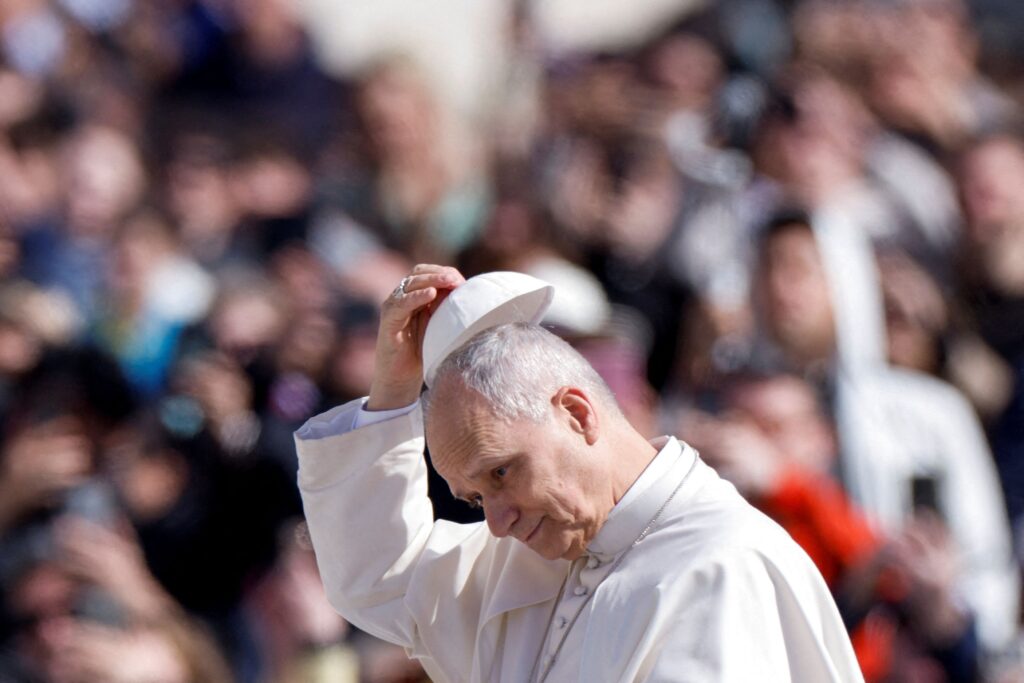
VATICAN CITY — This week, Pope Leo XIV will walk in the footsteps of his icon, Saint Augustine of Hippo, a towering theologian whose birth in what is now Algeria makes him history’s most revered African Catholic. In strife-ridden Cameroon and authoritarian Equatorial Guinea, Leo will flex his powers as peacemaker and diplomat. In oil-rich Angola, he will confront a microcosm of the global tussle between Catholicism and evangelical faiths.
Leo’s early papacy has been defined in large part by his response to President Donald Trump, with the Chicago-born pontiff becoming increasingly vocal about the U.S. administration’s use of force overseas, its migrant policy at home and what the Vatican sees as a troubling fusion of God and politics. But a 10-day trip to Africa, starting Monday, will let the pope focus on what he says is his real priority: spreading the faith.
During his longest voyage yet as pope, Leo will run the paces as a CEO of souls on the continent where Catholicism, like the human population generally, is growing fastest. Despite anecdotal signs of a Catholic revival in parts of North America and Europe — much of it disputed or based on faulty surveys — the most recent official Vatican data shows the number of baptized Catholics largely flatlining in Europe and the Americas.
By comparison, Catholicism is booming in Africa, where the number of faithful surged to 288 million in 2024 from 281 million in 2023 — shifting the center of the world’s largest Christian faith. There are now more Roman Catholics in Africa than there are in Europe. Catholicism in Africa, meanwhile, is growing five times as fast as in Asia, the church’s other major frontier.
“There is a boom in the Catholic Church on the continent — that is for sure,” said the Rev. Ebuka Mbanude, a Nigerian priest who serves in the Archdiocese of Washington. “The pope coming to Africa is him recognizing that the Roman Catholic Church he is the head of does not begin and end in Europe. It is a universal church.”
For the Vatican, the surge of Catholics in Africa offers risks as well as rewards. In churches, cathedrals, convents, hospitals and orphanages and at a host of meet and greets during his tour, Leo is set to address the troubled legacy of colonialism — perhaps, even, the church’s own role in it — as well as the exploitation of natural resources.
Leo’s predecessor, Pope Francis, sharply condemned what he described as the West’s continued ill treatment of the African continent during his last visit in 2023, declaring during a speech in the Democratic Republic of Congo that “political exploitation gave way to an economic colonialism that was equally enslaving.”
But Leo will also confront a growing culture clash as the globalizing church looks to the future.
In recent years, Africa’s Catholic bishops have become increasingly assertive. They rebelled in 2023 when Francis explicitly allowed priests to offer brief blessings to people in same-sex couples, issuing an official rejection of his ruling on a continent where homosexuality in some nations is punishable by death.
Now, they are pushing for their own dispensation, pressing the Vatican to embrace pastoral outreach for polygamists — more prevalent in some African nations than anywhere else.
In Germany and other progressive bastions, Catholic bishops have pushed for even broader recognition of same-sex couples in the church. That’s something the Rev. Humphrey Tatah Mbuy, a Catholic priest in the Archdiocese of Bamenda, Cameroon — which Leo will visit Thursday — insisted in an interview that African clerics would never accept.
Tatah Mbuy called same-sex relations “an abomination” and “cultural sacrilege.”
“Even though there are some Africans who are now giving in to it, the people know from deep within their culture that this is not acceptable,” he said. “We just call it bluntly: This is witchcraft.”
He backed a recent call by African bishops, however, to broaden pastoral care for people in polygamous relationships.
“Where we have a problem in Africa, and where the problem is not being fully addressed, is you meet a person [who] has been maybe for 60 years living with four, five wives, he is taught by the Gospel and wants to become a Christian,” Tatah Mbuy said. “Do you tell him to drive away all these five wives? This is where the real problem comes. This is where the pastoral approach should be applied.”
Leo, the first U.S.-born pope, will be making a foray into a part of the world where American power can be polarizing. Archbishop Andrew Nkea, who leads the National Episcopal Conference of Cameroon and is deeply involved in planning for the pope’s visit, said that Leo is not seen as an “American pope” but as a global figure — one who is spreading a message of “peace, of dialogue, of reconciling people.”
“The Holy Father is coming to Africa at a time when many of the countries have both internal and external conflicts,” Nkea said in an interview, “and he’s coming to us at a time when I think we need him most for his words of consolation, for his words of peace, for his words of reconciliation.”
In Cameroon, the pope’s visit is already promoting peace.
Bamenda, the capital of Cameroon’s Northwest Region, is at the center of a violent rebellion led by English-speaking separatists who have declared a breakaway state called Ambazonia after what they say is decades of repression by the Francophone-dominated Cameroonian government. In what is seen as a breakthrough, the rebel leadership has declared a halt in fighting for the papal trip, if not a formal ceasefire.
Some hold out hope that the pope can promote a lasting peace.
“He’ll be able to speak truth to power and open his high offices for negotiations between [the government] and the people of Ambazonia,” said Dabney Yerima, vice president of the separatist group, the Federal Republic of Ambazonia. “That is the assignment that we are giving the pope.”
But the pope’s visit will also involve navigating tricky political terrain.
In Cameroon, the 93-year-old president, Paul Biya, has held office since 1982 and this month was granted approval to choose his own successor.
In Equatorial Guinea, an authoritarian petro-state, the 83-year-old president, Teodoro Obiang Nguema, has been in office since 1979 and has used violence to repress his political opponents.
“It will be interesting to have a moral authority arriving, at a moment when the authority of the state could not be lower,” Michelle Gavin, senior fellow for Africa Studies at the Council on Foreign Relations, said of Cameroon. “Will the pope say something about old men moving on, and about leadership in a country that is basically falling apart?”
Both Cameroon and Equatorial Guinea have signed secretive deportation deals with the Trump administration. Lawyers for those detained in Equatorial Guinea have sent a letter to Leo asking him to address the dangers faced by the detainees deported from the United States.
“We hope that Pope Leo will talk about this,” said Meredyth Yoon, litigation director of Asian Americans Advancing Justice, who has helped deportees to Equatorial Guinea and said 10 people are being held in a decommissioned hotel by armed guards.
The initial leg of Leo’s trip is a more personal journey, to Algeria, birthplace of Saint Augustine, the namesake of Leo’s religious order who is considered one of Catholicism’s leading theologians. Leo, who is the first Augustinian pope, will further his agenda of interfaith dialogue with Islam, a focal point of his trip last year to Turkey and Lebanon.
But he will largely on a pilgrimage to the homeland of Saint Augustine, In the northeastern port city of Annaba — formerly Hippo, the ancient home of Saint Augustine — the pope will visit Roman archaeological sites including a forum surrounded by colonnaded porticos as well as a tiny religious community harboring three Augustinian clerics.
When Leo emerged on the balcony of St. Peter’s Basilica as pope last year, he described himself as a “son of Saint Augustine.” Geological digging quickly yielded evidence that he was also the son of diverse ancestry — including ancestors who were Creole people of color in New Orleans.
His visit to Algeria comes amid a debate over Augustine’s ethnic background. Christian nationalists have sought to claim Augustine as Roman, thereby ethnically European and one of their own. But in some predominantly Black churches, he is portrayed as a person of color, as he appears in a recent portrait unveiled at Villanova University.
Catherine Conybeare, a professor of humanities at Bryn Mawr College and author of “Augustine the African,” said research has shown Augustine’s father to be a citizen of the Roman Empire born in present-day Algeria, though his ethnicity is not known. His mother’s last name, meanwhile, suggests she was from the Indigenous Amazigh tribe, though there is no record of her appearance.
“The fact is we have zero evidence for what he looked like,” Conybeare said.
Nevertheless, she said, Leo’s emphasis on Augustine — including his recent citations of him in criticizing “the desire for domination” in the world today — “matters now precisely for this business of drawing attention to the importance of Africa specifically, and the Global South more generally, in the construction of European history. It’s absolutely fundamental, the greatest thinking in the European intellectual tradition came from Africa.”
Ombuor reported from Nairobi and Chason from Dakar.
The post On Africa trip, Pope Leo will face debate over polygamy as Catholicism booms appeared first on Washington Post.