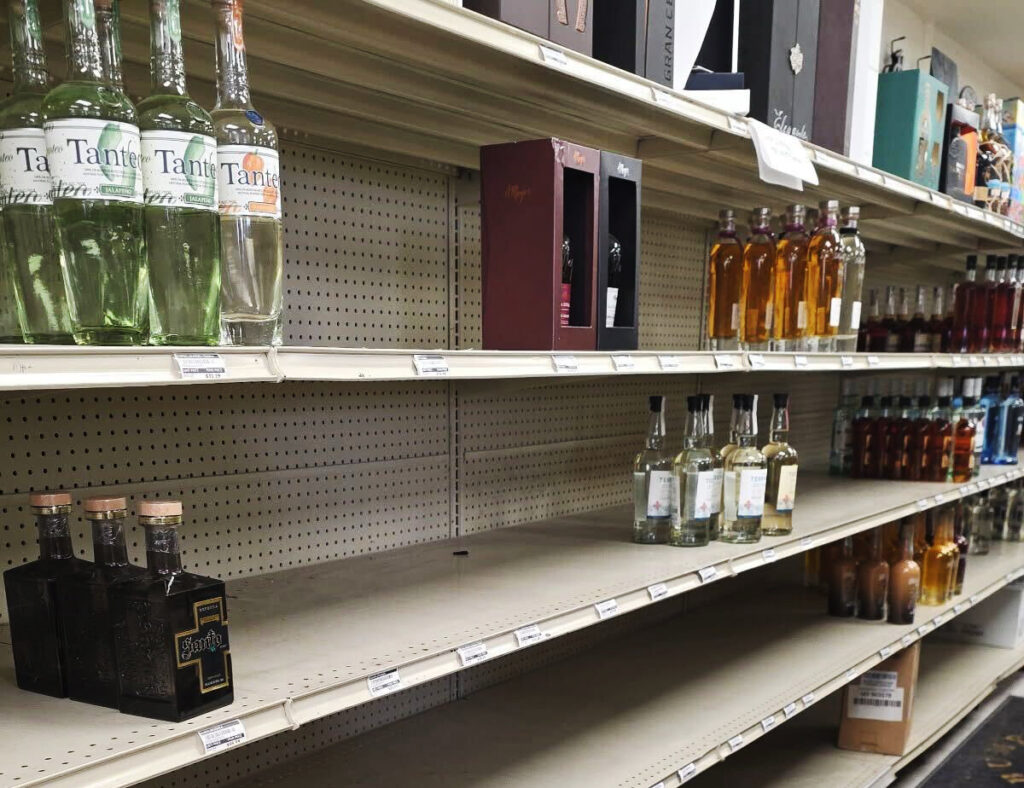
Willie the one-eyed skeleton is dressed for Cinco de Mayo, but the liquor store where Willie sits ran out of Jose Cuervo months ago. Arrow Wine and Spirits is also out of Tito’s and Burnett’s vodka, Franzia boxed wine, Jack Daniels, and every kind of premixed margarita.
The suburban shop used to sell 4,000 kinds of booze. But three months ago, the state’s only alcohol warehouse — Mississippi is one of 17 that controls the sale of wine and liquor — shut down for what was supposed to be a two-week inventory. The liquor hasn’t flowed right since.
Business owners across the state say they are in a state of emergency. Restaurants in Jackson had no wine on Valentine’s Day, and bars on the Gulf Coast ran dry before Mardi Gras. At least five liquor shops have closed, and if cheap pints don’t hit the corner stores soon, many of them will, too.
“We’re hanging on by the skin of our teeth,” said Shaun Blakeney, the manager of Arrow Wine and Spirits in Clinton. “This store’s my whole world, and I don’t want to lose it.”
Governments shut off crucial services all the time, especially when budgets get tight, but most haven’t run dry since 1966, when Mississippi became the last state in the nation to repeal Prohibition. Pennsylvania, another “control state,” faced a similar situation a decade and a half ago, and a few others ran low during the covid-19 shutdowns. But even then, local governments declared liquor stores “essential businesses.” Liquor remained on the shelves, even if toilet paper didn’t.
Mississippi lawmakers have urged business owners to be patient, but as both the state and its businesses lose millions in revenue, many say they see no real end to the crisis. Nearly 174,000 casesof alcohol are sitting in a warehouse north of Jackson, but no one seems to know how to get them out the door. Another 1,200 products — “the staples,” Blakeney calls them — are out of stock all together. Even the shops that have received deliveries say they often get the wrong thing — Jell-O shots, for instance, that should have been small-batch Norwegian gin.
Sommeliers and liquor brokers have their theories about how the problem began. Some see the breakdown as an intentional move to push the state toward privatization. Others see it as a genuine human mistake. Blakeney isn’t the type to court trouble, but she and Willie, the one-eyed mascot, used to make 300 to 400 sales a day. Last week, she had just 34 customers.
“There’s no life in the store at all,” Blakeney said. “It makes me sad. Willie’s the only thing that’s got anything on him right now. Our shelves are terrible, just empty.”
***
Blakeney knew when she took this job nearly eight years ago that the state controls the distribution of wine and liquor. If a restaurant or store anywhere in Mississippi wanted a bottle of Jim Beam, they had to order it from the wholesale warehouse in Gluckstadt, 20 miles north of Jackson. Mostly, that never felt like a problem. A few times a week, Blakeney put in her orders, and the alcohol showed up one to three days later.
A few years ago, though, the legislature passed a law requiring the state to hire a third party to run its warehouse. Mississippi officials chose Ruan Transport Corporation, an Iowa-based corporation with $1.5 billion in annual revenue. When Ruan told retailers last fall that it planned to close for inventory in January, most considered it no big deal. They stocked up and planned to place new orders after the new year.
But when February arrived with no sign of new deliveries, Blakeney and dozens of others across the state grew suspicious. A few shop owners started digging, and soon they learned that Ruan hadn’t just closed for inventory. The company had also implemented a new computer system.
Ruan officials knew, when they submitted their proposal, that they were taking over an aging facility. The 211,000 square-foot building is 43 years old. It lacks temperature control in 85 percent of the space, and its conveyor belts had long been prone to break down. They told state leaders in 2023 they planned to install new technology, but they wrote in their proposal that the new system would work well with Mississippi’s ancient one.
According to public testimony and documents filed in court, Ruan didn’t install that new technology until it closed for inventory this year. State leaders soon learned that the new software was not, in fact, compatible with Mississippi’s delivery system, Department of Revenue Commissioner Chris Graham explained in a February public hearing. It didn’t work with the state’s ancient conveyor belts, so when Ruan reopened its warehouse, it decided to switch to a slower system called pick-and-pallet. Instead of relying on a machine to ferry cases of Jagermeister and Kendall-Jackson onto a truck, humans would load the alcohol onto a pallet then into the back of delivery vehicles. (Ruan officials did not respond to requests for comment.)
The problem, business owners allege, is that the company tore out the conveyor belts but didn’t hire humans to replace them.
Graham admitted in the hearing that “we really crawled for a couple of weeks on shipping cases because of the challenges that they had with their system and getting it in place,” but he told lawmakers the state was hiring temporary staff to fill in the gaps. By then, the warehouse had a backlog of nearly 200,000 orders.
***
By Valentine’s Day, those 200,000 missing orders had reshaped drinking habits in towns big and small.
Raines Cellars, a wine store in tiny Flora, normally would have received 24 deliveries by mid-February. It had only gotten six, owner Anne Marie Smith said. She keeps a bunch of La Marca prosecco in stock, but otherwise she only orders a bottle or two of each wine so that her rural customers can try new things.
“We’re not like other stores,” she said. “I don’t do anything in quantity, so I don’t have a bunch of wine boxes in the back to help me restock when we sell a bottle.”
Gourmands in Jackson could no longer order a nice cabernet at the French restaurant with a Michelin recommendation. Brandi Carter runs the wine program at Elvie’s — along with her own natural wine shop, Levure. As her options at both places dwindled, she began to worry about the acclaimed restaurant’s standing. Most years, it’s a finalist for the James Beard awards. What if her newly spare wine menu cost them the honor?
“Other people only have grocery store wines,” Carter said. “I usually have a few normal wines and a couple of oddballs. I have no oddballs currently on my menu, which is completely embarrassing.”
And when Gulf Coast liquor stores ran out of bottles before Mardi Gras, more than one reported that desperate revelers had either cussed them out or promised to take their business to Louisiana.
But perhaps no one has been hit as hard, business owners across the state say, as the people who run corner stores. Though the warehouse still has plenty of high-end liquor in stock, no one can get the cheap vodkas that fuel addiction and sustain small shops across the state.
Jimmy Whatley, the owner of K & J Liquor in Greenville, told a local TV station that his Delta customers were fed up.
“The people come in here and the stuff that they get every day — I don’t be having it,” Whatley said. “I tell them I got the orders in, but they frustrated.”
***
Blakeney and Willie held on through the Super Bowl and Mardi Gras. By late February, she wasn’t bringing in enough to cover the $4,000 she spends monthly on payroll, electricity and other expenses. The owner of the store told her they could wait a few more weeks while the state and Ruan figured out a solution, but by mid-March, none had arrived.
Blakeney has always worked 58 hours a week, but as the crisis dragged on, she and the boss decided they could only afford to keep the shop open five hours on Friday afternoons.
Around 4:30 one Monday afternoon, Blakeney laid off the store’s other employees. She unplugged every light, then she said goodbye to Willie. The next day at 8 a.m., she started a job at an insurance company.
Blakeney said both she and her 4-year-old corgi, Clark W. Griswold, have been in “a deep depression” since. She’d been taking him with her to work since he was 7 weeks old, but Clark’s not suited to office life.
“All he knows is liquor store,” she said.
Around the time Blakeney was learning the ropes at her insurance job, the state released its first proposed solution. While Ruan worked through back orders, lawmakers suggested, shop owners could drive to Louisiana and buy alcohol from any retailer, then drive it back to Mississippi to sell.
Hordes of business owners rallied against that bill, though, and it died in committee. When the session ended in early April, the only solace lawmakers could offer is that they’d decided to build a brand new warehouse. It’s slated to open in 2027.
Blakeney said her shop can’t wait a year for a solution. Though some of her orders have started to trickle in, she still can’t get bottom-shelf liquors.
“That’s what people buy,” she said. “In this economy, if you don’t have that stuff, you’re not going to have any business because people can’t afford higher.”
For now, she’s auctioning off the fancier stuff to anyone willing to make a deal.
“If they walk in the door and they don’t like that price, I’ll start haggling,” she said. “I want your money. Let’s figure it out and get it sold.”
Razzan Nakhlawi in Washington contributed to this report.
The post Mississippi is running out of liquor, and it’s the state’s fault appeared first on Washington Post.