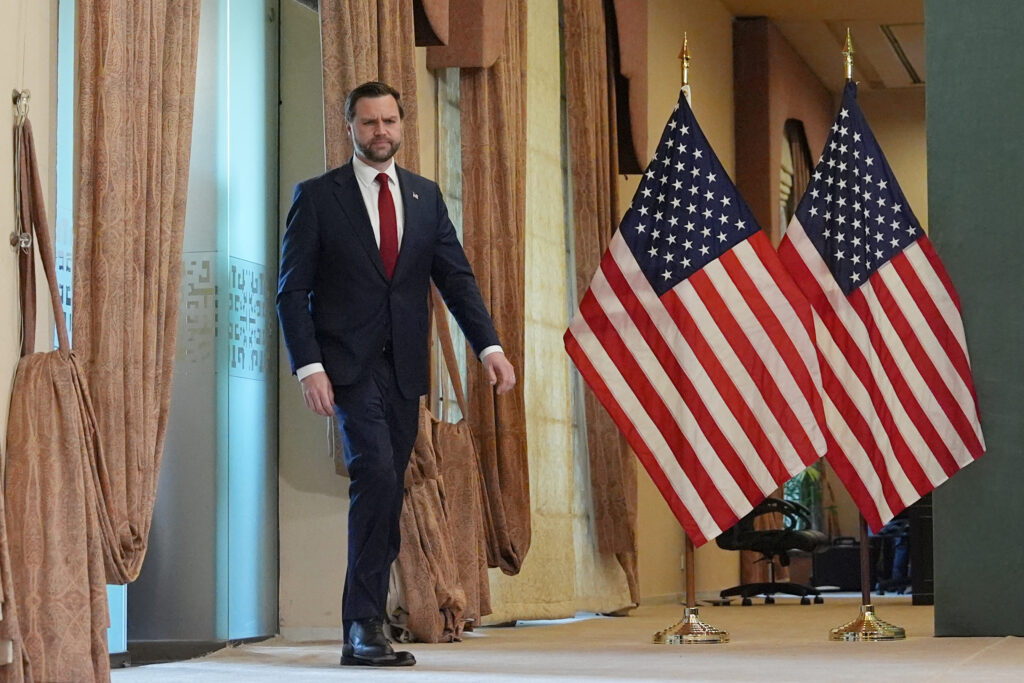
The involvement of Vice President JD Vance had raised hopes around the world that the weekend negotiations in Pakistan would solidify the ceasefire with Iran and put an end to the war within reach.
President Donald Trump’s most high-profile war skeptic gave it some time: He traveled 18 hours to meet with Iran’s negotiating team in Islamabad, the Pakistani capital. He engaged in talks for more than 20 hours. And he emerged Sunday morning lacking both sleep and a deal to end the war, ahead of the long journey back home.
But inside the negotiating room with Vance, special envoy Steve Witkoff and Trump’s son-in-law Jared Kushner, U.S. officials say progress was made on another front: establishing some measure of goodwill with officials of a country that has proven difficult to negotiate with or achieve mutual understanding with. That has led Trump, Vance and other top administration officials to believe that the Iranians may still come to accept their terms to end the deadly and costly war, some officials say.
“Well, good morning, everybody,” Vance said as he emerged from talks to address a room full of U.S. reporters who had also made the trek for the negotiations. He thanked the Pakistani officials who mediated and served as “incredible hosts,” saying “whatever shortcomings in the negotiations” were no fault of theirs.
“We have been at it now for 21 hours, and we’ve had a number of substantive discussions with the Iranians. That’s the good news. The bad news is that we have not reached an agreement.”
It was the vice president’s highest profile assignment since taking office 14 months ago — and he made the announcement as Trump socialized at a UFC fight in Miami on Saturday night after dispatching him to help end a six-week-long war that Trump started in late February.
In total, Vance will have spent 2½ days traveling and engaging in this weekend’s talks, the longest face-to-face discussions between U.S. and Iranian officials in many years. He was to arrive back in Washington on Sunday evening.
Previous discussions led by Witkoff and Kushner had failed to yield a deal to dissuade Trump from launching attacks on Iran in cooperation with Israel.
A U.S. official with knowledge of the negotiations, who spoke on the condition of anonymity to discuss the closed-door talks, said Vance was keenly aware going into the negotiations of the mistrust and risk of misunderstanding between the United States and Iran.
The official said Vance and the U.S. negotiators had developed rapport and became warmer with each other. Trump appeared to share the assessment.
“We had a very intensive negotiation, and toward the end, it got very friendly,” he told Fox News’s “Sunday Morning Futures.” “And we got just about every point we needed except for the fact that they refuse to give up their nuclear ambition.”
It became clear to the U.S. team once talks began, the official said, that the Iranians did not fully appreciate the far-reaching nature of the Trump administration’s insistence that any deal must center on prohibiting Iran from ever obtaining a nuclear weapon.
Iran has insisted for decades that it does not intend to build a nuclear weapon — a pledge that Trump and his allies, including Israeli Prime Minister Benjamin Netanyahu, have claimed cannot be taken at face value. The administration has maintained that Iran must entirely give up its nuclear enrichment capability, which can also be used for civilian purposes. Iran has refused to go that far and appears to have hoped that Trump would settle for something less.
Vance tried to correct that misunderstanding throughout the discussions, the official said. But he also used the negotiations to try to decipher how Iran actually felt about the position it was in — and determined that it believed it had more leverage than U.S. officials think is justified by the realities on the ground, according to the U.S. official, who did not elaborate on what the Iranians said. Armed with a better understanding of Iran’s vulnerabilities, the official said, the Trump administration now intends to test them.
Trump announced Sunday that he would impose a naval blockade on the Strait of Hormuz — a move that could derail the tenuous two-week ceasefire reached just five days ago and will probably further increase oil prices at least in the short term but that the president believes will force Iran into a deal.
Ultimately, the U.S. and Iran failed to reach agreement on several U.S. demands, according to the official, including that Iran end all uranium enrichment and allow the U.S. to retrieve its highly enriched uranium; the dismantling of all major nuclear enrichment facilities; accepting a broader de-escalation framework involving regional powers; ending funding for terrorist proxies, including Hamas, Lebanon’s Hezbollah and Yemen’s Houthis; and fully reopening the Strait of Hormuz, with no tolls for passage.
“We just could not get to a situation where the Iranians were willing to accept our terms. I think that we were quite flexible,” Vance said around 6:30 a.m. local time, after working overnight into Sunday morning.
Vance immediately left Islamabad at the conclusion of the brief news conference but suggested the U.S. is still open to striking a deal based on its last proposal. “We’ll see if the Iranians accept it,” he said, declining to share specifics.
Trump, hours later, told Fox News that he still believed Iran would come around to the U.S. terms, threatening further strikes to its infrastructure if it didn’t agree to give up its nuclear program. “I predict they come back and they give us everything we want,” he said.
The talks in Islamabad went through “mood swings” as they stretched into the early hours of Sunday, according to a Pakistani official briefed on the progress, who spoke on the condition of anonymity to discuss closed-door deliberations. The official said Vance left the country without any plans for “any possible engagement again.”
Vance in recent weeks had been in touch with officials in Pakistan, who mediated the negotiations. The Pakistani team encouraged the U.S. to have Vance in the lead role for the meeting, according to two White House officials, and Trump subsequently asked Vance to head the negotiations.
With no end in sight to the war and uncertainty about whether the ceasefire will hold, Trump and Vance will have to continue to stomach increased gas prices back home — a trend that has worsened their approval ratings ahead of the midterm elections.
On Sunday, Trump acknowledged that gas prices might increase at least temporarily because of the war and could not guarantee that they will dramatically fall before November.
“I hope so. I mean, I think so,” Trump said on Fox when asked whether prices would drop by the midterms. “It could be the same, or maybe a little bit higher. But it should be around the same. I think this won’t be that much longer.”
Trump is due to travel to Arizona and Nevada this week to tout the administration’s achievements — messaging that for months had included reducing gas prices.
It’s unclear how much Vance, who has been regularly dispatched to swing states to champion Trump policies, will continue to focus on the war as the U.S. works to find an off-ramp. Vance had privately expressed reluctance to launch a war with Iran, an administration official previously told The Post, though his involvement appears to have played a role in shifting the negotiating dynamics between the countries.
He is scheduled to travel to the University of Georgia on Tuesday to speak to students at a Turning Point USA event.
Susannah George contributed to this report.
The post Inside Vance’s Iran negotiations: No deal, but ‘friendly’ talks appeared first on Washington Post.