Friends danced on one another’s shoulders. Fathers embraced their children. A teenage girl wept. Beer flowed. After 16 years, Hungarians had voted their strongman leader, Viktor Orbán, out of office. “I knew it was possible,” Balázs Nagy, a warehouse worker, told me this evening in Budapest, on the banks of the Danube. “Hungarians are stubborn, and we don’t give up on each other.” To his wife, Szilvi, the evening’s results had reaffirmed a truth less geographic than metaphoric. “We’re in the heart of Europe, and that’s where we belong,” she said.
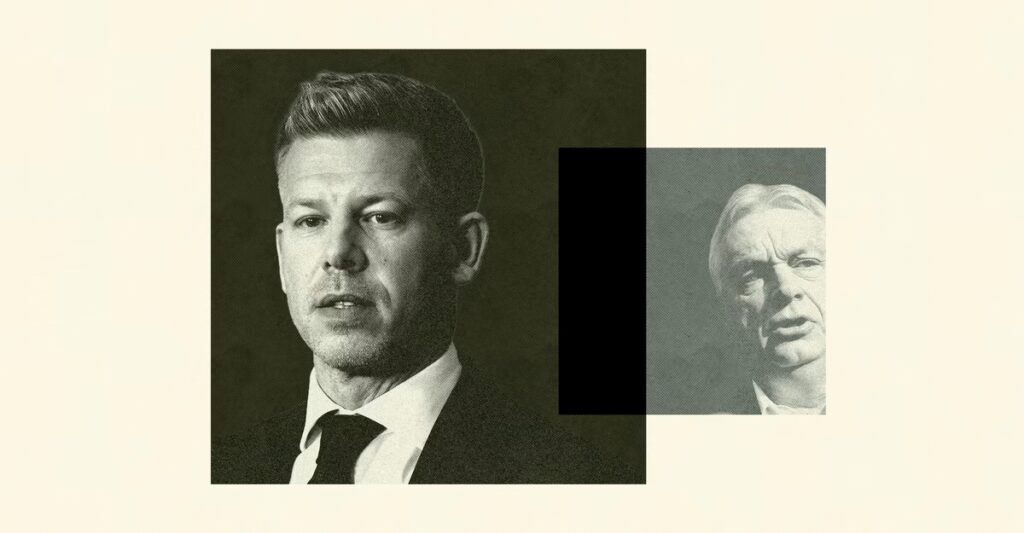
The couple stood in a throng of people waiting for Péter Magyar, who led the opposition to victory. Three hours after the polls closed in national elections, they watched as he marched through the crowd holding a Hungarian flag. “Fellow Hungarians, countrymen: We have done it,” he said. “Together we have replaced the Orbán system. Together we have liberated Hungary.”
He spoke opposite the river from the gargantuan neo-Gothic Parliament. Power is about to change hands in that body, so decisively that Magyar’s new government will be able to undo elements of the “illiberal state” that made Orbán a model for populists all over the world. In losing control of his country, Orbán became an exemplar of a rare political breed: an autocrat ousted in an election.
Voters rejected Orbán’s party, Fidesz, in favor of Magyar’s new faction, Tisza. In the process, they set a new national record for turnout. Magyar is a onetime Orbán loyalist who turned on the prime minister two years ago and managed to do what past opposition leaders couldn’t—overcome the incumbent’s enormous advantages. Since 2010, Orbán has rewritten election rules and removed independent checks on his power. He has suffocated civil society while extending his control over the media. And he has presided over patronage networks that have enriched his friends and family while impoverishing his society. State contracts helped turn the prime minister’s childhood friend, once a gas retrofitter, into a billionaire, but salaries for everyday Hungarians have languished at less than half the EU average. “It’s not livable,” Bendegúz Neszádeli, an 18-year-old who had just voted for the first time, told me. He held up a bracelet, braided with the Hungarian tricolor, that’s handed out to maiden voters. “It feels like there’s a future again.”
The European Parliament calls Hungary an “electoral autocracy”—voting still takes place, but under fundamentally undemocratic conditions. That makes elections harder to contest but, as Hungarian voters proved today, not impossible to win. Today, an election toppled a government whose advantages included support from the governments in both the United States and Russia. Echoing a chant in the crowd, Magyar declared in his victory speech, “Russians go home.”
Efforts by foreign governments to prop up Orbán gave his defeat implications that extend well beyond this small country of fewer than 10 million people. The prime minister has been a scourge to international institutions and a source of inspiration to far-right politicians throughout the West. He was demonizing immigrants and dictating talking points to friendly media before Donald Trump came down the golden escalator. Trump desperately tried to keep Orbán in power, issuing multiple endorsements and dispatching his vice president, J. D. Vance, to campaign with the prime minister in Budapest last week. Among Hungarians, however, sympathies had shifted dramatically. To note just one example: A Fidesz mayor who was recently elected with more than 70 percent of the vote in a small village in Hungary’s Southern Great Plain region declared his support for the opposition on Facebook this morning, writing, “I vote for European values and against Russian influence.”
[READ: J.D. Vance Is Definitely Against Foreign Election Interference]
The election campaign was fierce, characterized by competing claims of foreign influence. Orbán tried to paint the opposition as a puppet of Brussels, and an accomplice to Ukrainian President Volodymyr Zelensky’s war aims. He acknowledged economic misfortune but argued that his opponent would disrupt what little stability the country still enjoys. “The message was, ‘We could live even worse,’” András Bíró-Nagy, a political analyst, told me. Magyar, meanwhile, vowed to recoup funds frozen by EU institutions over rule-of-law violations, impose a wealth tax, and imprison Fidesz officials he accused of pilfering public coffers. “We will not be a country of no consequences,” Magyar told his supporters as he claimed victory.
The threat of civil unrest hung over the final days of voting. Orbán’s aides argued that Tisza agents were preparing to commit acts of violence—warnings that Tisza representatives decried as a pretext for a government crackdown. Consistently, independent polls showed the opposition with a sizable lead, but Western diplomats in Budapest cautioned me not to underestimate Orbán’s ability to mobilize voters at the last moment, or to manufacture circumstances justifying a state of emergency. They said Magyar would need a blowout, which is exactly what he got.
His party is set to command the two-thirds legislative majority necessary to amend the constitution, as well as to reconstitute influential bodies such as the Constitutional Court and to change so-called cardinal laws governing areas including media regulation and family policy. In his victory speech, Magyar said his party would have a “mandate to build a functioning and humane home.” As Magyar’s supporters waited for him, Orbán appeared on-screen to thank his voters and concede, but his words were drowned out by boos at the opposition’s gathering. I caught only snippets—the prime minister acknowledging the pain of defeat and pledging to start anew.
[Read: Viktor]OrbánCould Actually Lose
After Magyar’s speech, the riverbank became the scene of a spontaneous dance party. Fireworks burst into the air. A police officer who had traveled 70 miles with her family to listen to Magyar told me that Hungarians had used the last chance available to them to remove Orbán, whom she called a “dictator.” She regretted only that her mother, who died recently, hadn’t lived long enough “to see this ghost of Orbán go away.”
Budapest is filled with monuments to the country’s turbulent past. I waited for the results of the election tonight in Batthyány Square, named for the country’s first prime minister. A statue shows Lajos Batthyány holding up the April Laws—including self-government, freedom of the press, and equality before the law—that inspired the failed uprising against the Habsburg monarchy in 1848-49. Batthyány was executed by firing squad.
It’s April again in Hungary, but where armed struggle once failed, democratic elections have now succeeded.
Erika Nina Suárez contributed reporting.
The post Hungary Has Ousted an Autocrat appeared first on The Atlantic.