One July morning in 2023, I was driving my son to an art class when my friend, Amy Ryan, called with news that seems destined never to lose its shock value. The Gilgo Beach serial killer, who had murdered young women, all sex workers, over decades, leaving their bodies wrapped in burlap in the brush along the Atlantic Ocean on Long Island, had just been identified and taken into custody.
“You will not believe who it is,” she reported in whispered astonishment: “It’s Rex Heuermann” — a disclosure that had me pull over.
However unlikely it was that the two of us — lifelong New Yorkers in middle age, one a journalist, the other, an Oscar- and Tony-nominated actress — would know a serial killer merely by way of our domestic routines, it is in fact where we had landed. Heuermann was a consulting architect who worked with the stewards of several well-kept prewar apartment buildings in Brooklyn, brought in to sign off on individual renovations or advise on broader structural projects.
I dealt with him briefly over the reconstruction of a courtyard garden when I served on my co-op board in Brooklyn Heights. With other board members I sat in occasional basement meetings with him talking about, as I vaguely recall, things like drainage efficiency. But Amy’s contact had been closer; Heuermann had been in her apartment, arguing with her architect about window measurements.
That would have been chillingly bizarre enough on its own. But there was another, even more startling connection. Long before Heuermann had fallen on the radar of Long Island law enforcement, Amy starred in “Lost Girls,” the 2020 Netflix film about the families of the Gilgo Beach victims, which was based on Robert Kolker’s book of the same name. In it, she plays Mari Gilbert, the mother of Shannan Gilbert, whose remains were found in the bramble at Oak Beach, a few miles from Gilgo, an eerie part of the Long Island coastline.
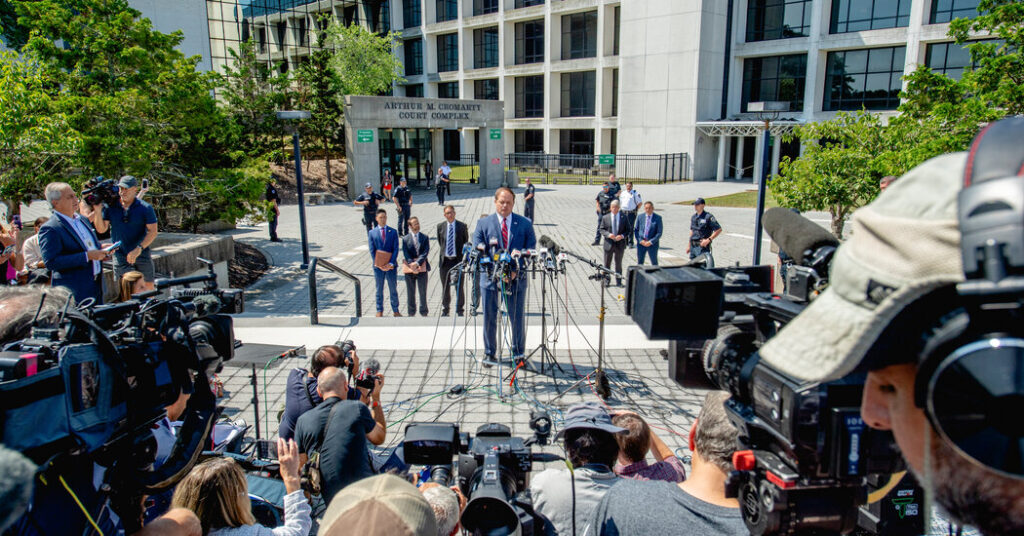
By 2011, seven other bodies — or parts of bodies — were found in the area. After nearly 12 years of mostly fruitless investigation, detectives finally arrested Heuermann; he had been scheduled to go to trial this fall for seven counts of murder, having entered a plea of not guilty despite the mountain of evidence against him. But this week, during an ordinary hearing in a Suffolk County courtroom, he reversed himself, pleaded guilty on all counts and admitted to killing an eighth woman, a case in which he had not faced charges. Over the course of 20 minutes, asked how he had ended the lives of each of his victims, he methodically answered “strangulation” in every instance.
The addiction to serial killer narratives has a long history in modern American life, but Heuermann’s apprehension landed in the news at a particular moment when prestige true crime had become ascendant, when art turned more aggressively to the truths of lurid violence and ambiguous resolutions. “The Jinx,” the acclaimed 2015 six-part documentary on HBO, might have signaled a turning point. The film ends, as viewers surely remember, with its subject, the real estate heir and suspected serial killer Robert Durst, seemingly confessing to three murders on a hot mic while he is in the bathroom. “Killed them all, of course,” he says, in the middle of urinating. A decade before, the French documentary, “The Staircase,” about a North Carolinian novelist who may or may not have killed both his wives, primed a generation toward a distinct set of obsessions — it inspired the producers of the groundbreaking podcast “Serial.”
Over the past several years, the Gilgo Beach murders have generated several podcasts, endless coverage in the news media, countless Reddit threads and, in addition to “Lost Girls,” a multipart documentary, “Gone Girls,” by the same director, Liz Garbus. That second effort, she told me, was driven by the opportunity to look at what was going on inside the Suffolk County Police Department. From the perspective of content creation, the Gilgo Beach story had the advantage of many layered parts and intoxicating sidebars, and the corruption and disarray within the world of local law enforcement was one of them. It had slowed an investigation that ultimately ended with pyrotechnic forensic work and the efficient interventions of the F.B.I.
If the break in the case seemed cinematic — involving the retrieval of a discarded pizza box in Midtown Manhattan, successfully mined for traces of DNA — the killer himself was not. Hulking and overweight with period-drama hair from no discernible period, Heuermann could not rely on charm and good looks to lure his victims, the way that Ted Bundy did.He was not in a position of authority, like the Golden State Killer, a cop who terrorized women up and down California for years; nor was he like Gerard John Schaefer, a former policeman who abducted hitchhikers in Florida in the 1970s. He was not a schizophrenic like Ed Gein, whose story was fictionalized in the 1959 Robert Bloch novel, “Pyscho,” the precursor to the Hitchcock film. Gein later served as the character sketch for the deranged Buffalo Bill in Thomas Harris’s “Silence of the Lambs.”
Heuermann’s mark of distinction was that he was a workaday architect operating without prestige in a profession fixated on it. He lived in Massapequa Park and commuted to his office in Manhattan on the Long Island Railroad. He killed poor women at night — when his wife was out of town — and tangled with privileged New Yorkers all day long, sometimes imperiously denying them the upgrades they were after. “Rex Heuermann is why I don’t have central air,’’ as a wealthy co-op owner living at a prestigious Brooklyn address put it to me three years ago, just after the arrest.
One reaction to the arc of the Gilgo Beach murders might be to say that it seems straight out of David Lynch — the horrors of suburbia lurking beneath that topcoat of civility and tidiness. Except that the veneer, in this case, was barely applied — Heuermann lived in the tiny house where he had grown up; it was dilapidated and he had tax liens. He kept a stash of guns inside and would swing an ax in the front yard. His neighbors found him unpleasant at best, menacing at worst. Parents warned their children to avoid his house on Halloween.
In the city, he merely seemed obstructionist — until he was identified as a barbaric criminal, at which point he emerged as something of a novelty: a serial killer in a place where serial killing had not been localized since the Son of Sam in the 1970s. For a while, I could hardly let a dinner party pass without telling parts of this story, a story whose point, as I had conceived it, was that I knew a serial killer — as if this ought to have been a line item on a résumé.
Invariably everyone at the table would gasp in a way that suggested they were also entertained. This is because the story was always told in neighborhoods where the most intimate connection the majority of people would ever have had to criminal activity was playing pickleball with the guy around the corner who just went down for insider trading.
The real point, of course, is something else entirely.
Ginia Bellafante writes features, profiles and social criticism for The Times.
The post How the Gilgo Beach Killings Fueled a Mania for Prestige True Crime appeared first on New York Times.