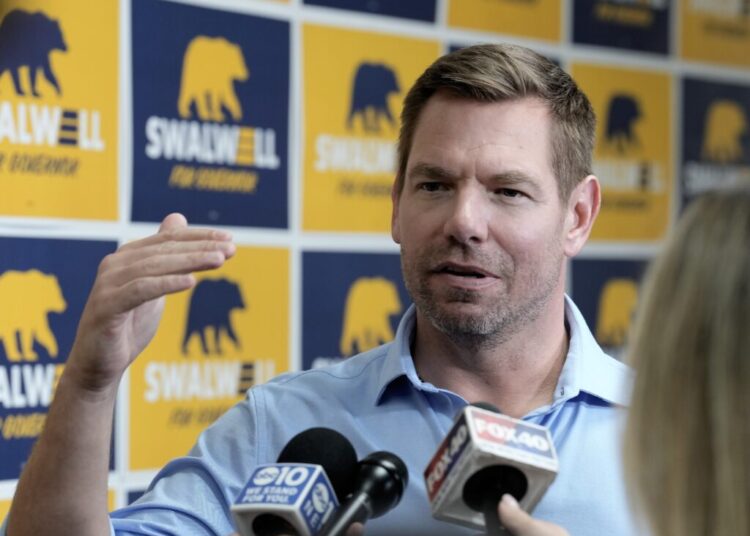
Representative Eric Swalwell entered the race to become California’s next governor with a splashy debut on late-night TV in November. Jimmy Kimmel introduced him as a popular congressman who “does battle daily with the forces of MAGA — and the president does not like him at all.”
If Californians knew anything about Mr. Swalwell, that was it.
Mr. Swalwell, a Democrat, had no experience in state government and few connections with leaders in a State Capitol run by his party. What he had was a media profile as a Trump antagonist, burnished by years of appearances on news shows that made him more familiar to voters than most of his competitors.
Mr. Swalwell quickly ascended past Democrats whose campaigns had failed to catch fire, in a vast state where it is notoriously difficult to break through without celebrity status or money. By March, he had won over much of the Democratic establishment and the influential groups that shape California politics.
But it all came crashing down on Friday when four women accused him of sexual misconduct in news reports, including allegations that he had twice sexually assaulted a former staff member when she was intoxicated.
Mr. Swalwell said the accusations were “flat false.” But in an instant, campaign committees froze spending, unions retracted their endorsements and political advisers quit. The rapid implosion of Mr. Swalwell’s campaign revealed how shallow his relationships were in California, and how low his credibility was in state circles.
“It’s not like anybody in California outside of his district had ever voted for him,” said Garry South, a Democratic consultant who ran campaigns for former Gov. Gray Davis. “So when something like this breaks, their kind of flimsy support can collapse very, very quickly.”
Mr. Swalwell, who represents a suburban district in the San Francisco Bay Area, did not yet have a dominant advantage in polls but was emerging as one of three Democratic front-runners in a race that remains a free-for-all. Voters have barely paid attention so far.
Just before Thanksgiving, Mr. Swalwell entered the race with few ties to the labor unions and professional associations that are huge campaign donors in California politics. Many lawmakers at the State Capitol didn’t know him at all.
It is not uncommon for members of Congress to become creatures of Washington the longer they stay in the nation’s capital, and Mr. Swalwell’s ties to California grew thin after he leaped from the Dublin City Council to the House. His family lived in Washington, and he and his wife rented a room in a suburban Bay Area home as his residence in California.
Over the winter, he began meeting California power brokers — some for the first time — trying to break into Sacramento’s insular political community.
“We knew him how most Californians knew him: on cable news and on TV,” said Assemblyman Matt Haney, a Democrat from San Francisco, just across the bay from Mr. Swalwell’s district. “I had never met him, and I think that was true for a lot of local and state elected officials and community leaders.”
For the last century, most California governors had first served in at least one other statewide office. (Hollywood stars Ronald Reagan and Arnold Schwarzenegger were the notable exceptions.) They built relationships with power players at the State Capitol and developed expertise in the policy matters that fall under a governor’s purview.
That Mr. Swalwell could enter the race among the front-runners despite his lack of state experience underscored how nationalized politics had become.
Mr. Swalwell’s experience combating President Trump gave him tremendous exposure — much more than a state government official can garner in today’s media ecosystem. For proof, look no further than the Democratic candidates lagging in the polls despite having years of California government experience.
In Washington, Mr. Swalwell had a prominent role condemning the Jan. 6 attack on the Capitol by a pro-Trump mob, serving as a manager of the 2021 impeachment against Mr. Trump and then suing him in federal court for acts of terrorism and incitement to riot.
Earlier, through his seats on the House Intelligence and Judiciary Committees, he helped investigate evidence against Mr. Trump during the first impeachment of the president in 2019. As a young lawmaker with social media fluency and a background as a prosecutor, Mr. Swalwell turned routine exchanges during hearings into viral moments that made him a recognizable figure on Capitol Hill. Representative Nancy Pelosi, the influential former House speaker from San Francisco, brought Mr. Swalwell into her leadership team, though she has not endorsed anyone in the governor’s race this year.
But Washington is a different universe than the one a California governor must inhabit. The state is so big that many political professionals build lucrative careers as lobbyists or campaign strategists without ever having worked in Washington.
“They’re very distinct political cultures,” said Paul Mitchell, a Democratic consultant based in Sacramento who has also worked with House Democrats. He said the worlds were so different that he could see how one’s reputation in Washington might never really be known in Sacramento circles.
Mr. Swalwell had two allies in Congress who helped him make inroads at the State Capitol. Representatives Jimmy Gomez and Adam Gray, both Democrats, had previously served in the state legislature and were chairing his campaign for governor. (Both of them left his campaign, withdrew their endorsements and called on him to drop out of the race after the allegations were published.)
Some potential supporters in California said that they had heard that Mr. Swalwell had a reputation for hitting on young women. But when they asked him about it during endorsement interviews, he blew it off purely as rumor. He told groups that Mr. Trump’s opposition researchers had been trying to find dirt on him for a decade and that the lack of any evidence showed that the gossip was untrue, according to two people familiar with the interviews.
In the weeks before the San Francisco Chronicle and CNN reported detailed allegations of sexual misconduct against Mr. Swalwell, the rumors escalated as social media influencers described allegations in vague terms.
By then, though, many key players in California’s Democratic establishment had already thrown their might behind him. Senator Adam Schiff endorsed him, as did the state’s two most powerful labor unions. Several political consultants affiliated with Gov. Gavin Newsom, who cannot run again because of term limits, began working for Mr. Swalwell or the super PAC backing his campaign.
“He was presenting a sort of middle of the road, ‘I’ll work with everyone’ kind of vibe and that was enough to start generating both labor and business support,” said Scott Wiener, a Democratic state senator who has not endorsed anyone in the governor’s race.
The governor’s race has long lacked an obvious front-runner. Former Vice President Kamala Harris could have been a prohibitive favorite, but she decided last summer not to run. Many influential leaders in Sacramento had hoped that Senator Alex Padilla would jump in the race, but he, too, opted against.
That left a disorganized field.
With eight prominent Democrats and two well-known Republicans running in a nonpartisan primary the growing fear among Democrats was that the two Republicans could win the primary and shut Democrats out of the November election. The top two vote-getters advance regardless of party. Democratic insiders desperately wanted to get behind a candidate who could win enough support to avoid that scenario.
Two of the Democrats, former Representative Katie Porter, and billionaire Tom Steyer, were polling near Mr. Swalwell. But five other Democratic candidates had been consistently polling in the single digits, making them unappealing to many political veterans and potential donors.
Republicans, meanwhile, had focused on only two candidates, Steve Hilton, a former Fox News host, and Chad Bianco, the sheriff of Riverside County.
Embarrassing videos showing Ms. Porter berating a staff member and belittling a television reporter had given pause to some potential backers. And labor unions were not sure that they could stomach getting behind a billionaire in Mr. Steyer.
That increasingly made Mr. Swalwell a candidate to coalesce around, someone with strong anti-Trump credentials, a middle-class background and an agenda that was suited to institutional Democrats.
So the vague online rumors about Mr. Swalwell were easier for supporters to dismiss as dirty politics — until the accounts landed with searing detail.
They described a former staff member who said Mr. Swalwell’s assault left her with bruises and vaginal bleeding. Another woman said he had touched her thigh and tried to kiss her during a night of heavy drinking together that ended in a hotel room. Two other women said Mr. Swalwell sent them unsolicited photos of his penis.
When Mr. Swalwell learned what the news outlets planned to publish, he scrambled early Friday morning to call leaders of the groups that had endorsed him, according to two people familiar with the calls. The forthcoming news reports, he told them, were false.
It didn’t matter.
Staff members with deep California ties who had recently joined Mr. Swalwell’s campaign and California organizations who had recently endorsed him immediately abandoned him.
On Friday night, Mr. Swalwell posted a video saying the accusations of sexual assault were false, and apologizing to his wife for “mistakes in judgment.” He also apologized to viewers “if in any way you have doubted your support for me.”
“But I think you know who I am,” he said.
By then, supporters in California were wondering if they ever really had.
Robert Jimison contributed reporting from Washington.
Laurel Rosenhall is a Sacramento-based reporter covering California politics and government for The Times.
The post How California Democrats Got Behind Swalwell — and Quickly Abandoned Him appeared first on New York Times.