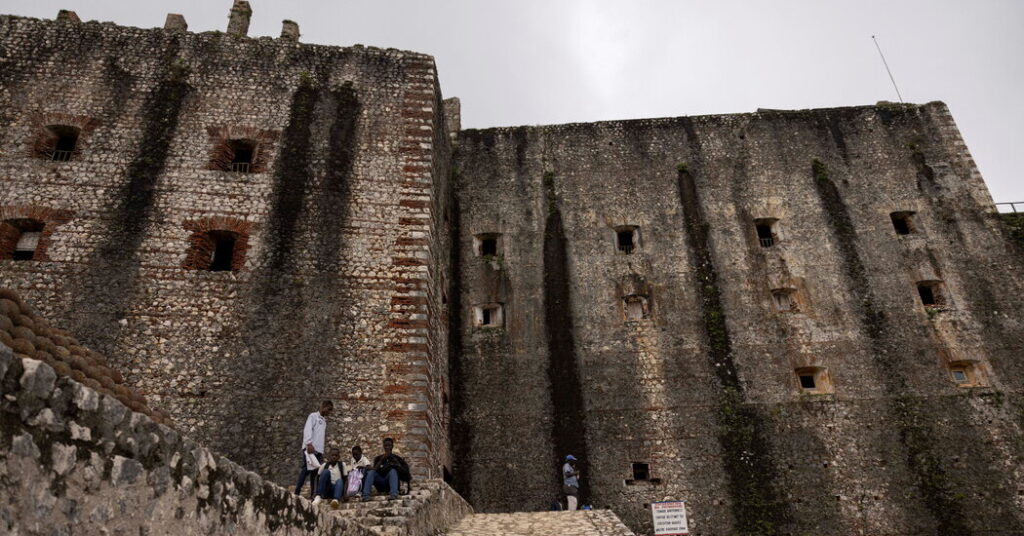
Velino Merelus still recalls his first visit to the Citadelle Laferrière in northern Haiti, more than two decades ago. He went to the historical site with his parents as a 13-year-old, walking through the forest and into the high mountains. The cities of Milot and Cap Haitien faded as he trekked up the narrow path to the fort, taking in Haiti’s lush, undulating landscape.
For Mr. Merelus, who now lives in Brevard County, Fla., the Citadelle served as an example of Haitian strength and innovation. And for a country long mired in poverty, political instability and natural disasters, the site is a source of pride for Haitians across the world. The fortress appears on Haitian currency, postage stamps and tourist promotions.
On Saturday, the grounds that help to buoy that national spirit became the site of the latest tragedy to rock the country: At least 30 people died in a stampede at the Citadelle, according to officials. The death toll is expected to rise.
Early reports suggest that as rain fell, two large groups of mostly young people locked against each other at the entrance to the fortress.
“While some people wanted to leave, others were trying to enter,” the minister of culture and communication, Emmanuel Ménard, told The New York Times. “People began pushing. Some fell, and others trampled over them. Consequently, some people died from suffocation.”
For the Haitian diaspora in America, the news has brought sadness and frustration. In interviews, many lamented the mismanagement that allowed a mass of young people to gather at the site. Others expressed interest in the findings of an official investigation. Nearly all described the Citadelle Laferrière as a prominent symbol of Haitian sovereignty.
Built in the early 19th century, in the years after the successful slave rebellion against the French, the Citadelle was the brainchild of Henri Christophe, the first and longest-serving king of Haiti. It was designed as a fortress to ensure that if the French ever returned, the Haitian people could survive their assault. Made out of stone, the site was constructed on the top of a mountain, offering a bird’s-eye view of any threat.
“It’s magical,” Mr. Merelus said. “The way it is built, where it is built — that is why people want to visit it so bad.”
It has long been a tradition for nationals to make a pilgrimage to the Citadelle in April to commemorate its anniversary. Some say the customary way to scale the mountain is on the back of a horse or mule. The site is a tourist destination and a common field trip locale for families, churches and schools.
“I was so proud of myself and so proud that Haitians back in the day could put on such an impressive site,” Viles Dorsainvil, the executive director of the Haitian Support Center in Springfield, Ohio.
Mr. Dorsainvil, who visited the fortress as a teenager, said the trip “helped me to be proud of who I am as Haitian, to be proud of my heritage and to be proud of the work my forefathers did.”
Some worried that the stampede would mar a bright spot in Haitian history. “What happened at the citadel is a slap on our pride,” said Eddy Laguerre, a lawyer based out of Miami, Fla.
Mr. Laguerre, who toured the grounds as a young person and later with his wife on their honeymoon, said that leaders should never have allowed such a large crowd to gather. The long, steep path to the fortress was not made to accommodate emergency vehicles, he said, speculating that it may have been a challenge for paramedics to reach the injured.
“We failed to take care of one of the most important elements in our history,” he said.
Videos on social media show a swarm of young people across the Citadelle, packed together in an semi-enclosed area, chanting.
Regine Jackson, the president of the Haitian Studies Association and a Haitian American, acknowledged the Citadelle as a source of gravity for Haitians around the world. Still, given the Easter holiday and the years of turmoil the country has faced, she said she understood why people gathered to celebrate in such numbers.
“Trying to capture moments of joy at this time when there’s so much heaviness in the world, I’m not ready to say that is wrong on the face of it,” she said, adding, “of course, safety precautions are important.”
Bernard Mokam covers breaking news.
The post For Haitians, Stampede at Citadelle Laferrière Mars a Bright Spot appeared first on New York Times.