ISLAMABAD, Pakistan — Talks between the United States and Iran failed to reach a resolution over ending the war, Vice President JD Vance announced after more than 20 hours of negotiations here.
“We just could not get to a situation where the Iranians were willing to accept our terms. I think that we were quite flexible,” Vance said around 6:30 a.m. local time, after working well into Sunday morning.
Vance said the U.S. team was “quite accommodating” to the Iranians and acted on instructions from President Donald Trump to “come here in good faith and make your best effort to get a deal.”
“We did that, and unfortunately, we weren’t able to make any headway,” Vance said.
Vance immediately left Islamabad at the conclusion of the brief news conference, but suggested the U.S. is still open to striking a deal based on its last proposal: “We’ll see if the Iranians accept it,” Vance said, declining to share specifics.
He did not answer shouted questions about whether the ending of the talks meant that fighting would resume or about the status of ship traffic in the Strait of Hormuz.
The negotiations, led on the U.S. side by Vance, were the highest level of face-to-face engagement between leaders of the U.S. and Iran in decades, and the fact that the two sides agreed to speak directly was welcomed as a positive sign by diplomats and officials in the region.
But the talks went through “mood swings” as they stretched into the early hours Sunday, according to a Pakistani official briefed on the progress, who spoke on the condition of anonymity to discuss sensitive closed-door deliberations. The official said Vance left Pakistan without any plans for “any possible engagement again.”
Dispatching the vice president to the talks was widely seen as a sign of Trump’s seriousness about reaching a deal to end the war — and also marked the highest-profile job Vance has taken on since becoming vice president.
Vance said the negotiating team had “substantive discussions with the Iranians,” but failed to persuade them to accept the U.S. terms for a deal.
“The simple fact is that we need to see an affirmative commitment that they will not seek a nuclear weapon, and they will not seek the tools that would enable them to quickly achieve a nuclear weapon,” he said, referring to Iran’s program to enrich nuclear fuel, which could be put to civilian uses but could also be developed into a weapon.
Around the time Vance spoke at a lectern to update reporters early Sunday in Pakistan, Trump took in the scene of a UFC fight Saturday night at Kaseya Center in Miami, where Secretary of State Marco Rubio was among those who joined him. Reporters accompanying Trump saw the two men speaking animatedly for a few minutes before Rubio left. The president had traveled to his golf club in Virginia earlier in the morning before flying to Florida to spend the rest of the weekend.
U.S. and Iranian negotiators were aiming to build on the shaky ceasefire that both sides agreed to Tuesday and identify a more permanent end to the war. After both parties took their first break of the night late Saturday, talks moved to the technical level, signaling progress in the initial phase, according to the Pakistani official. However, the two sides struggled to bridge differences over the future of the Strait of Hormuz and Tehran’s demand that the U.S. unfreeze billions of dollars in its assets.
Speaking to reporters as he left the White House for Florida on Saturday, Trump confirmed that negotiations had lasted “many hours.”
“Maybe they make a deal, maybe they don’t,” he told reporters several hours before Vance emerged to announce no deal had been reached. “From the standpoint of America, we win.”
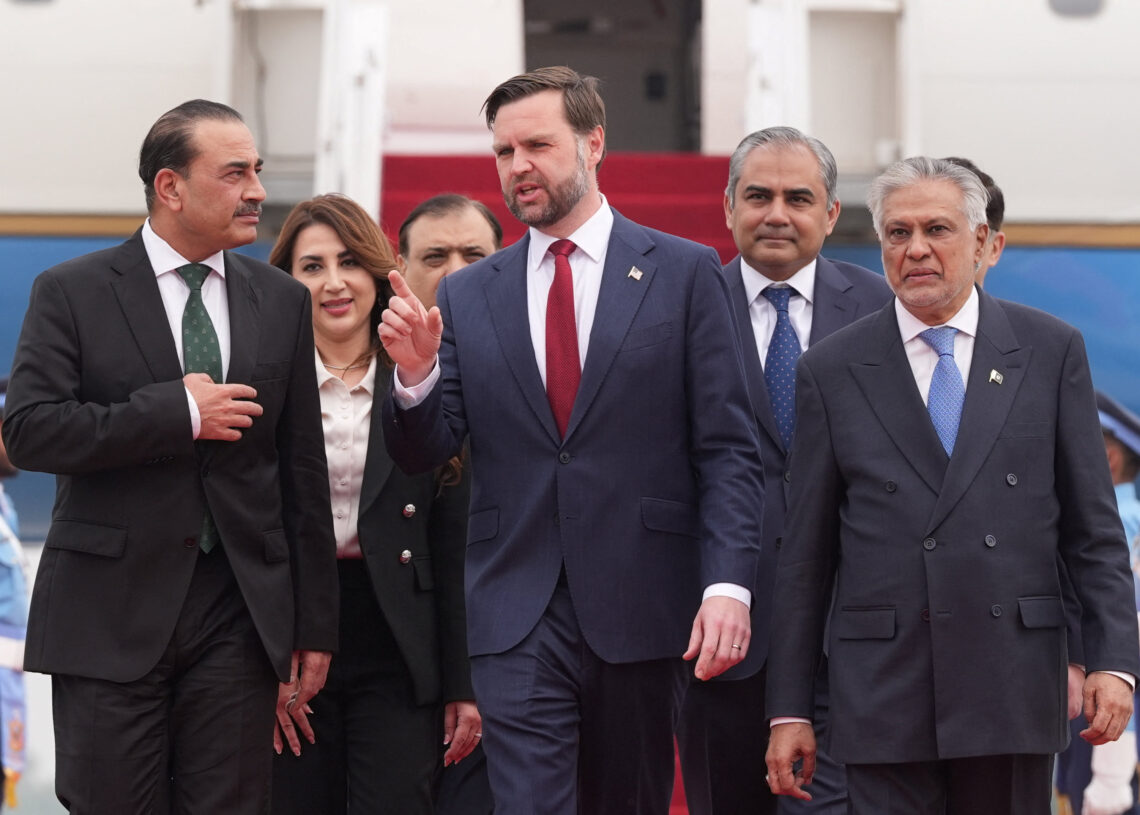
Earlier Saturday, Vance arrived to heavy security in Islamabad, where the mood was nonetheless jubilant. At Nur Khan air base outside Islamabad, Vance was escorted down a red carpet from Air Force Two. Inside the capital city, roads were newly decorated with banners depicting American, Pakistani and Iranian flags.
Local news coverage of the talks was wall to wall and glowing. An editorial in Dawn, Pakistan’s influential English-language daily newspaper, declared “the world’s eyes are focused on Islamabad,” and Pakistan’s “deft diplomacy.”
While both sides appeared to signal a strong desire to negotiate an end to the war, Iran and the U.S. continued to trade accusations of ceasefire violations up until the meetings began on Saturday. But, diplomats in the region cited the makeup of the two delegations — larger, more senior groups of officials — as cause for optimism.
Vance’s presence, in particular, signaled the Trump administration’s seriousness, according to one Western diplomat based in the Persian Gulf. The vice president was seen in the region as more supportive of a peace deal because of his past opposition to foreign military intervention, the diplomat said, speaking on the condition of anonymity because he was not authorized to brief the media.
Iran and the U.S. originally planed to hold “proximity talks” — meaning the delegations would be seated in different rooms — to build confidence, according to Husain Haqqani, a former Pakistani ambassador to the U.S. After the talks got underway Saturday, a senior White House official described the format as “a trilateral face-to-face meeting.”
“The talks have started from a point of deep mistrust and unwillingness to talk, so in that sense, Pakistan has already accomplished a great deal in bringing the two sides to its capital,” said Haqqani, who is now a senior fellow at the Hudson Institute.
Joining Vance in the U.S. delegation were U.S. envoy Steve Witkoff and Trump’s son-in-law Jared Kushner. Witkoff and Kushner led talks with Iran over its nuclear program earlier this year.
The vice president said that he, Witkoff and Kushner spoke to Trump anywhere from a half-dozen to a dozen times throughout the marathon negotiations, which involved several breaks, as well as other Cabinet members, including Rubio, Defense Secretary Pete Hegseth and Treasury Secretary Scott Bessent.
The Iranian delegation that arrived in Pakistan late Friday included more than a dozen senior officials. Led by the Iranian parliamentary speaker, Mohammad Bagher Ghalibaf, the delegation also included Iranian Foreign Minister Abbas Araghchi, who took the lead on nuclear talks, several senior security officials and Iran’s central bank governor.
In the lead up to talks, Iran and the U.S. clashed on some of the ceasefire’s central terms. Iran has refused to relinquish control of the Strait of Hormuz since a ceasefire was declared. Over the course of the conflict, Iran took control of the critical waterway — mining parts, requiring tankers to request permission from Tehran to pass and collecting tolls, moves that have roiled global energy markets.
Trump has repeatedly lashed out at Tehran over the strait. In a social media post Saturday, Trump said, “We’re now starting the process of clearing out the Strait of Hormuz as a favor to Countries all over the World.”
U.S. Central Command later announced the start of mine-clearing operations in the strait.
Iran’s request that the U.S. unfreeze billions in assets emerged as the other key sticking point for talks, according to the Pakistani official. Ghalibaf mentioned the assets in a post on X on Friday, saying they were one of two measures “mutually agreed upon” that “have yet to be implemented.” The other measure was the ceasefire in Lebanon, he said. “These two matters must be fulfilled before negotiations begin.
The assets Ghalibaf appears to be referring to are those that the Biden administration pledged to unfreeze following a 2023 hostage release deal with Iran. However, the transaction was still pending when Hamas launched its Oct. 7, 2023, assault on Israel, and Tehran was blocked from accessing the funds in response to reporting on Iran’s involvement in the Hamas attacks.
Iran has emphasized the importance of some kind of reparations for the conflict since the war’s early days. Iranian leaders said the payment of war-related damages would be a key element of an assurance that the U.S. would not attack again, and the demand is included in Tehran’s 10-point plan to end the war that was released by Iranian state-run media this week.
The plan also called for Iran to remain in control of the Strait of Hormuz and the withdrawal of U.S. forces from military bases in the Middle East. Both are likely problematic for the U.S., but Trump has called the outline “a workable basis on which to negotiate.”
George and Hussain reported from Islamabad, and Allison from Washington.
The post Direct U.S.-Iran talks fail to reach resolution after lengthy negotiation appeared first on Washington Post.