Twice in one year, the United States has been humbled by an adversary’s ability to weaponize its control over one of the global economy’s main arteries.
First, China wielded its dominance over rare earth minerals to secure a truce in President Donald Trump’s trade war. Then, Iran effectively closed the Strait of Hormuz, taking hostage global energy markets and leading to a ceasefire in its six-week war with the United States and Israel.
Washington once enjoyed a near-monopoly over this type of economic warfare, punishing wayward nations by barring them from using the dollar or enjoying access to Silicon Valley’s most advanced technologies.
But as faith in global economic integration broke down amid the pandemic, Russia’s invasion of Ukraine and souring U.S.-China relations, nations increasingly saw commercial links as potential pressure points. In response, the United States, China and Europe are all moving to bolster their economic defenses by investing in domestic production of essential goods.
“The global economy was designed for the benign environment of the 1990s when we assumed that China and Russia would be our friends. But we’re living in a period of intensifying geopolitical competition,” said Edward Fishman, author of “Chokepoints,” a history of the U.S. approach to economic warfare. “This process is just going to keep going on until you have a new global economy.”
Exploiting economic dependency is not unprecedented. The 1973 Arab oil embargo, which plunged the U.S. into a stagflationary episode of recession and high inflation, is just one example. But the global economy today offers more opportunities to leverage commercial links for strategic ends: Trade as a share of overall output is twice as large today as it was in 1973.
The “America First” president, who criticizes globalization for draining jobs and wealth from the U.S., often speaks as if his nation exists on a plane apart. Earlier this year, he said Americans “don’t need” anything from Canada, the nation’s No. 2 source of imported goods. He boasts of the U.S. being “energy independent,” though it relies on imports of some petroleum products, including a minor amount that transits the strait.
Some of Trump’s top aides see danger in the commercial ties that flowered following the end of the Cold War, especially those that left the U.S. dependent upon China, its principal strategic rival. Secretary of State Marco Rubio has worried publicly that other nations’ economic leverage will “constrain our ability to make foreign policy” unless the U.S. diversifies its supply lines.
“There is virtually none of the leading-edge industries of the 21st century in which we don’t have some level of vulnerability, and it’s become one of the highest geopolitical priorities that we now face,” Rubio said in a speech last year.
The U.S. has struggled, however, to adjust to the shifting landscape. In both of his terms in the White House, Trump has been a heavy user of financial sanctions, hitting countries, individuals and companies. He reimposed sanctions on Iran in 2018, hit Venezuela with “maximum pressure” the following year and levied penalties on multiple Chinese entities.
This term, he piled more sanctions on Iran, expanded export controls to cover an estimated 20,000 Chinese companies, and tightened controls over advanced chipmaking equipment and jet engines to China.
But the administration has been caught unawares when other nations have weaponized their economic advantages. Last April, when China retaliated for Trump’s tariffs by banning exports of rare earth materials — critical ingredients in civilian and military products — the president called the move “a real surprise” on social media.
Likewise, the U.S. seemed to have no answer when Iran closed the Strait of Hormuz. With shipping carriers unwilling to brave Iranian threats, oil markets quaked, sending U.S. gas prices above $4 per gallon and hammering import-dependent economies across Asia.
If the U.S. seemed flat-footed, it may be because the Treasury Department performed no prewar analysis of the conflict’s potential energy market consequences, according to Sen. Ron Wyden of Oregon, the senior Democrat on the Senate Finance Committee and a frequent administration critic.
Sriprakash Kothari, nominated to become assistant treasury secretary for economic policy, told committee staffers “that not only did he not perform any work related to energy markets leading up to the war, but that he wasn’t aware of anyone at Treasury who did,” Wyden said in an April 9 letter to Treasury Secretary Scott Bessent.
The Treasury Department did not respond to a request for comment.
“It turns out that the United States does not have all the choke points. We are in a world where the U.S. simply cannot get away with the stuff that it thought it could get away with,” said Henry Farrell, co-author of “Underground Empire,” a book about economic warfare.
On Friday, the president scoffed at Iran’s ability to maintain its commercial chokehold, minimizing the global economic tumult that it has unleashed. “The Iranians don’t seem to realize they have no cards, other than a short term extortion of the World by using International Waterways,” Trump wrote on Truth Social.
Yet even after a fragile ceasefire took hold, around 3,200 vessels, including 800 tankers and cargo ships, remained stranded west of the strait in the Persian Gulf, according to Windward, a maritime intelligence firm in London.
Iran is allowing a trickle of vessels, so long as they pay a toll and hail from nonhostile nations. Iranian authorities, in effect, are acting like a bouncer at a popular nightclub, permitting some fortunate customers to enter the strait while leaving others to idle in frustration.
“You can think of the Hormuz Strait as a form of flow control. The greatest power actually does not come from total blockade. What Iran is showing is that the real power that it conveys is that you can control who passes and who doesn’t,” said Nicholas Mulder, a sanctions expert and history professor at Cornell University.
Iran’s continuing grip on the strait has not only pushed up the prices Americans pay for gasoline and diesel fuel, it is beginning to do the same for mattresses, fertilizer, aluminum, plastics, and fruits and vegetables.
At Fresh Del Monte, a fruit and vegetable producer in Coral Gables, Florida, Mohammed Abbas, the company’s president and chief operating officer, is battling a wave of disruption rippling from the strait. The roughly one-third increase in oil prices since the war’s onset lifts the cost of almost every aspect of his operation.
“With the fuel cost going up significantly over the past six, seven weeks, at one point more than 30 percent, that 30 percent translates directly to a percentage increase in the cost of everything it touches,” he said. “I don’t think U.S. consumers have realized the impact of this war yet.”
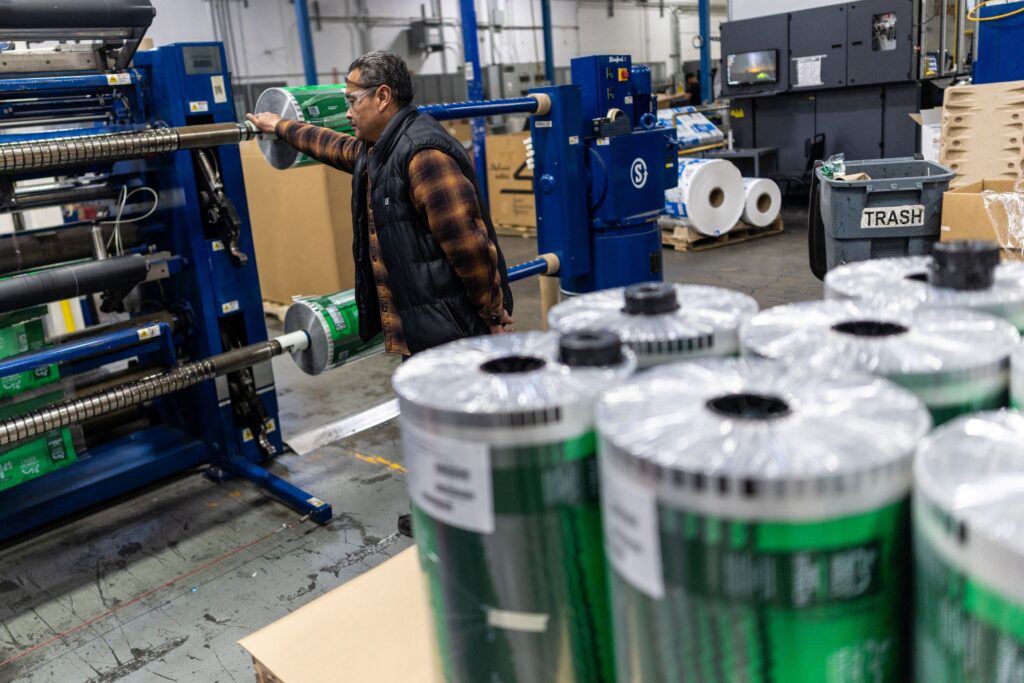
The paper mills that produce the cardboard boxes for Fresh Del Monte’s bananas devour an enormous amount of fuel. The vacuum plastic bags that cradle the fruit in transit are made of a resin that’s produced by Saudi Arabia’s SABIC, one of the world’s largest chemical companies.
A few days ago, a wave of Iranian missiles and drones pummeled the company’s facilities in Jubail Industrial City. It could be a full year before the plant returns to normal operations, Abbas said. Meanwhile, those bags made with now-scarce resin will cost more.
The trucks that bring wood to the paper mill and move the cardboard and the plastic to the ports run on diesel, which is close to a record high price in the U.S.
It’s the same story at the plantations in Costa Rica, Guatemala and Ecuador where the bananas are harvested. Moving goods between the plantations and local ports takes more diesel, which in Central America now costs twice what it did before the war began.
Fertilizer shipments used to boost crop yields are trapped behind the strait. Fresh Del Monte customarily holds some crop nutrients in reserve, meaning its needs are covered through June. But after that, the company will be forced to compete with other desperate buyers on the open market. Abbas expects his fertilizer bill to double.
When he looks ahead, Abbas spies an increasingly grim scene: soaring inflation and a slowing economy, food shortages in the developing world, and economic woes that will linger long after the guns fall silent.
In the U.S., assuming that the war continues, consumers will see a significant increase in produce prices, he said. The global effects will probably be even more dire in a crisis that Abbas said will be many times worse than the pandemic or the aftermath of Russia’s invasion of Ukraine.
“I don’t think we’ve seen anything to this magnitude since the Great Depression,” he said. “The longer this war goes on, the worse and worse it will become.”
The damage caused by economic weapons is sparking a response. Whatever the outcome of this weekend’s U.S.-Iran ceasefire talks in Islamabad, Pakistan, nations that depend on the Strait of Hormuz are already making plans to reduce their vulnerability to a future closure.
In South Korea, President Lee Jae Myung is pushing renewable energy. Saudi Arabia and the United Arab Emirates are among the nations considering multibillion-dollar proposals for new or expanded pipelines to circumvent the strait, the Financial Times reported this month.
When China flexed its control over rare earth processing by limiting exports, U.S. automakers such as Ford suspended vehicle production as their inventories of the critical materials dwindled. Later that year, China broadened the export licensing scheme to affect third-country sales of goods containing even a tiny amount of Chinese material, mirroring the U.S. “foreign direct product rule.”
Jon Lang, who served as director of international economic affairs in the first Trump White House, said that China’s overreaching incentivized other nations to invest in their own supply chains.
The Trump administration has launched a major effort to develop domestic sources of rare earth materials with the federal government taking financial stakes in companies such as MP Materials and USA Rare Earth.
“That’s why I refer to the current time as ‘peak rare earth for China,’” said Lang, now a senior director with APCO in Washington. “As soon as you start using that tool, it become slowly less viable.”
The post China, Iran weaponized the global economy to beat the U.S. at its own game appeared first on Washington Post.