Asha Bhosle, the Indian singer whose astonishing range and longevity made her one of the most recorded voices in modern Indian music, died on Sunday in Mumbai. She was 92.
Her son, Anand Bhosle, confirmed the death. Hospital officials said the cause was multiple organ failure following a cardiac arrest. She had been admitted a day earlier with exhaustion and a chest infection.
For more than eight decades, Ms. Bhosle’s voice was threaded through the fabric of Indian cinema, particularly Bollywood, the Hindi film industry. She recorded thousands of songs across genres and languages, earning recognition from the Guinness World Records for the most studio recordings by any artist.
If her elder sister, the equally famous Lata Mangeshkar — who died in 2022 — tended to be cast as the voice of the sweet and innocent heroine, Ms. Bhosle was more often the voice of the cabaret dancer or the heartbroken courtesan. While her sister embodied a desexualized and melodic classicism, Ms. Bhosle represented playful reinvention. Their relationship, marked by both familial closeness and professional rivalry, became one of the defining narratives of Indian popular music.
Ms. Bhosle’s legacy is in her bold embrace of an unconventional and unapologetically modern female voice in films. Like that of her sister and singers like Mohammed Rafi, her voice was lip-synced by movie actors performing musical numbers. But she created a vocal persona that was bold, flirtatious and rhythmically adventurous, in a sharp break from the dominant “playback” tradition. That also brought Ms. Bhosle to a younger, more cosmopolitan audience.
To define her solely by cabaret or Western-influenced songs would be to overlook her extraordinary breadth. She moved across a wide variety of genres, recording devotional music, folk songs and pop, as well as ghazals — lyrical, poetic compositions rooted in classical traditions.
Her early years in the film industry were marked by struggle. Overshadowed by Lata’s meteoric rise, she was often assigned to secondary songs or lower-budget productions. These constraints became the crucible of her originality.
Her breakthrough came through her collaboration with the composer O.P. Nayyar, whose sensuous and playful compositions like “Aaiye Meherbaan” (“Come, kind sir”) and “Yeh Hai Reshmi Zulfon Ka Andhera” (“The darkness of silky tresses”) suited her huskier voice.
It was her later partnership with the composer R.D. Burman, whom she would eventually marry, that transformed her career. Mr. Burman’s experimental arrangements and global influences of jazz, rock and Latin rhythms found their ideal medium in Ms. Bhosle. Together they produced some of the most iconic songs in Indian cinema, including the sultry “Piya Tu Ab Toh Aaja” (“Beloved, come to me now”), from “Caravan” (1971).
Ms. Bhosle remained relevant even as musical tastes evolved. In her 60s and beyond, she lent her voice to a new generation of actors, working with music directors like A.R. Rahman, who was 30 years her junior. She had international music collaborations with artists like Boy George, Michael Stipe and even the cricketer Brett Lee. In 1997, she was celebrated in the song “Brimful of Asha” by the British band Cornershop, in a track which was later remixed by Fatboy Slim. Her last collaboration was with the British band Gorillaz on their album “The Mountain.”
Ms. Bhosle received numerous national awards throughout her career, including India’s highest honors in cinema and civilian life, the Dadasaheb Phalke Award and the Padma Vibhushan. She was nominated for a Grammy Award twice.
At 79, she made her acting debut in the film “Mai” (2013), portraying a mother with Alzheimer’s disease. She also launched an Indian restaurant brand, “Asha’s,” with locations in Dubai and Kuwait.
Born on Sept. 8, 1933, in the state of Sangli, in present-day Maharashtra, Asha Mangeshkar was one of five children born to Deenanath Mangeshkar (her father) and Shevanti. Mr. Mangeshkar was an actor and a musician of Hindustani classical music. His death when Asha was nine plunged the family into financial distress, forcing Asha and her siblings into early careers. She began singing in films as a child, recording her first song in 1943.
She got married young, to Ganpatrao Bhosle, against her family’s wishes. She had three children with him before they divorced in 1963. A daughter, Varsha, and a son, Hemant, predeceased her.
She found both creative and personal companionship with R.D. Burman, whom she married in 1980. He died in 1994.
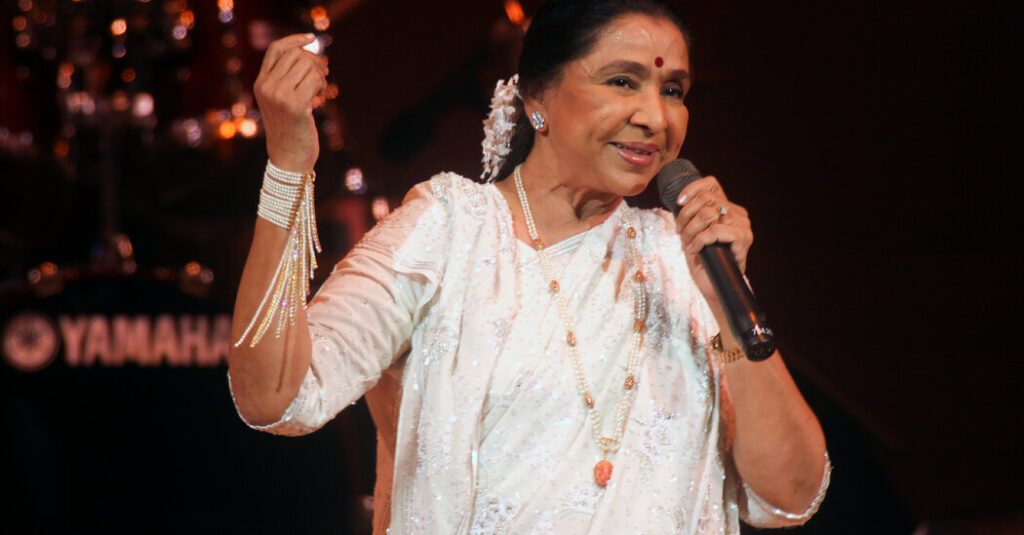
In public appearances, Ms. Bhosle cultivated a distinctive style — embellished silk saris, bold bindis and statement jewelry — standing in visual contrast to her sister’s austere simplicity. Her power, as critics have noted, lay not just in her prolific output but in her insistence on being seen and heard on her own terms.
She is survived by her sisters, Usha Mangeshkar and Meena Khadikar, a brother, Hridaynath Mangeshkar, and a son, Anand Bhosle.
Pragati K.B. is a reporter for The Times based in New Delhi, covering news from across India.
The post Asha Bhosle, One of India’s Most Beloved Singers, Dies at 92 appeared first on New York Times.